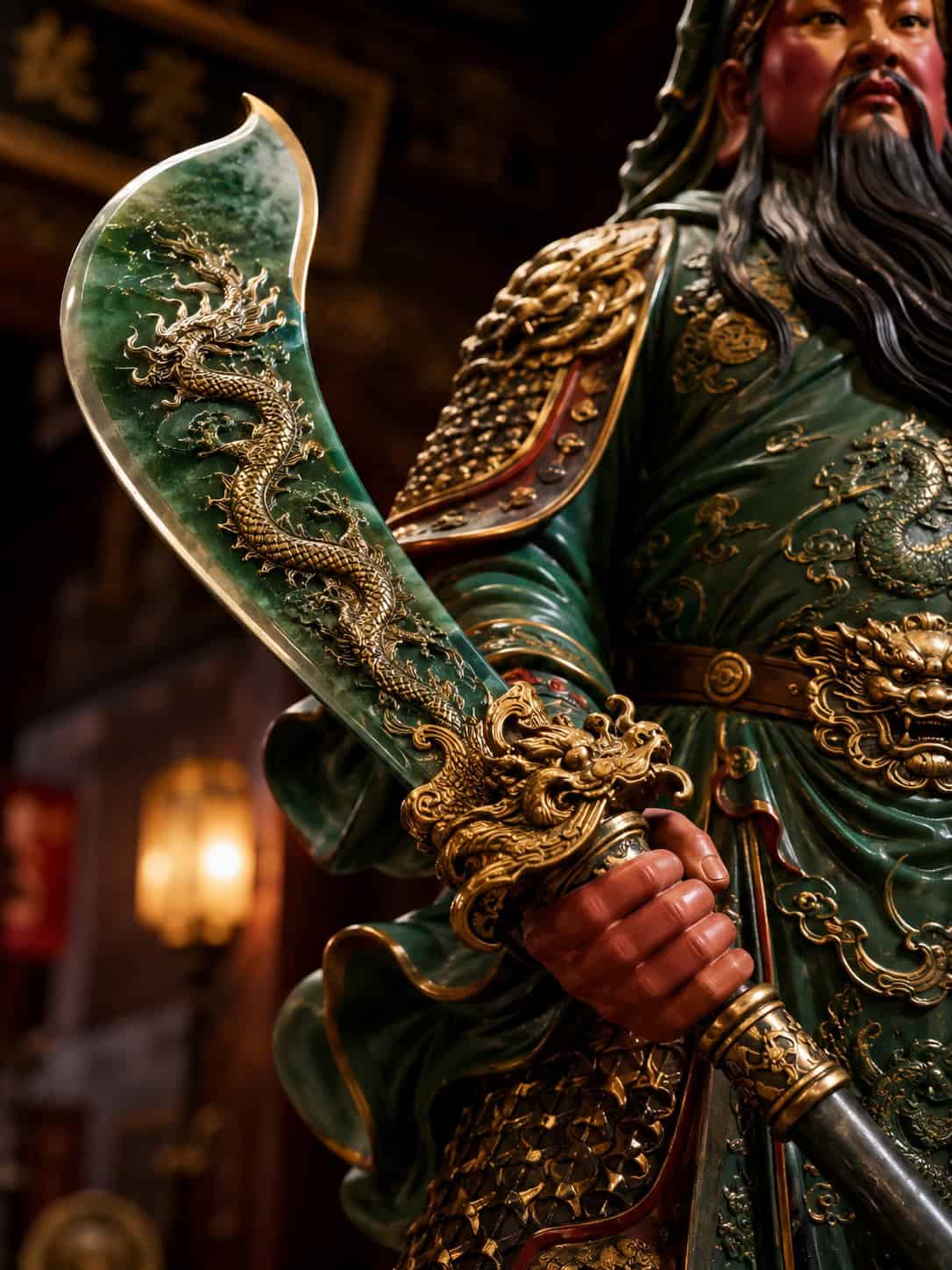
The first time I held a Guan Gong carving, I ran my thumb along the blade. Not the face, not the robe — the blade. The edge of the Green Dragon Crescent Blade, thinned to a sliver where the carver had spent what must have been an unreasonable amount of time on a detail most buyers would never touch.
The workshop master noticed. He didn't compliment the blade. He said: "That's how you know someone cared. The part nobody checks is the part that tells you everything."
I had walked in thinking of Guan Gong as a war figure — the red-faced general from every kung fu film and Three Kingdoms game I'd ever seen. The master corrected me almost immediately. "Soldiers don't buy these," he said. "Shopkeepers do. People who need someone watching the door while they count the day's money."
That gap between what I assumed and what turned out to be true is what this article is about.
Who Is Guan Gong?
Guan Gong — also romanized as Kuan Kung in older Wade-Giles transliteration — begins as a real person. Guan Yu (关羽), courtesy name Yunchang (云长), was born around 160 CE in Xie County, Hedong Commandery — present-day Yuncheng, Shanxi Province. He served the warlord Liu Bei during the collapse of the Han dynasty and became one of the most celebrated generals of the Three Kingdoms period (220–280 CE). He was killed in 219 CE after losing the Battle of Fancheng.
That is the historical layer. On top of it sits a literary one: the fourteenth-century novel Romance of the Three Kingdoms (三国演义) by Luo Guanzhong turned Guan Yu into a larger-than-life figure — the oath-brother, the lone rider through enemy lines, the man who played chess while a surgeon scraped poison from his bone. The novel made the legend vivid, but it did not create the worship.
The deification started earlier. In 1102 CE, Song Emperor Huizong granted Guan Yu the title "Duke Zhonghui" (忠惠公), formally elevating him within the Taoist pantheon — roughly two to three centuries before the novel was even written. By the Ming dynasty, Emperor Wanli conferred the title "Emperor Guan" (关帝) in 1594, completing the ascent from mortal general to supreme deity.
This is why you will see three names used interchangeably: Guan Yu (the historical man), Guan Gong (关公, "Lord Guan" — the respectful form most people use), and Guan Di (关帝, "Emperor Guan" — the full divine title). They are all the same person at different stages of a remarkable afterlife.
Why a Warrior Became the God of Wealth
This is the question most English-language sources skip over, and it is the most interesting part of the story.
A third-century war general ended up on the altars of merchants — from a salt pond in Shanxi, to gold-rush San Francisco, to the back office of a modern shop in Singapore. The short answer is salt.
In the early twelfth century, the salt lake at Xiezhou (解州) — Guan Yu's birthplace in Shanxi — stopped producing salt. This was not a minor inconvenience. The Xiezhou salt ponds were a critical source of government revenue during the Song dynasty, and the disruption threatened the imperial treasury. According to the account that shaped Guan Yu's religious career, Emperor Huizong summoned the Taoist master Zhang Jixian (张继先), a thirtieth-generation descendant of the Celestial Master lineage, to investigate. Zhang diagnosed the problem as the work of Chi You (蚩尤), an ancient war deity. He then called upon the spirit of Guan Yu — a native son of Xiezhou — to battle Chi You over the salt lake.
Guan Yu won. The salt returned. And in that single episode, a regional military hero became directly linked to the financial lifeblood of the state.
Emperor Huizong formally deified Guan Yu shortly after, granting him the Taoist title "Immortal of Chongning" (崇宁真君). But the transformation from state deity to merchant patron came through a different channel entirely: the Shanxi merchants.
The Shanxi traders (晋商, jìnshāng) built China's earliest private banking networks, operating credit systems across thousands of miles before modern contracts existed. What held these networks together was not law — it was personal reputation and sworn loyalty. They needed a shared standard of trustworthiness, a figure who embodied the idea that a man's word was unbreakable. Guan Gong, the loyalty incarnate, became that standard. His temples doubled as meeting halls and oath-swearing sites where business deals were sealed.
When Chinese merchants migrated overseas — to Southeast Asia, to the goldfields of California and Australia, to the docks of New York — they carried Guan Gong with them. The temples they built in San Francisco, Melbourne (then called "New Gold Mountain"), and Singapore were not just places of worship. They were community anchors, dispute-resolution centers, and visible declarations that the people inside did business by the code Guan Gong represented.
That is why Guan Gong statues sit in restaurants and trading offices today. Not because he brings wealth out of thin air, but because he guards the integrity of those who earn it.
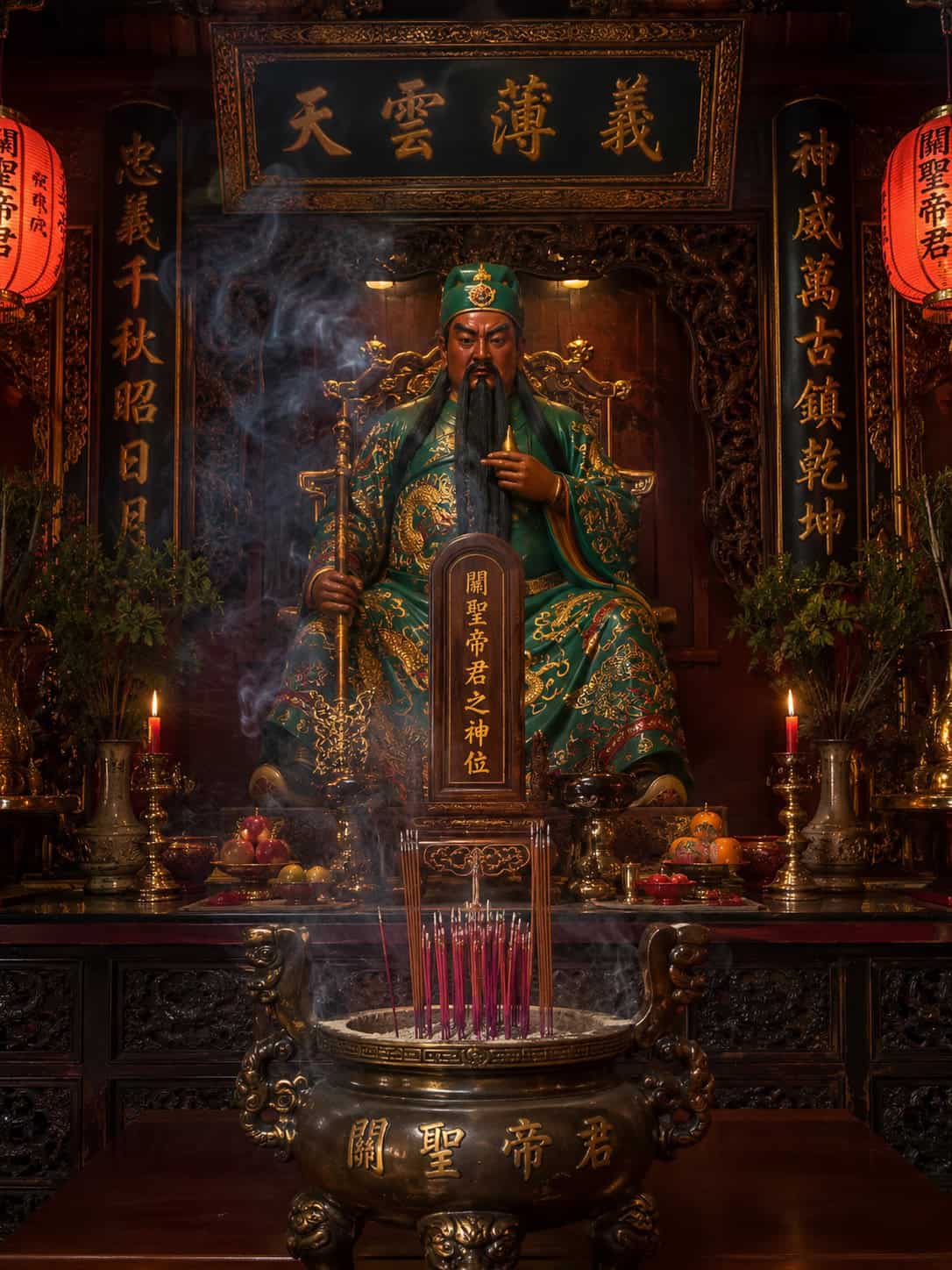
The Many Faces of Guan Gong
One figure, but several distinct roles depending on which tradition claims him. If you have seen Guan Gong statues in different settings and wondered why the energy felt different each time, this is why:
- Wǔ cái shén (武财神) — Martial God of Wealth. Unlike Cai Shen (财神), the civil wealth god who bestows fortune, Guan Gong is the defender of wealth — appropriate for businesses that need protection from bad debts, dishonest partners, and financial loss. Pixiu, the wealth-attracting creature we covered in our earlier guide, works by drawing wealth in. Guan Gong works differently — he guards the wealth and the integrity of those who handle it.
- Hù fǎ shén (护法神) — Buddhist Dharma Protector. Chinese Buddhism adopted Guan Yu through the Tiantai school at Yuquan Temple (玉泉寺) as early as the Sui dynasty (581–618 CE). In this role he is a guardian of monasteries and sacred texts, not a wealth figure.
- Guān dì / Guān shèng dì jūn (关帝 / 关圣帝君) — Taoist Heavenly Emperor. Officially enshrined as a Taoist deity from the Ming dynasty onwards, with the full imperial title conferred in 1594. This is the form worshipped in the thousands of Guan Di temples across China and Southeast Asia.
- Symbol of yì (义) — loyalty and righteousness. The cultural archetype invoked in sworn brotherhoods (the famous Peach Garden Oath, 桃园结义), police codes, and overseas Chinese clan associations. The concept of yì is closer to "personal honor held at all costs" than the English word "loyalty" alone can capture.
- Protector of overseas Chinese communities. Guan temples mark the historical centers of Chinatowns in San Francisco, Melbourne, Sydney, and New York. They served as the first community institutions before any secular alternative existed.
Reading the Statue: Pose, Color, and What's in His Hand
A Guan Gong statue is not purely decorative — every element carries specific meaning. Here is how to read the four main visual dimensions.
Pose: Standing vs. Seated
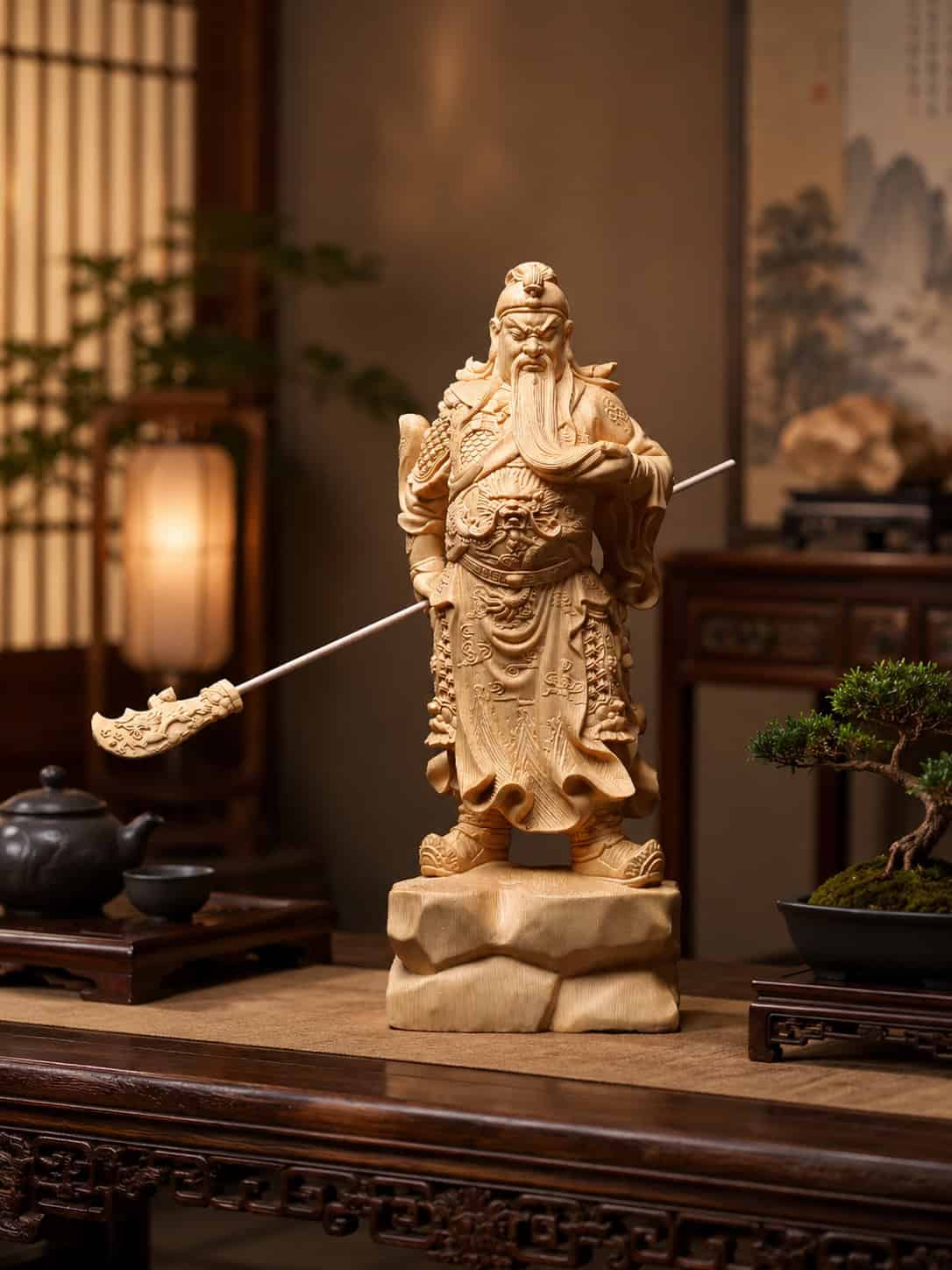
Standing (站立) — Wǔ Guān Gōng (武关公): the active warrior posture, blade in hand, eyes forward. This is the form traditionally placed in shops, offices, and restaurants — anywhere business is transacted and the entrance needs guarding. This is the form we sell.
Seated (坐姿) — Wén Guān Gōng (文关公): reading the Spring and Autumn Annals (春秋), one hand stroking the beard. This contemplative form belongs in homes, private studies, and family altars. The energy is inward rather than outward.
What's in His Hand
Green Dragon Crescent Blade (青龙偃月刀): the active, protective form. The blade banishes evil and guards the threshold. This is what our statue holds.
Spring and Autumn Annals (春秋): a Confucian classic. The book form emphasizes loyalty, study, and righteous judgment over martial force.
Both: a blade in one hand, the book in the other. This is the complete form, suitable for traditional altars that honor both aspects.
The Red Face
Not a costume choice. In Chinese opera — particularly Beijing Opera (京剧) — painted face colors are a moral code. Red signifies absolute loyalty and righteousness. Guan Gong is the archetype that fixed this convention; his face was painted red because of who he was, and after him, red became the color of loyalty for every character who followed.
The Beard
The famously long beard earned Guan Yu the epithet "Lord of the Magnificent Beard" (美髯公, měi rán gōng) — a detail recorded in both Chen Shou's historical Records of the Three Kingdoms and the later novel. In carving, the beard is where the most time goes. The strands should fall in even, flowing lines from cheek to chest. An asymmetric or truncated beard is often the first sign of a rushed piece.
Materials: What to Look For
Wood — the Traditional Carving Choice
The pieces we currently offer are standing Guan Gong figures carved from solid wood. Depending on the batch, we work with two species:
Boxwood (黄杨木, huáng yáng mù) — a dense, fine-grained hardwood with a warm, honey-gold color that deepens over years of handling. Boxwood has been the preferred material for small-scale Chinese figurine carving for centuries because it holds extremely fine detail — the individual strands of a beard, the dragon scales on armor — without splitting. This is the same material we use for our Pixiu carvings.
Hinoki cypress (桧木, guì mù) — a lighter-toned wood from the Chamaecyparis family, prized across East Asia for sacred carvings. It has a distinctive clean, resinous scent and natural resistance to insects. Japanese temple builders have used hinoki for over a thousand years; in the Chinese carving tradition, cypress-family woods are considered especially appropriate for deity figures because of their association with permanence and spiritual purity.
Wood is the most personal material for a Guan Gong statue because it ages with the owner. The surface darkens, the grain settles, and the carved details slowly catch the patina of household incense and morning light. A wooden Guan Gong that has sat on someone's shelf for ten years looks entirely different from one that just left the workshop — and that is part of the point.
Other Materials You May Encounter
Bronze and brass — the traditional material for temple-scale statues and large shop installations. If you have ever visited a Guan Di temple, the main figure was almost certainly cast in bronze or iron.
Porcelain (Dehua white porcelain, 德化白瓷) — a Ming and Qing dynasty tradition from Fujian Province. The quiet, luminous white surface lends itself to the contemplative seated form more than the warrior posture.
Jade and stone — rare and high-end, mostly found in collector circles and traditional shops in Fujian and Guangdong.
For a personal statue placed in a home office or behind a shop counter, a hand-carved wood Guan Gong is the closest thing to the traditional family-altar piece. It is the form that ages with you.
How to Place a Guan Gong Statue
Placement matters more with Guan Gong than with most feng shui objects, because he is a deity figure — not a charm or an ornament. The traditional rules are consistent across most schools of practice:
- Face the door, not the room. Guan Gong is a guardian. He must "see" what enters. The standard placement is on a high shelf or cabinet directly facing the main entrance of the room or business.
- Higher than eye level. Unlike a pixiu (which sits at desk height), Guan Gong is a deity and should be placed above the head of anyone seated in the room. On top of a cabinet, on a dedicated altar shelf, or above a doorway are all traditional positions.
- Standing (Wǔ) for shops and offices; seated (Wén) for homes and studies. The standing form with the blade is active and outward-facing — suited to spaces where business happens and the entrance needs guarding. The seated form with the book is contemplative — suited to a study, a reading room, or a family altar.
- Avoid placing him directly facing a bathroom or kitchen. Bathrooms and kitchens are associated with draining or dispersing energy in traditional feng shui. A Guan Gong facing either is considered disrespectful.
- Avoid placing him below a window or under a ceiling beam. Beams overhead create what traditional practice calls "beam pressure" (liáng shā, 梁煞); a deity beneath a window is considered unsupported and exposed.
- Do not place a Guan Gong inside a bedroom. The traditional reasoning is that his energy is too "fierce" (shā qì, 煞气) for a sleeping space. The practical reasoning is simpler: an active guardian belongs at the threshold, not at rest.
- Pair with offerings if you wish, but it's not required. A small bowl of fruit, a cup of clear water, an incense holder. Many modern owners keep it minimal — a clean surface and a respectful position are already enough.
How to Care for & Respect a Guan Gong Statue
Guan Gong is a deity figure. The tone of care is more formal than for a decorative object like a pixiu — not because of superstition, but because the tradition treats him as a guest in your space who deserves a certain standard of respect.
- Do not let strangers casually touch the face — especially the eyes and the beard. In traditional practice, the face is considered the seat of the statue's spiritual presence.
- Clean weekly with a dry, soft cloth. For wood statues, avoid water, oil, and chemical cleaners. The natural patina that builds over time is desirable, not something to strip away.
- Incense is welcome but not required. Modern households can simply place a cup of clear water nearby and replace it regularly. The gesture matters more than the form.
- If you leave home for an extended period, cover the statue with a clean red cloth. This is the same convention used for pixiu and other sacred objects — red signals respect and temporary rest, not abandonment.
- Opening the eyes (kāi guāng, 开光): traditionally, a newly acquired deity statue is "activated" through a ceremony at a temple, performed by a Taoist priest or Buddhist monk. Many Guan Di temples in Asia — Yuncheng in Shanxi, Dongshan in Fujian, the Quan Yin Temple in Singapore — still offer this service. Modern owners who do not have access to a temple often treat the moment of first placement as a personal ritual: clean the statue, set it in its position with intention, and acknowledge what it represents to you. Either approach is valid.
Buying Guide: What We Check Before Shipping
We inspect every piece by hand before it leaves the workshop. These are the specific things we look for — and the same things you should check if you are buying from any source:
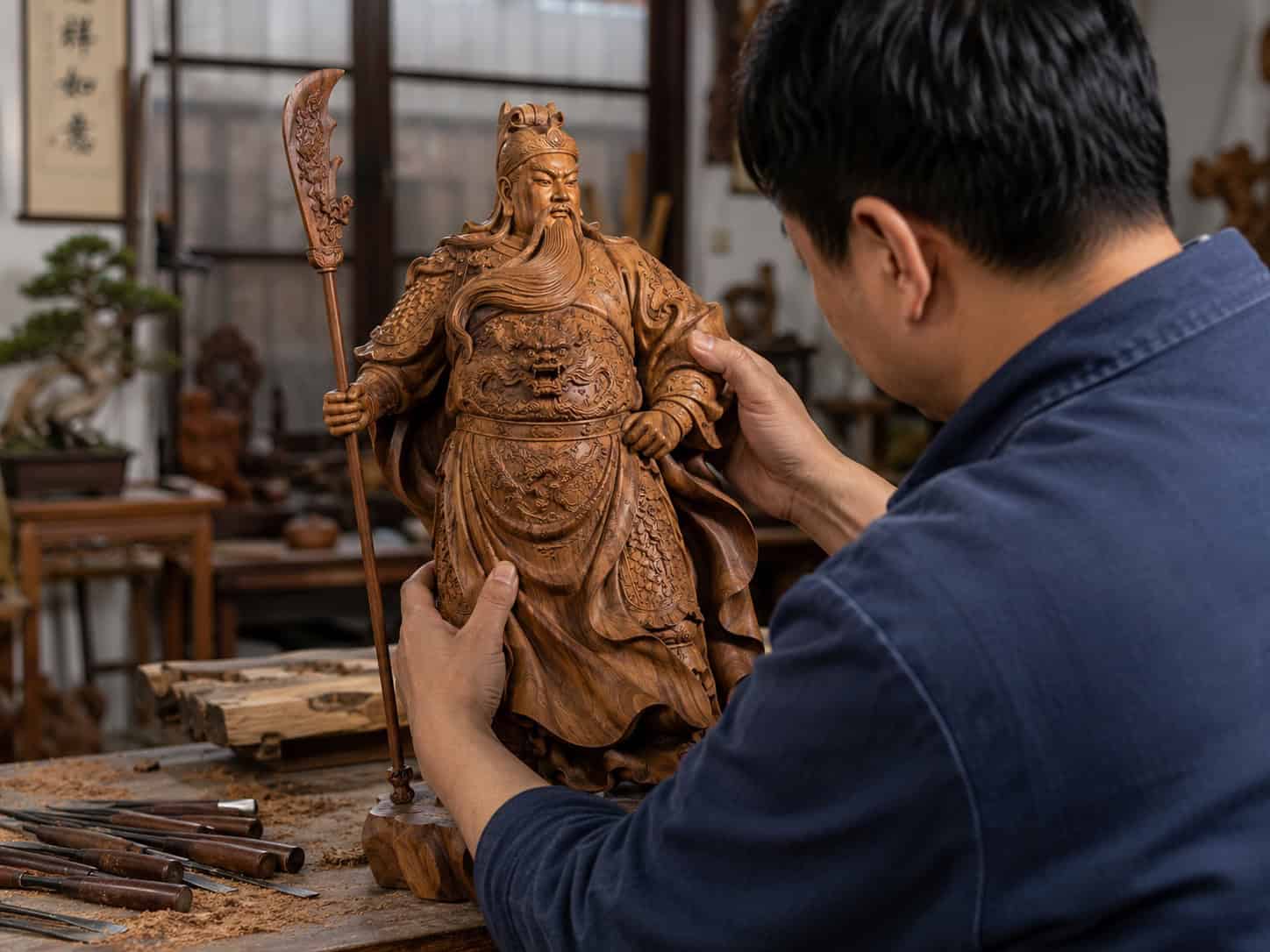
- One-piece carving, no seams. Turn the statue over. The base, the robe folds, and the blade should all flow from a single block of wood. Assembled blades — a separate metal or wood piece glued into the hand — are common in lower-grade pieces and are the first thing to crack over time.
- The blade angle. A well-carved Green Dragon Crescent Blade rests against the shoulder or extends slightly outward — never pointing at the figure himself. The outward angle is both an aesthetic tradition and a symbolic one: the blade protects the space in front of it.
- Face symmetry and beard flow. Both eyes should sit at the same height. Eyebrows should be symmetric. The beard should fall in even, flowing strands from cheek to chest. The beard is where carvers cut corners first — it is the single best indicator of how much care went into the piece.
- Armor detail. Look at the dragon scales on the chest plate, the knot on the belt, the folds of the war skirt. Hand-carved pieces show small, natural irregularities. If the surface is too perfect and uniform, the piece is likely mold-cast resin painted to look like wood.
- Stable base. The statue should sit on a desk or shelf without rocking. The base is typically integrated into the same block as the figure — a separate, glued-on base is a cost-saving shortcut.
- Wood honesty. Genuine boxwood has a warm, honey-gold tone that deepens with age. Genuine hinoki cypress is paler with a clean resinous scent. A statue that smells strongly of varnish or chemical lacquer is hiding the quality of the wood underneath.
Frequently Asked Questions
Who is Guan Gong, and is he the same as Guan Yu?
Yes — they are the same person. Guan Yu (160–219 CE) is his historical name. Guan Gong ("Lord Guan") is the respectful form used after deification. Guan Di ("Emperor Guan") refers to his highest divine rank, conferred by Ming Emperor Wanli in 1594. In everyday conversation, "Guan Gong" is the most common form.
Why does Guan Gong have a red face?
Chinese opera — particularly Beijing Opera — uses facial color as a moral code. Red signifies absolute loyalty and righteousness. Guan Gong is the archetype that established this convention. His red face is not decorative; it is a visual statement about his character.
Should I get a Guan Gong with a blade, or with a book?
The blade (Green Dragon Crescent Blade) form is active and protective — best for shops, offices, and entrances. The book (Spring and Autumn Annals) form is contemplative — best for homes, private studies, and family altars. For business owners, the blade is the more traditional and more common choice.
I'm not Chinese — is it disrespectful to own a Guan Gong statue?
No. Guan Gong is venerated across Buddhism, Taoism, and Confucianism, and Chinese artisans have made statues for foreign collectors and practitioners for generations. What matters is placement and basic respect — displaying him at an appropriate height, facing the right direction, and not treating the statue as a casual ornament. The tradition welcomes sincerity regardless of background.
Can I place a Guan Gong statue at home, or is he only for businesses?
Both. The seated (book) form is traditional for homes and family altars. The standing (blade) form is traditional for shops and offices. Many homes display the standing form as well, especially when a family member runs a business from home. The key distinction is placement — a pixiu sits on the desk; a Guan Gong belongs above eye level, facing the door.
Do I need to have it blessed at a temple?
Traditionally, yes — through a ceremony called kāi guāng (开光, "opening the eyes"). Many Guan Di temples across Asia still perform this service. If you do not have access to a temple, treating the moment of first placement as an intentional personal ritual is a widely accepted modern alternative. Clean the statue, set it in its chosen position deliberately, and acknowledge what it represents. The sincerity of the gesture is what the tradition values most.
Final Thoughts
A Guan Gong statue is one of those objects that asks something of its owner. Face him toward the door, give him a place above eye level, treat him as a guest with a job to do — and a third-century general becomes a daily companion to the way you handle money, work, and the people you do business with.
He does not promise easy wealth. He never did. What he represents is older and more practical: that the person who keeps their word, who guards what they have earned with integrity, is the person who lasts.
If you want to see the piece we currently have in the workshop, the product page is here.
If you want to understand why we started sourcing these in the first place, our about page tells that story.