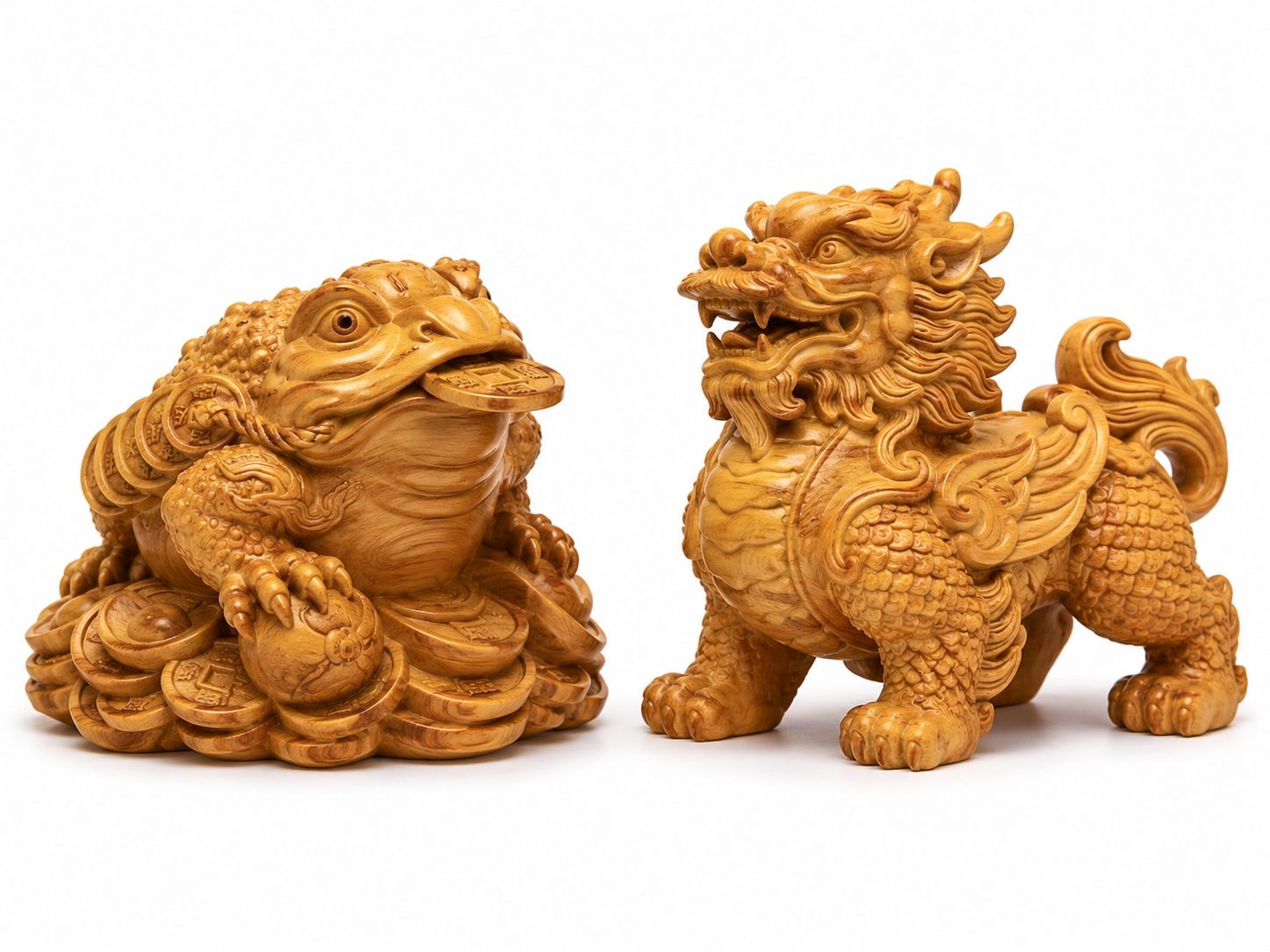
Buyers ask me this more than almost anything else: "I want something for wealth — should I get a Money Frog or a Pixiu?"
The short answer is that they do different jobs. The Money Frog brings money in. Pixiu keeps it from leaving. One earns; the other guards. They're not interchangeable, and getting the wrong one doesn't bring bad luck — it just means the piece isn't addressing what you actually need.
This question isn't new, either. On Chinese social media, one of the most popular comparison posts frames the four main wealth figures like this: Money Frog is "来钱快" (fast cash), Pixiu is "守财" (wealth retention), Dragon Turtle is "稳" (stability), and Lucky Boy is "喜庆财" (celebratory fortune). The top comment? "成人不做选择,全要。" — Adults don't choose. Get all of them.
That's one approach. Here's a more considered one.
The Origin Stories: Two Very Different Creatures
Money Frog (Jin Chan 金蟾)
The three-legged toad comes from two layers of Chinese mythology. The older layer is lunar: the toad lived on the moon in Han dynasty cosmology (206 BCE – 220 CE), a yin creature tied to cycles and celestial balance.
The wealth layer came later, through the legend of Liu Haichan, a tenth-century Daoist immortal who lured a golden toad from a well using a string of copper coins. The toad could spit gold and became Liu Hai's companion. Liu Hai used the coins to help the poor and was eventually honored as a manifestation of Caishen, the God of Wealth.
The Money Frog's identity is active and generous: it produces wealth and delivers it to you.
→ Full story: Jin Chan — The Three-Legged Toad in Chinese Culture
Pixiu (貔貅)
Pixiu is a different kind of creature entirely. It's a dragon-lineage beast — often described as having a dragon's head and a lion's body, with a voracious appetite for gold and precious things. (Some traditions count it among the dragon's nine sons, though the exact roster of those nine varies across sources and was never fully standardized.)
The defining myth: the Jade Emperor caught Pixiu causing chaos in heaven and sealed its body as punishment. From that point on, Pixiu could swallow wealth endlessly but never release it. What enters stays.
That single detail is the entire symbolism. Pixiu doesn't generate wealth — it traps it.
→ Full story: Hand-Carved Pixiu Statue — Meaning, Placement & Buyer's Guide
Side-by-Side Comparison
| Money Frog (Jin Chan) | Pixiu (貔貅) | |
|---|---|---|
| Core function | Attracts and delivers new wealth | Accumulates and retains existing wealth |
| Action | Spits coins out (gives you money) | Swallows everything, releases nothing |
| Energy | Active, outward, earning | Defensive, inward, holding |
| Mythology | Daoist (Liu Hai legend + moon myth) | Dragon-lineage beast (Jade Emperor sealed its body) |
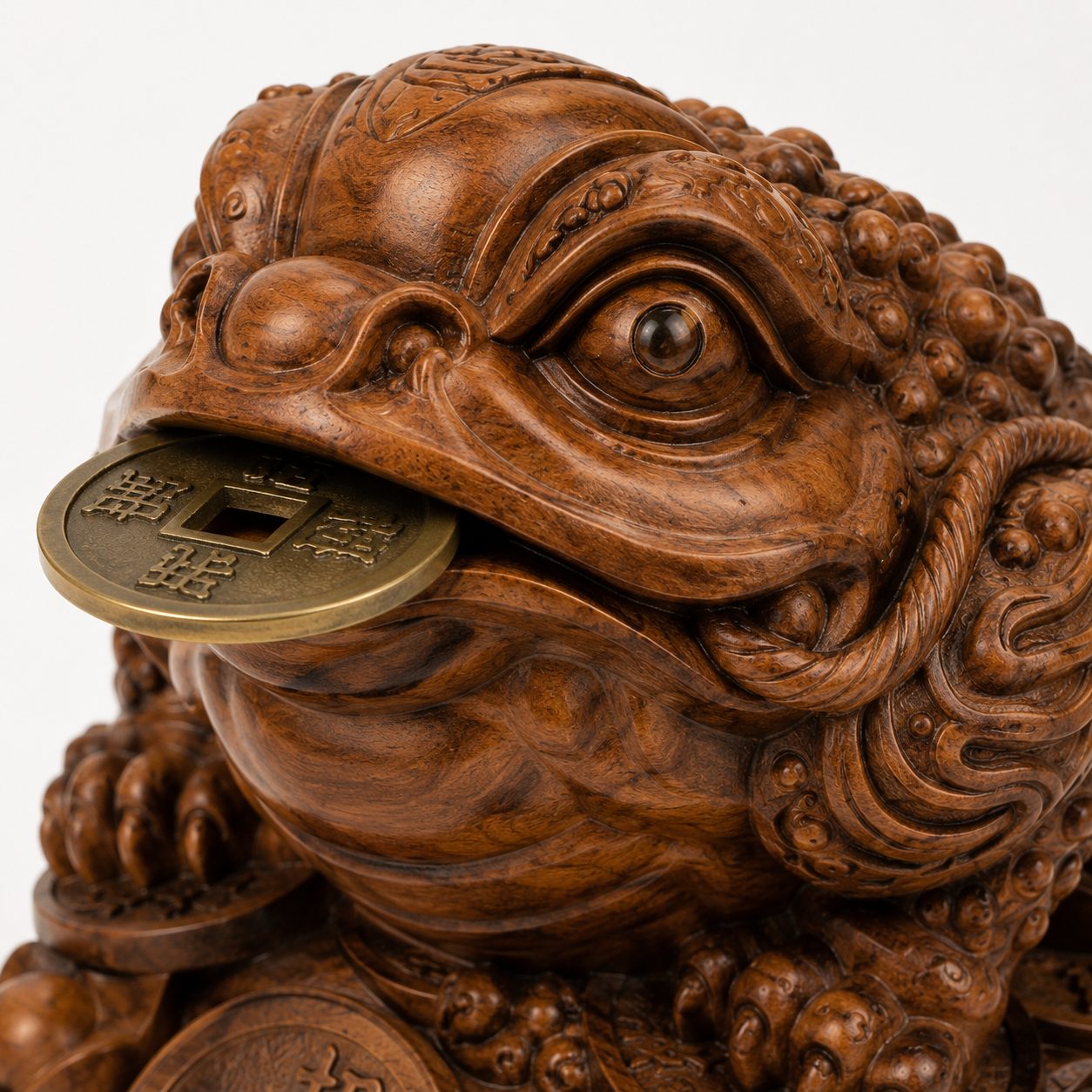
| Appearance | Three-legged toad, coin in mouth, sitting on coin pile | Dragon-headed lion, open mouth, sealed body |
| Recognizable by | Three legs + coin in mouth | Open mouth + no exit (the sealed body is the whole point) |
| Classic placement | Near entrance or cash register, facing inward | On desk or shelf, facing door/window |
| Best for | New income, cash flow, business launch | Protecting savings, preventing loss, wealth retention |
| Religious origin | Daoist folk tradition | Chinese imperial mythology |
| Art history | Han dynasty bronzes, Ming-Qing jade | Pre-Qin texts, Tang dynasty tomb guardians |
How They Work Together
Chinese business owners often use both, and the logic is straightforward:
Money Frog near the entrance → pulls new money into the space. The toad faces inward (if it has a coin in its mouth), directing the flow of incoming wealth toward the interior.
Pixiu on the desk → guards whatever has been earned. Pixiu faces outward, toward the door or window, watching for opportunities to consume — and once consumed, the wealth stays.
Together, they form a cycle: attract, receive, hold. One without the other leaves a gap. The Money Frog brings it in, Pixiu makes sure it doesn't walk back out.
Where You'll See This Pairing
In Chinese restaurants, the setup is almost standard: Money Frog at the register (often a brass or resin one, sometimes wedged between the POS terminal and a stack of takeout menus — these are working objects, not showpieces), Pixiu in the back office or on the owner's desk.
Small business offices: both on the same desk, facing different directions. The Money Frog toward the door, the Pixiu toward the window or the main traffic flow.
Home offices: Money Frog on a shelf near the door, Pixiu next to the computer.
The Chinese social media comparison I mentioned earlier actually captures the dynamic well: the Money Frog is "吐财" (spitting out wealth) while Pixiu is the creature that "只进不出" (only takes in, never lets go). Different temperaments, same team.

Which One Should You Choose?
Get a Money Frog if:
- You're starting a new business or venture and need to attract clients and revenue
- Your income is variable — freelancing, sales, consulting — and you want the symbolic boost of active cash flow
- You're opening a new shop or office and want a traditional welcome-wealth piece for the entrance
- You like the idea of a compact desk piece with a specific story behind it
Get a Pixiu if:
- You're focused on saving and protecting what you've already built
- You worry about money leaving — unexpected expenses, investments that don't return, financial leakage
- You want a piece with more visual presence — Pixiu tends to be larger and more dramatic than the typically compact Money Frog
- You resonate with the dragon mythology and the idea of a powerful guardian creature
Get both if:
- You want the complete traditional setup — attract and retain
- You run a physical business and want to honor the traditional Chinese practice of pairing the two
- You're building a collection of Chinese cultural pieces and want them to work as a system rather than standalone decorations
One Chinese buyer's comment on the "which one?" debate: "会摆放的才招财。" — It's the ones who know how to place them who attract wealth. The implication: the choice matters less than the intention and care behind it.
Placement Rules Compared
Money Frog
The key rule is the coin direction:
- Coin in mouth → face inward (delivering wealth to you)
- No coin → face outward (attracting wealth from outside)
Place on a table or shelf near the entrance, in the wealth area (southeast corner in classical feng shui, or far-left corner in the BTB school), or on a desk. Never on the floor, never in the bedroom or bathroom.
→ Full placement guide with common mistakes →
Pixiu
The key rule is sight line:
- Face toward the door or window (so it can "see" and catch incoming wealth)
- Never face it toward a wall or into a corner
Place on a desk, shelf, or side table at or above waist height. Like the Money Frog, never on the floor, never in the bedroom.
→ Full Pixiu placement guide →
Universal Principles (Both Symbols)
- Elevated placement — never on the floor
- Avoid bedroom, bathroom, and kitchen
- Keep them clean and treated with respect — don't pile junk on top of them
- Red accents (ribbon, paper) are considered activating in Chinese folk practice
- Neither should face the other directly — they're teammates, not opponents
A Note on Material
Both figures are available in nearly every material: resin, brass, crystal, jade, ceramic, and wood. The feng shui symbolism doesn't change with material — a resin Money Frog is symbolically identical to a wood one.
What changes is the craft. A hand-carved boxwood piece carries the mark of individual attention: grain patterns, tool marks, the small decisions a carver makes when the wood grain goes a different direction than expected. Over time, boxwood develops a warm amber patina that resin never achieves.
At Carvzen, we carve both the Money Frog and Pixiu from solid boxwood. If you're choosing between them, the decision isn't about material — it's about function. What do you need right now: more money coming in, or better protection for what's already there?
Frequently Asked Questions
Can I put a Money Frog and Pixiu together?
Yes, and it's a traditional pairing. Place the Money Frog to attract wealth and the Pixiu to retain it. Face them in different directions — the frog typically inward, the Pixiu outward.
Is one more powerful than the other?
Neither is "more powerful." They serve different functions. Asking which is stronger is like asking whether a lock or a key is more important — they do different jobs.
Can I have a Money Frog if I already have a Pixiu?
Absolutely. They complement each other. Many Chinese business owners have both, plus a Guan Gong statue for an entirely separate protective function — guarding business integrity rather than wealth flow.
What if I can only get one?
If you're starting something new (business, job, freelance career), the Money Frog is the traditional first choice — you need money coming in before you can worry about keeping it. If you're already established and want to protect what you have, lean toward Pixiu.
Do they have to be the same material?
No. A boxwood Money Frog and a brass Pixiu work just as well together as a matched pair. The function is symbolic, not material-dependent.
Where does Guan Gong fit in?
Guan Gong is the Martial God of Wealth — but his role is different from both the Money Frog and Pixiu. He guards business integrity and wards off dishonesty, rather than attracting or retaining money directly. Some owners have all three: Money Frog for income, Pixiu for retention, Guan Gong for trust.
Explore Both on Carvzen
- Feng Shui Money Frog — Meaning, Placement & What to Look For — the full guide to the three-legged toad
- Jin Chan — The Full Cultural Story — mythology, art history, and the legend most English sources skip
- Hand-Carved Pixiu Statue — Meaning, Placement & Buyer's Guide — everything about the wealth guardian
- Guan Gong — The Martial God of Wealth — the third piece of the Chinese wealth-protection system
Every Carvzen piece is hand-carved from solid wood. No molds, no two alike. Browse the collection →