약사불상의 의미: 약사여래, 상징과 불상 형태
무릎 위에 작은 병을 얹고 오른손을 든, 히말라야 미술에서는 짙은 청색 몸을 지닌 좌상 부처. 이 안내서는 약사여래가 누구인지, 그의 병과 색, 권속이 무엇을 뜻하는지, 그리고 중국·일본·한국·티베트 불상에서 그를 다른 부처와 어떻게 구별하는지 설명합니다.
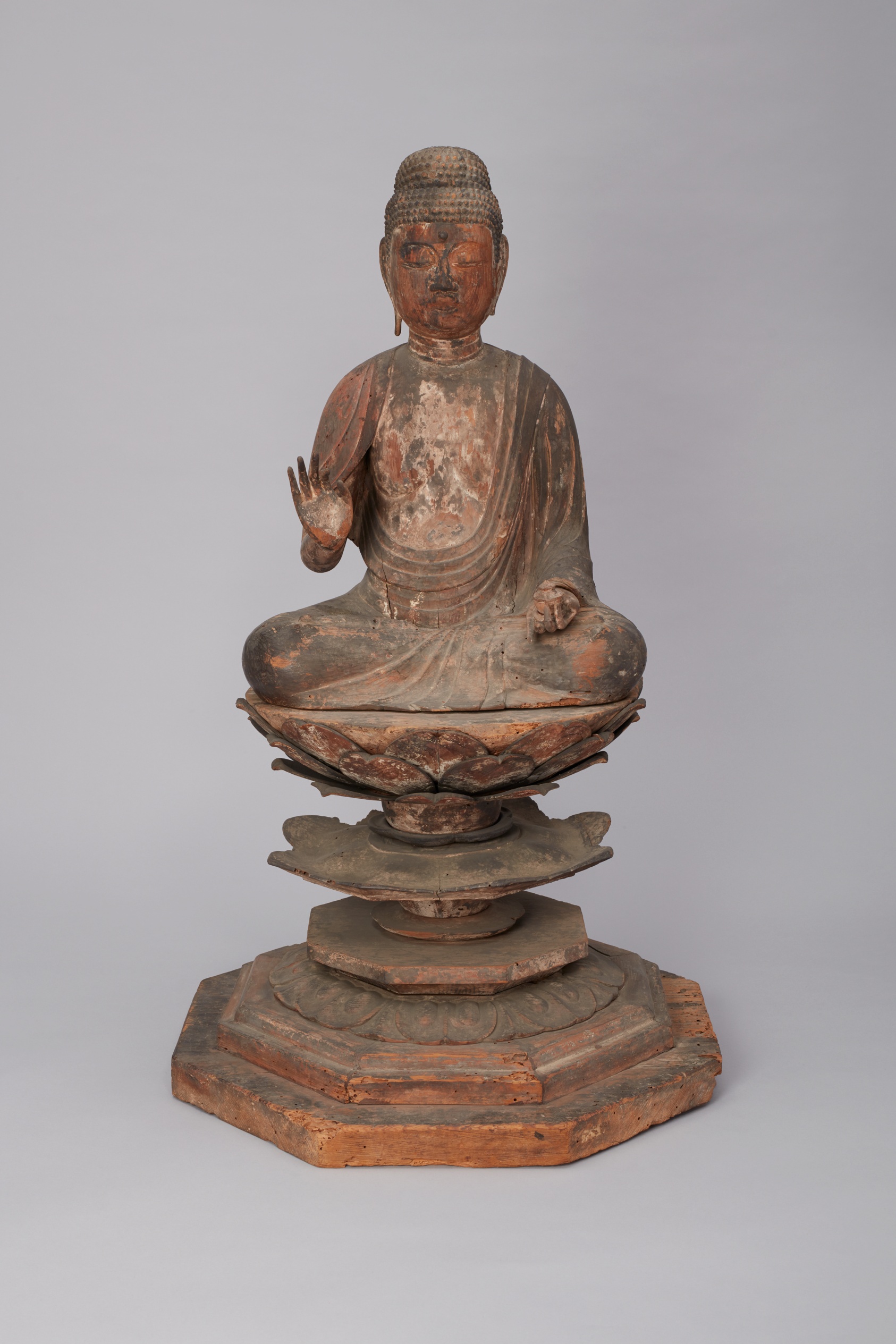
병을 든 부처
동아시아 미술 속 대부분의 부처는 언뜻 보면 비슷합니다. 소박한 승복을 입고, 곱슬곱슬한 머리와 정수리에 둥근 육계가 있으며, 손은 몇 가지 정해진 수인 중 하나를 취합니다. 이들을 구별하는 것은 작은 세부에 달려 있습니다.
약사여래의 경우 그 세부는 대개 무릎 위에 있습니다. 왼손에 받쳐 든 뚜껑 있는 작은 병이나 약병, 또는 그릇입니다. 여기에 든 오른손, 관을 쓴 두 협시, 때로는 갑옷을 입은 호법신의 고리가 더해지면 식별은 훨씬 확실해집니다.
그 모습은 아시아 전역에서 달라집니다. 중국 사찰의 벽화, 일본의 목조 불상, 한국의 금빛 판, 티베트의 탱화는 각각 그를 다르게 보여줍니다. 이 안내서는 변하지 않는 단서를 따라가며, 변하는 단서들을 설명합니다.
약사여래는 누구인가?
약사불은 대승불교의 부처인 바이샤쟈구루로, 산스크리트어 이름은 “의약의 스승’을 뜻합니다. 더 완전한 명칭은 흔히 ”청금석 광명의 의약 스승’으로 번역되며, 경전에서는 그를 우리 세계가 아닌 동방정토에 위치시킵니다.
중국에서는 야오스포(藥師佛) 또는 야오스루라이, 일본에서는 야쿠시 뇨라이(薬師如来), 한국에서는 약사여래, 티베트에서는 상예 멘라로 알려져 있습니다. 이들은 서로 다른 언어와 지역의 조상 전통 속에서 형성된 같은 부처의 이름입니다.
시카고 미술관은 그를 더 넓은 불교적 비유의 구현으로 설명합니다. 즉 부처를 고통의 근원적 원인을 제거하여 고통을 끝내고자 하는 위대한 의사로 보는 비유이며, 불교 교리는 그 원인을 탐욕, 성냄, 무지로 말합니다. 의료적 이미지는 실제이지만, 그것은 이 더 큰 개념 안에 자리합니다.
이 안내서는 경전, 신앙의 역사, 조상 전통을 설명합니다. 약사불상은 공부, 기념, 개인 수행에 의미가 있을 수 있으나 질병을 치료하거나 건강을 보장하거나 의료를 대체하지 않으며, 이 사이트에서 판매되는 어떤 불상도 그러한 결과의 약속으로 해석되어서는 안 됩니다.
경전과 열두 서원
약사불에 관해 알려진 내용의 대부분은 흔히 다음과 같이 불리는 하나의 경전에서 비롯됩니다: 바이샤쟈구루 수트라 또는 약사불경. 이 경전은 여러 중국어 번역본으로 전해집니다. 가장 잘 알려진 것은 7세기 순례 승려 현장과 관련된 번역, 그리고 인도로 여행한 승려 의정이 중국어로 번역한 것으로, 스펜서 미술관은 의정이 이 경전을 중국어로 번역했다고 밝히며, 그 후 중국에서 약사불 신앙이 엄청나게 확장되었다고 덧붙입니다.
이 경전은 약사불이 아직 보살이었을 때 세운 열두 가지 큰 서원을 설명합니다. 그 서원들은 무엇보다 중생이 질병, 가난, 궁핍에서 벗어나고, 생활에 필요한 것을 받으며, 불교의 길로 향하게 될 것을 약속합니다. 메트로폴리탄 미술관은 이 서원들의 실천적 측면을 질병 치유, 건강한 아이의 출산 보장, 의복과 기타 필수품 제공으로 요약합니다.
이는 경전 안에서 제시된 종교적 약속이며 의학적 주장이 아닙니다. 역사적으로 이러한 약속은 통치자와 일반 가정 모두에게 질병, 전염병, 재난의 시기에 약사불을 자연스러운 기도의 중심으로 만들었습니다.
병, 손, 청금석 빛깔
세 가지 특징이 그를 식별하는 데 가장 큰 역할을 합니다.
약단지 또는 약그릇 이 가장 분명한 표식입니다. 보통 왼손에 들고 무릎 위에 놓습니다. 동아시아 조각에서는 흔히 뚜껑이 있는 작은 단지나 둥근 항아리이고, 히말라야 회화에서는 더 자주 열린 그릇입니다. 클리블랜드 미술관은 약사불이 보통 한 손바닥에 약그릇을 들고 표현된다고 밝힙니다.
손 은 종종 단지와 함께 오른손을 들어 손바닥을 밖으로 향하게 하여 안심 또는 “두려워하지 말라’는 수인을 취합니다. 이 페이지 맨 위의 시카고 야쿠시 뇨라이 작품과 아래의 클리블랜드 가마쿠라 회화 모두 이 조합을 사용합니다. 티베트 이미지에서는 대신 오른손을 무릎에 얹고 손바닥을 밖으로 향하게 하여 약초 줄기를 쥡니다.
청금석의 청색 은 그의 명칭에서 비롯됩니다. 히말라야 미술에서는 이런 이유로 그의 몸을 짙은 청색으로 그리며, 이 안내서 뒤에 나오는 탕카가 그 예입니다. 동아시아 불상에서는 몸을 청색으로 만드는 경우가 드물며, 그곳에서는 명칭이 피부색이 아니라 이름과 배경으로 전달됩니다.
부속 요소는 취약합니다. 오래된 목조 상의 단지는 나중에 교체된 것일 수도 있고 아예 없을 수도 있으며, 빈손으로 앉은 부처가 한 사찰에서는 약사불이고 다른 사찰에서는 석가모니일 수 있습니다. 하나의 단서는 출발점이지 단정이 아닙니다.
일광·월광과 십이신장
약사불은 큰 구성에서 혼자 등장하는 경우가 드뭅니다. 보통 두 보살이 그의 양옆에 서는데, “햇빛’인 수리야프라바(중국어로 리광푸사, 일본어로 닛코)와 ”달빛’인 찬드라프라바(웨광푸사, 갓코)입니다. 아래 메트로폴리탄 미술관의 대형 벽화에서는 그들 옆의 붉은 태양과 흰 달로 식별할 수 있습니다.
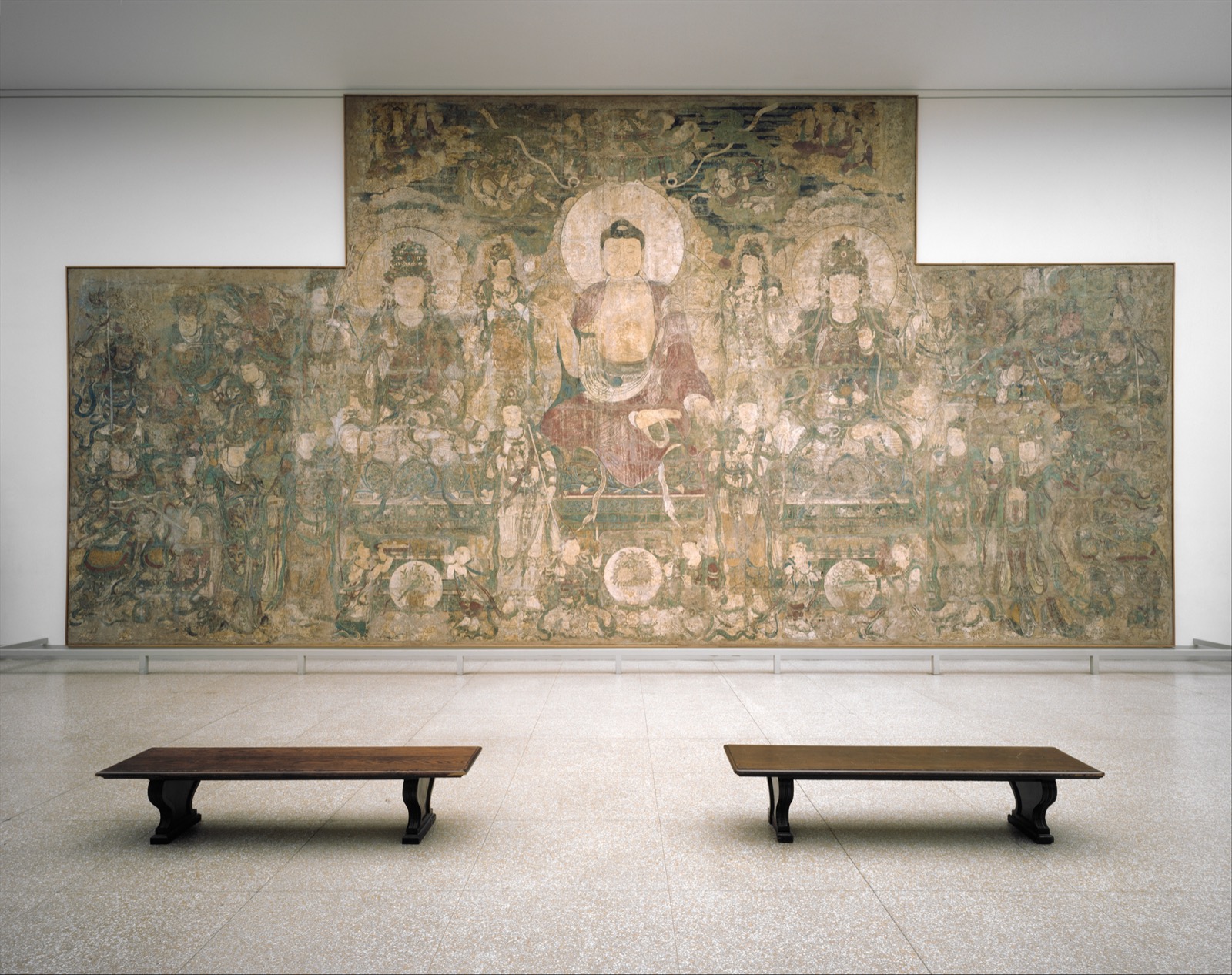
Around them stand the Twelve Divine Generals, armoured guardians who protect those who honour the sutra. The Met reads them as personifications of the Medicine Buddha’s vows. In Japanese images each general often carries one of the twelve zodiac animals in his hair or headdress, as the Cleveland Museum of Art points out in its Kamakura painting, which links the group to the hours, months and years of the calendar.

중국의 야오스 포
Chinese devotion to the Medicine Buddha spread with the sutra translations of the seventh century, and his Paradise became a major subject in the cave temples of Dunhuang, where Tang-dynasty murals depict the Eastern Pure Land and scenes from the sutra in great detail.
The Metropolitan Museum’s mural, painted around 1319 for a temple in Shanxi Province, shows how monumental these images could become. The museum notes that it was originally paired with an equally large painting of Tejaprabha, the Buddha of Blazing Light, an unusual pairing that may reflect concerns raised by the earthquake and fire that destroyed the Guangsheng monastery complex in 1303. Two smaller bodhisattvas near the bottom carry a monk’s staff and a medicine bowl, the Medicine Buddha’s traditional attributes.
In many later Chinese temples the Medicine Buddha sits in a row of three buddhas: Shakyamuni at the centre, Amitabha of the Western Pure Land on one side and the Medicine Buddha of the Eastern Pure Land on the other. This arrangement is why a single carved buddha with a jar is sometimes sold as part of a “three buddhas” set. Our 관음 또는 부처 안내 explains how to tell crowned bodhisattvas from buddhas in the same halls.
일본의 야쿠시, 한국의 약사
The Medicine Buddha became one of the earliest focuses of state Buddhism in Japan. The Cleveland Museum of Art notes that from the 700s people in Japan prayed to Yakushi Nyorai for longevity, and the great temple of Yakushiji in Nara is named after him. Heian-period aristocrats commissioned calm, finely carved wooden figures such as the Chicago statue at the top of this page, which the museum says was traditionally invoked against both physical and spiritual afflictions.
In Korea, the Medicine Buddha appears in sculpture and painting from at least the Unified Silla period. The small gilt plaque below is only about 11 cm tall. It was made by hammering a copper sheet from the back, a technique called repoussé, and shows the buddha seated on a lotus between two standing attendants.
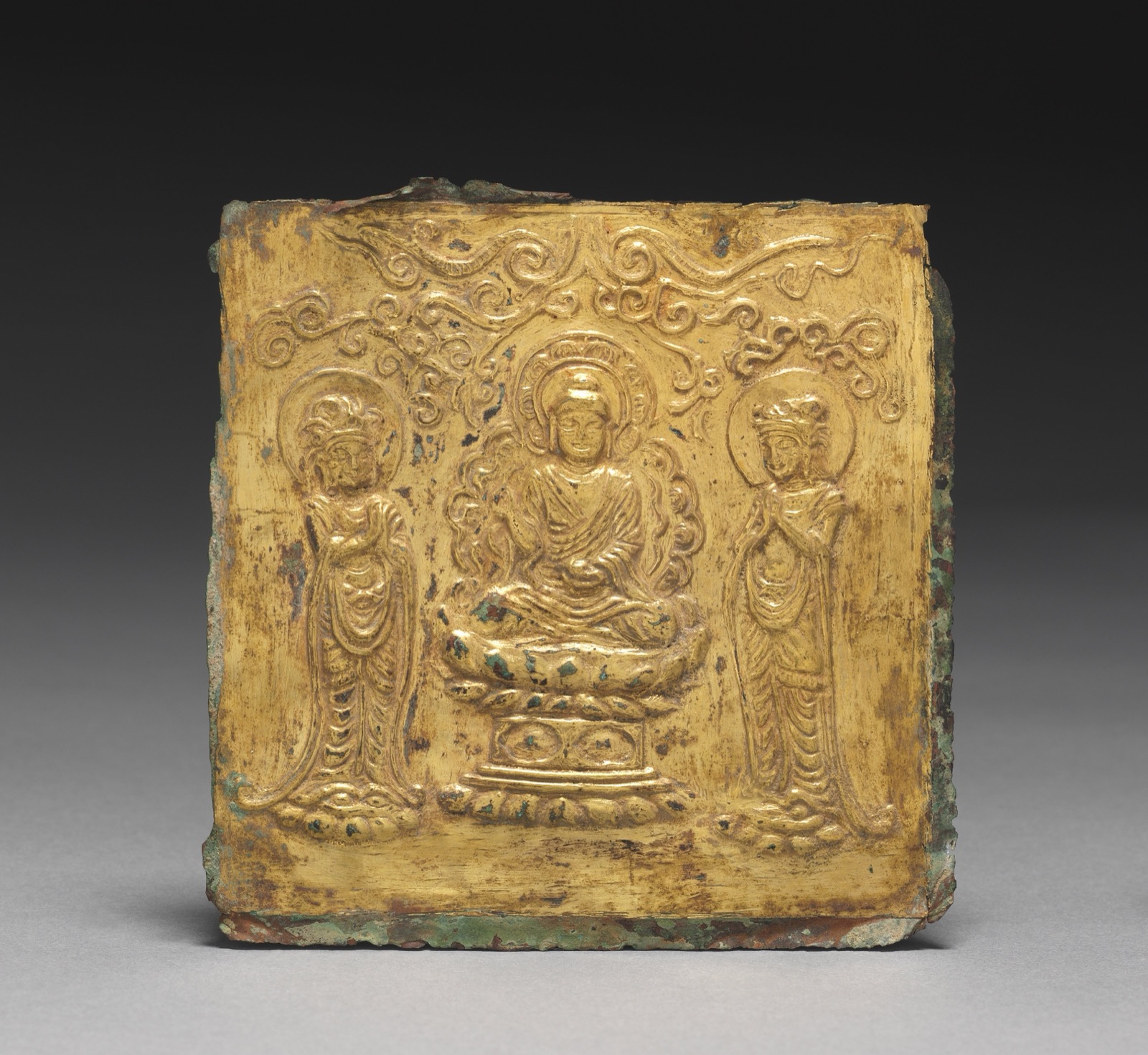
Notice that the triad formula, one buddha between two attendants, is shared with many other subjects. Without an inscription or a clear jar, the museum’s identification rests on context and comparison, which is how most identifications of old figures work.
티베트의 청색 약사여래
The Art Institute of Chicago notes that the Medicine Buddha as patron of healing gained particular popularity in Tibet. Tibetan paintings make the lapis title visible: the body is deep blue, the left hand holds an alms bowl in the lap and the right hand rests on the knee holding a plant stem.

티베트 전통에서는 약사불을 다른 치유 부처들과 함께 묶기도 합니다. “여덟 약사불'에 관한 질문은 대개 이 모음을 가리킵니다. 경전의 긴 버전에 나오는 일곱 부처로, 자주 석가모니와 함께 등장합니다. Christian Luczanits의 초기 티베트 도상 연구에 따르면 이 집단의 도상학은 자리를 잡는 데 시간이 걸렸으므로, 모든 초기 회화가 똑같이 배열된 것은 아닙니다.
약사여래인가, 다른 부처인가?
세 인물이 약사불과 가장 자주 혼동됩니다. 한 가지 세부만 보지 말고 인물 전체를 읽으십시오.
사제의 옷과 곱슬머리; 왼손에 항아리, 단지 또는 발을 들고, 흔히 오른손을 듭니다. 보살은 일광, 월광과 십이 장군이 포함될 수 있습니다.
대개 명상, 지권(지면을 만지는 손) 또는 설법의 손 모양을 하며 약 항아리는 없습니다. 세 인물이 한 줄일 때 가운데 인물인 경우가 많습니다.
흔히 명상 자세나 맞이하는 자세이며, 때로 연꽃을 들고, 보살은 대개 관음과 대세지보살입니다.
긴 머리, 왕관과 보석을 하고 승복을 입지 않습니다. 병은 긴 물병으로, 흔히 버드나무 가지가 있습니다. 저희 관음 가이드.
웃는 얼굴에 배가 나온 인물이 천수천안(미륵)이지 약사불이 아닙니다. 저희 미륵과 미소부처 가이드 가 별도의 전통을 설명합니다.
약사불 조상을 식별하는 방법
Look for a small jar, pot, bottle or bowl resting in the lap. It is the strongest single sign, but it can be lost or replaced on old figures.
A raised right hand in East Asian work, or a hand on the knee holding a plant stem and a blue body in Himalayan work.
Sunlight and Moonlight bodhisattvas, sun and moon discs, or twelve armoured generals point clearly to the Medicine Buddha.
Use listed material, measurements, finish and provenance. Do not infer age, material or ritual status from colour, patina or a room scene.
A seller’s title is a clue, not proof. “Medicine Buddha,” “Bhaisajyaguru,” “Yaoshi Fo,” “Healing Buddha” and “Yakushi” can all describe the same figure, and some listings use the name for any seated buddha.
살아있는 수행, 전시, 구매 확인 사항
The Medicine Buddha remains part of living Buddhist practice, and many temples hold Medicine Buddha services and recitations. Anyone looking for ritual guidance, including where a statue should face or which texts to recite, should ask a relevant temple or teacher rather than rely on a retail article.
For decorative display, choose a stable, clean surface at or above eye level, where the figure will not be knocked. Some people echo the temple arrangement by placing the Medicine Buddha on the eastern side of a group, matching his Eastern Pure Land; this is a convention, not a rule. Keep the piece away from standing moisture, strong heat and long direct sun. For wooden figures, our 목조 불상 관리 안내 covers dry and humid rooms, and our antique wooden Buddha guide explains why “old-looking” finishes do not prove age.
Before buying, compare real front, side, detail and base views where available, check that the jar or bowl is actually present, and confirm the listed measurements rather than estimating scale from a room photo. Review the current 배송 정책 와 반품 및 환불 정보입니다. 이러한 확인은 어떤 오브제가 제공되는지를 알려줄 뿐, 불상이 무엇을 “할 것인지”를 알려주지는 않습니다.”
자주 묻는 질문
What does the Medicine Buddha hold?
Usually a medicine jar, pot or bowl in the left hand, resting in the lap. In East Asian images the right hand is often raised in reassurance; in Tibetan images it rests on the knee and holds a stem of a medicinal plant.
Why is the Medicine Buddha blue?
His title is “Medicine Master of Lapis Lazuli Light.” Himalayan painters express that title by giving him a deep blue body. Chinese, Japanese and Korean statues usually do not; they keep the ordinary colouring of a buddha image.
Is the Medicine Buddha the same as Yakushi Nyorai?
Yes. Yakushi Nyorai is the Japanese name for Bhaiṣajyaguru, just as Yaoshi Fo is the Chinese name and Yaksa Yeorae the Korean. Each tradition developed its own local forms.
Who are the eight Medicine Buddhas?
In Tibetan tradition, a group of seven healing buddhas described in a longer version of the sutra is often joined by Shakyamuni to make eight. The Medicine Buddha himself is the principal figure of the group.
Where should a Medicine Buddha statue be placed?
There is no single rule. Temples often place him on the eastern side of a group of three buddhas, matching his Eastern Pure Land. At home, most people simply choose a clean, stable and respectful place at or above eye level. For religious guidance, ask a temple or teacher.
Can a Medicine Buddha statue heal illness?
No statue can treat illness. The sutra’s promises are religious teachings, and devotion to the Medicine Buddha has always sat alongside, not instead of, medical care. Treat a statue as an object of study, remembrance or practice.
출처 및 추가 자료
- 시카고 미술관: 야쿠시 뇨라이, Heian period, 10th/11th century, 1921.388
- 메트로폴리탄 미술관: Buddha of Medicine Bhaishajyaguru (Yaoshi fo), Yuan dynasty, ca. 1319
- 클리블랜드 미술관: Medicine Master Buddha and the Twelve Divine Generals, Kamakura period, 1938.422
- 클리블랜드 미술관: Plaque with the Image of Medicine Buddha Triad, Unified Silla period, 1987.59
- 시카고 미술관: 약사불 부처 바이샤야구루와 그 만다라 권속, Tibet, 14th century, 1996.29
- Spencer Museum of Art: 藥師佛 Yaoshi fo (Medicine Buddha)
- Rubin Museum of Art, Project Himalayan Art: Bhaishajyaguru, the Buddha of Healing
- Christian Luczanits, “Establishing an Iconography: The Case of Early Tibetan Representations of the Medicine Buddhas” (2020), SOAS Research Online
- Smithsonian National Museum of Asian Art: Bhaishajyaguru (“Master of Healing”), S2015.25
- Smarthistory: Buddha of Medicine Bhaishajyaguru (Yaoshi fo)
- Wikipedia: Bhaiṣajyaguru (sutra translations, twelve vows, temple arrangements)
이미지 공개: This guide uses five Public Domain or CC0 museum images and two approved Carvzen product images. It contains no AI-generated editorial illustrations.
현재 상품
Medicine Buddha statues at Carvzen
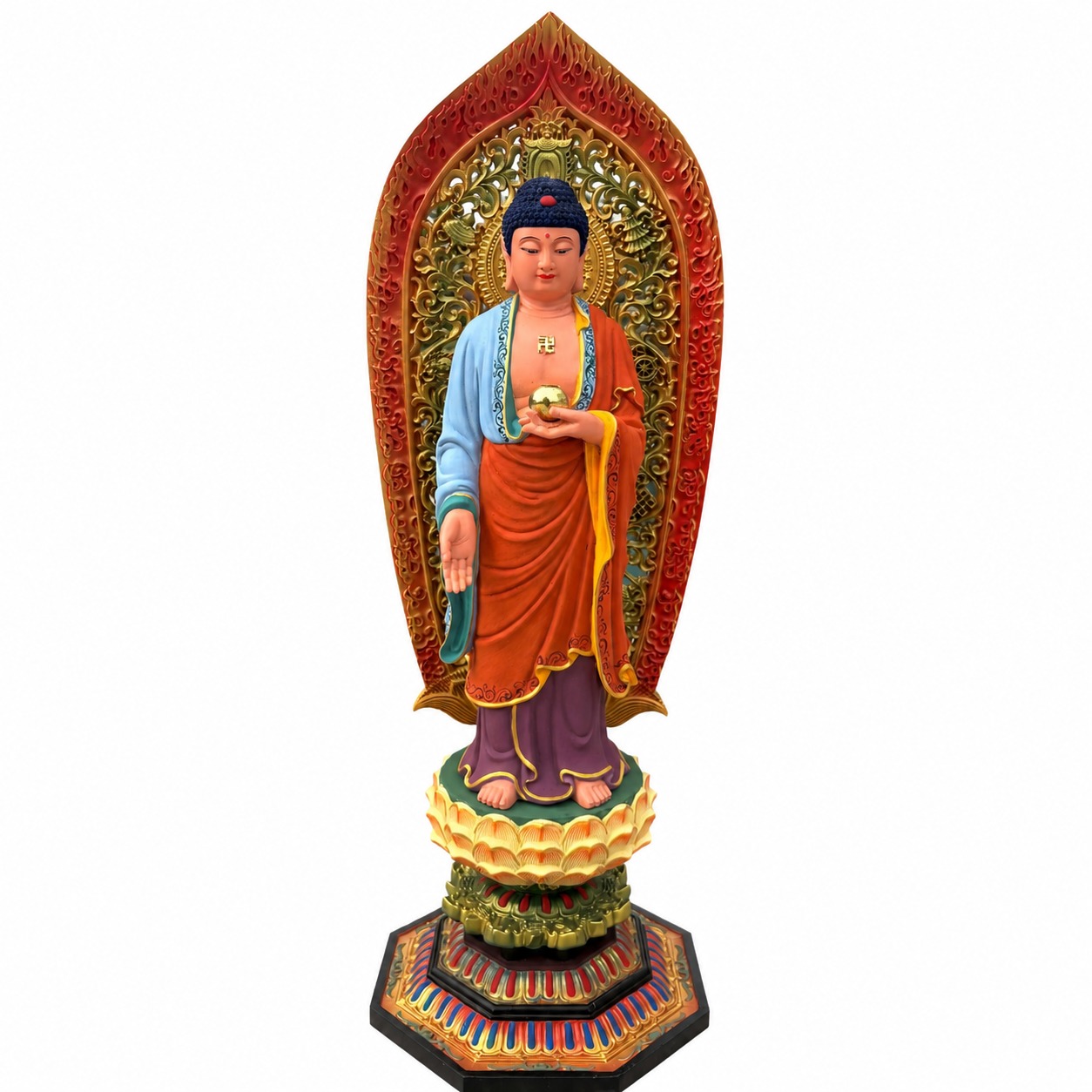
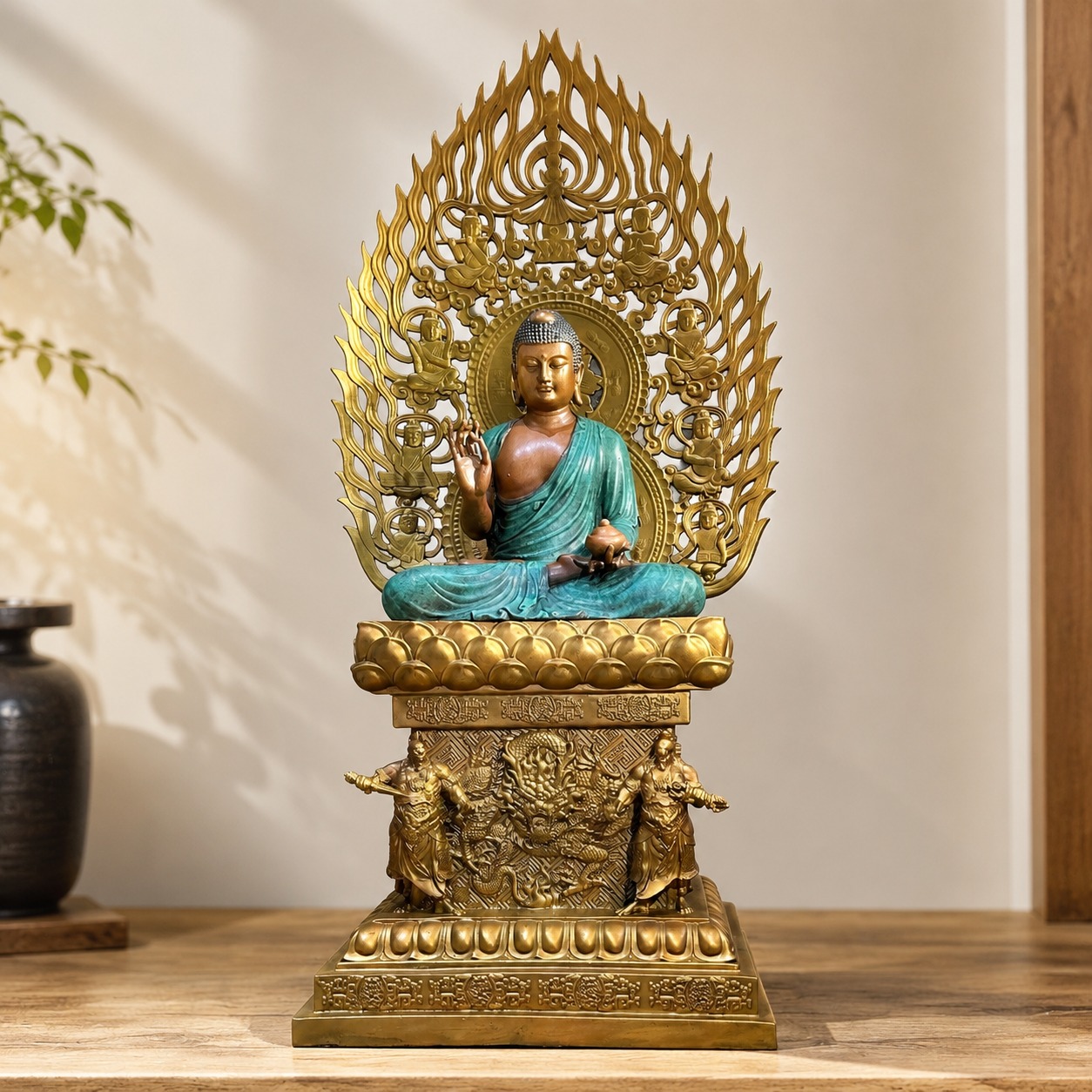
약사불 구리 합금 불상
The product record lists copper alloy and approximate dimensions of 6.0 × 7.7 × 18.7 in (15.2 × 19.6 × 47.5 cm).
현재 갤러리 보기실제 갤러리, 기재된 치수, 보이는 마감 및 현재 정책을 비교하세요. 문화적 의미는 보장된 결과가 아닙니다.