Bouddha Amitabha : signification, Terre Pure, mudras et formes de statues
Un bouddha assis en méditation, ou debout, une main abaissée comme pour saluer quelqu'un. Ce guide explique qui est Amitabha, ce que signifient la Terre Pure et l'expression “ Namo Amituofo ”, et comment les images chinoises, japonaises, coréennes et tibétaines le montrent, lui et ses compagnons.
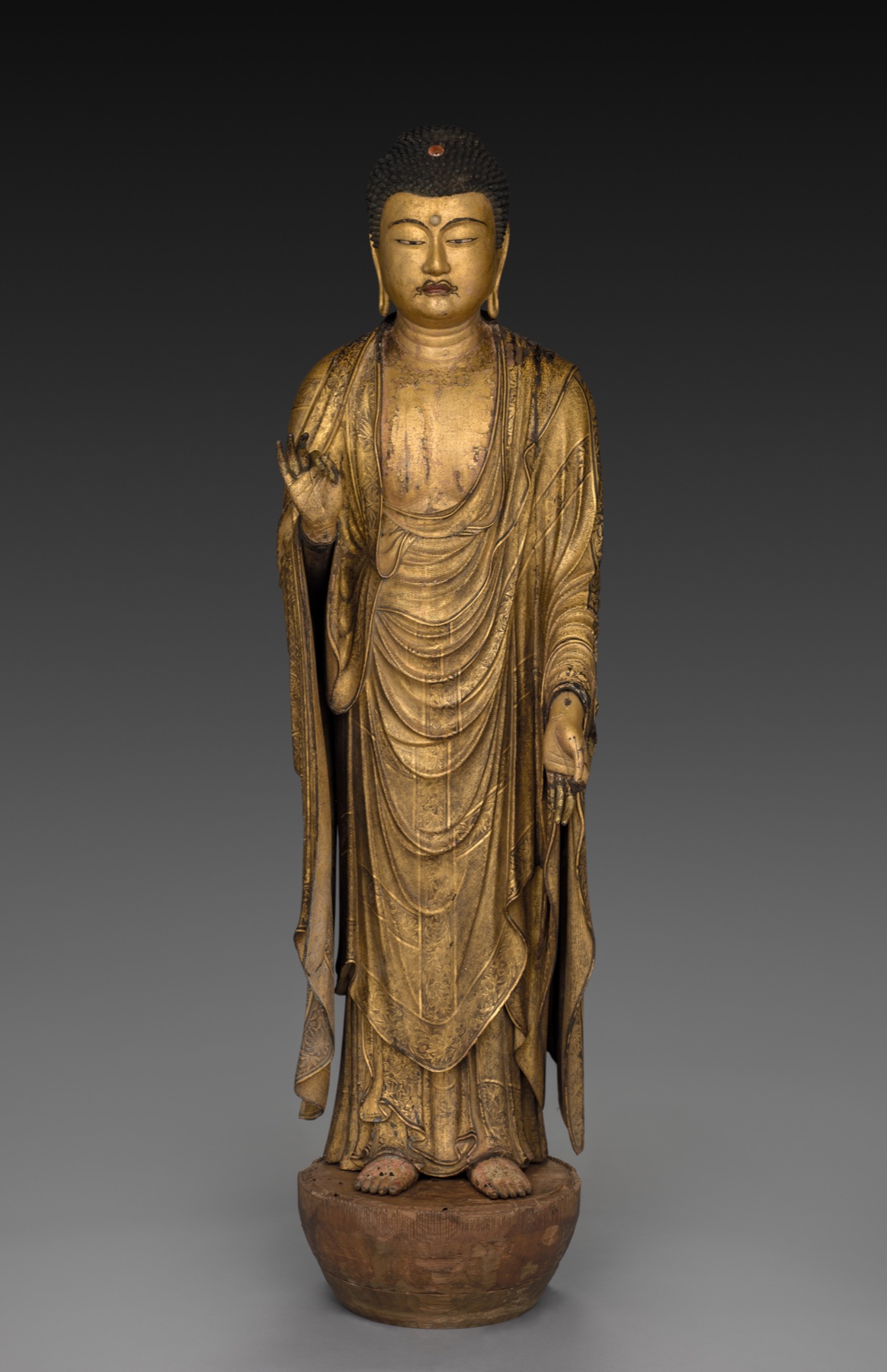
Le bouddha qui vient à votre rencontre
La plupart des bouddhas de l'art est-asiatique se ressemblent au premier regard : robes monastiques simples, cheveux finement bouclés, un renflement arrondi au sommet du crâne et quelques gestes de la main. Les distinguer dépend de petits détails et de la compagnie qu'ils tiennent.
Amitabha est le bouddha le plus souvent représenté s'avançant vers le spectateur. Dans les peintures, il descend sur les nuages ; dans les statues debout, il abaisse une main comme pour tendre la main. Assis, il repose généralement les deux mains sur ses genoux en méditation. Ces images sont nées de l’une des formes de dévotion bouddhique les plus répandues en Asie orientale : l’espoir de renaître dans sa Terre pure.
Ce guide suit cette tradition à travers des objets de musée provenant de Chine, du Japon, de Corée et du Tibet, et explique quels indices identifient Amitabha et lesquels peuvent induire en erreur.
Qui est Amitabha ?
Amitabha est un bouddha du Mahayana dont le nom sanskrit signifie “ Lumière infinie ”. Les écritures de la Terre pure le décrivent présidant à Sukhavati, la “ Terre de béatitude ” ou Terre pure de l’Ouest, où les conditions seraient idéales pour atteindre l’éveil.
En chinois, il est Amituo Fo (阿彌陀佛). En japonais, il est Amida Nyorai ou Amida Butsu, en coréen Amita Bul, et en tibétain Öpame. Il est étroitement lié à un second nom, Amitayus, “ Vie infinie ” ; en chinois et en japonais, les deux sont souvent fusionnés, comme le montre le titre donné par le Cleveland Museum of Art à la statue ci-dessus, Bouddha de Vie et de Lumière infinies, l’indique. L’art tibétain les distingue généralement (voir ci-dessous).
Le Metropolitan Museum of Art note que la dévotion à Amitabha constitue une part majeure de la pratique bouddhique chinoise depuis le VIe siècle, avec pour but la renaissance dans une Terre pure où les conditions favorisent la compréhension spirituelle. Il n’est pas le bouddha historique, Shakyamuni, mais l’un des nombreux bouddhas que les textes du Mahayana situent dans d’autres mondes.
Ce guide explique les écritures, l’histoire de la dévotion et les traditions iconographiques. Une statue d’Amitabha peut avoir un sens pour l’étude, le souvenir ou la pratique personnelle ; elle ne garantit ni renaissance, ni protection, ni bonne fortune, ni aucun autre résultat, et aucune statue vendue sur ce site ne doit être comprise comme une telle promesse.
Dharmakara et les quarante-huit vœux
L’histoire d’Amitabha est racontée principalement dans trois textes, souvent regroupés sous le nom des Trois sutras de la Terre pure : le long Sukhāvatīvyūha Sutra (le Sutra de la Vie incommensurable), le court Sutra d’Amitabha, et le Sutra de la Contemplation, qui enseigne la visualisation de la Terre pure.
Le sutra long raconte qu’un moine nommé Dharmakara fit jadis une série de vœux décrivant la terre de bouddha qu’il créerait et les êtres qu’il aiderait. Lorsqu’il devint le bouddha Amitabha, les vœux furent accomplis et Sukhavati vit le jour. La version la plus connue énumère quarante-huit vœux. La recherche philologique sur les plus anciennes traductions chinoises montre que les versions antérieures contenaient vingt-quatre vœux ; le nombre familier s’est donc lui-même développé au fil du temps.
Deux vœux importent surtout pour les images. Les maîtres ultérieurs de la Terre pure accordèrent une importance particulière au dix-huitième, qui lie la renaissance à une foi sincère et à l’invocation du nom d’Amitabha. Et, comme l’explique l’Asia Society Museum, les peintures de sa descente illustrent le dix-neuvième vœu, dans lequel il promet d’apparaître au moment de la mort à ceux qui souhaitent renaître dans sa terre.
Ce sont des enseignements religieux formulés dans des écritures. Différentes écoles les interprètent différemment, et ce guide ne prend pas position à leur sujet.
Que signifie “ Namo Amituofo ”
“ Namo Amituofo ” (南無阿彌陀佛) est la forme chinoise d’une courte phrase signifiant “ Hommage au bouddha Amitabha ” ou “ Je prends refuge dans le bouddha Amitabha ”. En japonais, c’est “ Namu Amida Butsu ”. Sa récitation est appelée nianfo en chinois et nenbutsu en japonais. C'est la pratique la plus courante associée à Amitabha.
La peinture des Song du Sud ci-dessous rend cette pratique visible. Le Cleveland Museum of Art note que la phrase est écrite dix fois dans la calligraphie au-dessus des figures, chaque ligne s'élevant d'une fleur de lotus, pour souligner la récitation continuelle.

Dans les communautés bouddhistes sinophones, la phrase sert aussi de salutation, de remerciement ou d'adieu quotidiens entre pratiquants. Cet usage quotidien est une coutume vivante ; il n'a pas besoin d'une statue, et une statue n'en a pas besoin.
Mains de méditation et d'accueil
Amitabha n'a pas d'objet fixe comme le vase du Bouddha de la Médecine, ce sont donc ses mains qui font l'essentiel du travail d'identification.
Méditation. Les figures d'Amitabha assis reposent souvent les deux mains sur les genoux, paumes vers le haut, parfois avec les pouces et les index formant deux anneaux. Le Met lit la position des bras de la statue Tang ci-dessous, dont les mains sont aujourd'hui perdues, comme la preuve qu'elle tenait autrefois ce geste de méditation, c'est pourquoi elle est cataloguée comme “ probablement Amitabha ”.”
Accueil. Les figures debout abaissent souvent la main gauche et lèvent la droite, paume vers l'extérieur. Le Met décrit la main droite de sa peinture des Song du Sud comme tenue dans un geste d'accueil, et le Cleveland Museum of Art décrit sa statue de Kamakura en haut de cette page comme dressée dans une posture d'accueil pour les mourants. De nombreuses figures chinoises debout plus tardives, souvent appelées jieyin (接引, “ recevoir et guider ”), tiennent dans une main un petit lotus ou un siège de lotus contre la poitrine, tandis que l'autre pend, ouverte vers le spectateur.
Variantes d'enseignement. L'art de la Terre Pure en Asie de l'Est a aussi développé des gestes des mains liés aux “ neuf degrés ” de renaissance décrits dans le Sutra de la Contemplation. Dans un essai du Cleveland Museum of Art, Ghichul Jung explique que la triade coréenne présentée plus loin dans ce guide adopte l'un d'eux, avec la main droite levée vers la poitrine, la gauche abaissée et chaque pouce touchant le majeur.
Les gestes se recoupent entre les bouddhas, et les mains des statues anciennes sont souvent endommagées ou remplacées. Un geste de méditation seul pourrait tout autant appartenir à Shakyamuni. Lisez les mains avec les compagnons et le contexte.
Guanyin, Mahasthamaprapta et autres
Amitabha usually appears between two bodhisattvas: Avalokiteshvara, known in China as Guanyin, and Mahasthamaprapta (Dashizhi in Chinese, Seishi in Japanese). Together they form the Western Paradise triad. Guanyin often wears a small seated buddha in the crown, representing Amitabha; our guide Guanyin explains that detail and Guanyin’s many other forms.
This is the clearest difference from the Medicine Buddha, whose attendants are the Sunlight and Moonlight bodhisattvas. In many later Chinese temples Amitabha also sits beside Shakyamuni and the Medicine Buddha in a row of three buddhas; our Medicine Buddha guide compares those three figures side by side, so the comparison is not repeated here.
Not every triad follows the standard pair. Korean artists sometimes replaced Mahasthamaprapta with Ksitigarbha, as the Korean section below shows.
Amituo Fo en Chine
The Tang-dynasty figure below, made in the early seventh century, is one of the most impressive early Chinese images thought to show Amitabha. It was made with the dry-lacquer technique: according to the Met, a core was covered with clay and wrapped in layers of lacquer-soaked cloth, with further layers of lacquer added on top. The museum notes that this technique spread from China to Japan in the eighth century.

From the twelfth century onward, paintings of Amitabha descending to welcome the dying became common. The Met notes that images of Amitabha, alone or with bodhisattvas, were among the most widely produced in China from the twelfth to the fourteenth century. In its painting below, he stands on two lotuses with the right hand raised in welcome.

Amida au Japon
Pure Land devotion grew strongly in Japan from the late tenth century. The Met notes that the monk Genshin (942–1017) wrote The Essentials of Rebirth in the Pure Land (Ōjōyōshū), which described the hells and explained practices, including nenbutsu, aimed at rebirth in paradise. The Tokyo National Museum describes Hōnen (1133–1212) as the founder of Jōdo Shū, Japan’s first Pure Land school, who taught repeated recitation of “Namu Amida Butsu.”
Paintings of Amida’s welcoming descent, called raigō, became one of the great subjects of Japanese Buddhist art. The Cleveland Museum of Art notes that such images could be placed before a dying person to help them remain faithful.
The standing Amida at the top of this page belongs to the same world. The museum records that documents placed inside its hollow body include a copy of the Amida Sutra, a list of donors who joined in dedicating the statue, and a record that it was completed in 33 days in 1269 at Shitennōji temple in Osaka. The lead sculptor was Kōshun.
Amita en Corée
Amitabha was also central in Korea from the Unified Silla period onward. The small Joseon-dynasty bronze below shows how a triad could vary. Ghichul Jung’s Cleveland Museum of Art essay notes that Amitabha sits slightly larger at the centre. The crowned figure is Avalokiteshvara, and the figure with a shaven head, like a monk, holding a jewel, is Ksitigarbha, who here replaces Mahasthamaprapta. The essay says this pairing was in vogue in Korea in the 1300s and 1400s.

Readers who know Ksitigarbha from our Ksitigarbha (Jizo) guide will recognise the shaven head and jewel. Seeing him beside Amitabha is a useful reminder that companions identify a scene only when read together.
Amitabha et Amitayus au Tibet
Tibetan painting shows Sukhavati as a crowded, jewelled landscape. In the Met’s painting below, made in Central Tibet around 1700, the buddha sits in meditation at the heart of his Pure Land, surrounded by palaces, trees, pools and assemblies of figures.

Himalayan art usually separates Amitabha from Amitayus, the “Buddha of Infinite Life.” Himalayan Art Resources describes Amitayus as normally red, wearing a crown and jewels, with a long-life vase held above his hands in meditation. Museums such as the Met and LACMA describe the vase as holding the elixir of immortality and link Amitayus with prayers for long life. Amitabha, by contrast, is usually shown in a buddha’s plain monastic robes without a crown.
Himalayan Art Resources also notes a great deal of overlap between the two in Tibetan tradition, while in early sutra literature they were not the same figure. A crowned buddha holding a vase in the lap is therefore usually Amitayus, not the Medicine Buddha and not a plain Amitabha.
How to identify an Amitabha statue
Both hands resting in the lap in meditation, or a standing figure with one hand raised, sometimes holding a small lotus, and one lowered in welcome. No medicine jar in the lap.
Guanyin, often with a small buddha in the crown, and Mahasthamaprapta at the sides point clearly to Amitabha. Korean triads may show Ksitigarbha instead.
A plain robe and no crown suggest Amitabha; a crown, jewellery and a vase in the lap usually indicate Amitayus in Himalayan art.
Utilisez le matériau, les mesures, la finition et la provenance indiqués. Ne déduisez pas l’âge, le matériau ou le statut rituel de la couleur, de la patine ou d’une mise en scène.
A seller’s title is a clue, not proof. “Amitabha,” “Amituofo,” “Amida,” “Buddha of Infinite Light” and sometimes “Amitayus” can describe the same or closely related figures, and some listings use the name for any seated buddha. A smiling, round-bellied figure with a sack is the Laughing Buddha; our guide Maitreya et Bouddha rieur explains that separate tradition, and our guide Guanyin ou Bouddha explains how to tell crowned bodhisattvas from buddhas.
Pratique vivante, présentation et vérifications à l’achat
Amitabha is at the centre of living Pure Land practice in China, Japan, Korea, Vietnam and elsewhere, and many temples hold recitation services in his name. Anyone looking for ritual guidance, such as which direction an image should face or which texts to recite, should ask a relevant temple or teacher rather than rely on a retail article.
For decorative display, choose a stable, clean surface at or above eye level where the figure will not be knocked. Some people echo the temple arrangement by placing Amitabha on the western side of a group, matching his Western Pure Land; this is a convention, not a rule. Keep the piece away from standing moisture, strong heat and long direct sun. For wooden figures, our guide d'entretien des statues en bois couvre les pièces sèches et humides, et notre guide du Bouddha ancien en bois explique pourquoi les finitions “ d’aspect ancien ” ne prouvent pas l’âge.
Before buying, compare real front, side, detail and base views where available, check what the hands are actually doing, and confirm the listed measurements rather than estimating scale from a room photo. Review the current Politique d'expédition et Retours et remboursements informations. Ces vérifications vous indiquent quel objet est proposé ; elles ne vous disent pas ce qu’une statue “ fera ”.”
Questions fréquentes
What does Amitabha Buddha represent?
In Pure Land Buddhism, Amitabha is the buddha of the Western Pure Land, whose vows describe a realm where beings can be reborn and continue toward awakening. His name means “Infinite Light,” and he is closely associated with compassion through his attendant Guanyin.
Why do people say “Amitabha” or “Namo Amituofo”?
The phrase means “Homage to Amitabha Buddha.” Pure Land practitioners recite it as their main practice, and in Chinese-speaking Buddhist communities it is also used as a greeting or expression of thanks.
How is Amitabha different from Shakyamuni?
Shakyamuni is the historical Buddha who taught in India. Amitabha is a buddha described in Mahayana scriptures as presiding over another realm. In art the two can look almost identical; Amitabha is more often shown in welcome or with Guanyin and Mahasthamaprapta, while Shakyamuni is more often shown touching the earth or teaching, or at the centre of a row of three buddhas.
What is the Amitabha hand gesture?
Seated figures usually hold the meditation gesture, hands resting in the lap. Standing figures often raise the right hand and lower the left in welcome. East Asian art also developed variations linked to the nine grades of rebirth.
Are Amitabha and Amitayus the same buddha?
In Chinese and Japanese tradition the names are often merged. In Tibetan art they are usually shown differently: Amitabha in plain robes, Amitayus crowned and holding a long-life vase. Early scriptures treat them as distinct.
Where should an Amitabha statue be placed?
There is no single rule. Temples often associate him with the west, matching his Western Pure Land. At home, most people simply choose a clean, stable and respectful place at or above eye level. For religious guidance, ask a temple or teacher.
Sources et lectures complémentaires
- The Cleveland Museum of Art : Bouddha de la Vie et de la Lumière Infinies (Amida Nyorai), Kamakura period, 1269, 1960.197
- The Metropolitan Museum of Art : Buddha, probably Amitabha, Tang dynasty, early 7th century, 19.186
- The Cleveland Museum of Art : Bouddha Amitābha avec deux bodhisattvas assistants, Southern Song dynasty, 1974.35
- The Metropolitan Museum of Art : Buddha Amitabha Descending from His Pure Land, Southern Song dynasty, 1987.148
- The Cleveland Museum of Art : Amitabha Triad, Joseon dynasty, 1918.501, and Ghichul Jung, “Korea in Focus: The Amitâbha Triad” (2021)
- The Metropolitan Museum of Art : Amitabha, the Buddha of the Western Pure Land (Sukhavati), Central Tibet, ca. 1700, 2004.139
- The Cleveland Museum of Art : Welcoming Descent of Amida (Amida Raigō), Kamakura period, 1953.123
- Asia Society Museum: Buddha Amitabha (Amida Nyorai), 1979.204
- The Metropolitan Museum of Art : The Essentials of Rebirth in the Pure Land (Ōjōyōshū)
- Tokyo National Museum: Hōnen and the history of Japanese Pure Land Buddhism (special exhibition, 2024)
- The Metropolitan Museum of Art : Amitayus, the Buddha of Eternal Life, Tibet
- Himalayan Art Resources: Amitayus and its conflation with Amitabha
- BDK English Tripiṭaka: The Three Pure Land Sutras (translation, 2003)
- “On the Vows in the Earliest Version of the Larger Sukhāvatīvyūha Sūtra,” Journal of Indian and Buddhist Studies
- Wikipedia: Amitābha (names, scriptures and regional traditions)
Divulgation d'image : This guide uses six Public Domain or CC0 museum images and three approved Carvzen product images. It contains no AI-generated editorial illustrations.
Objets actuels
Amitabha statues at Carvzen
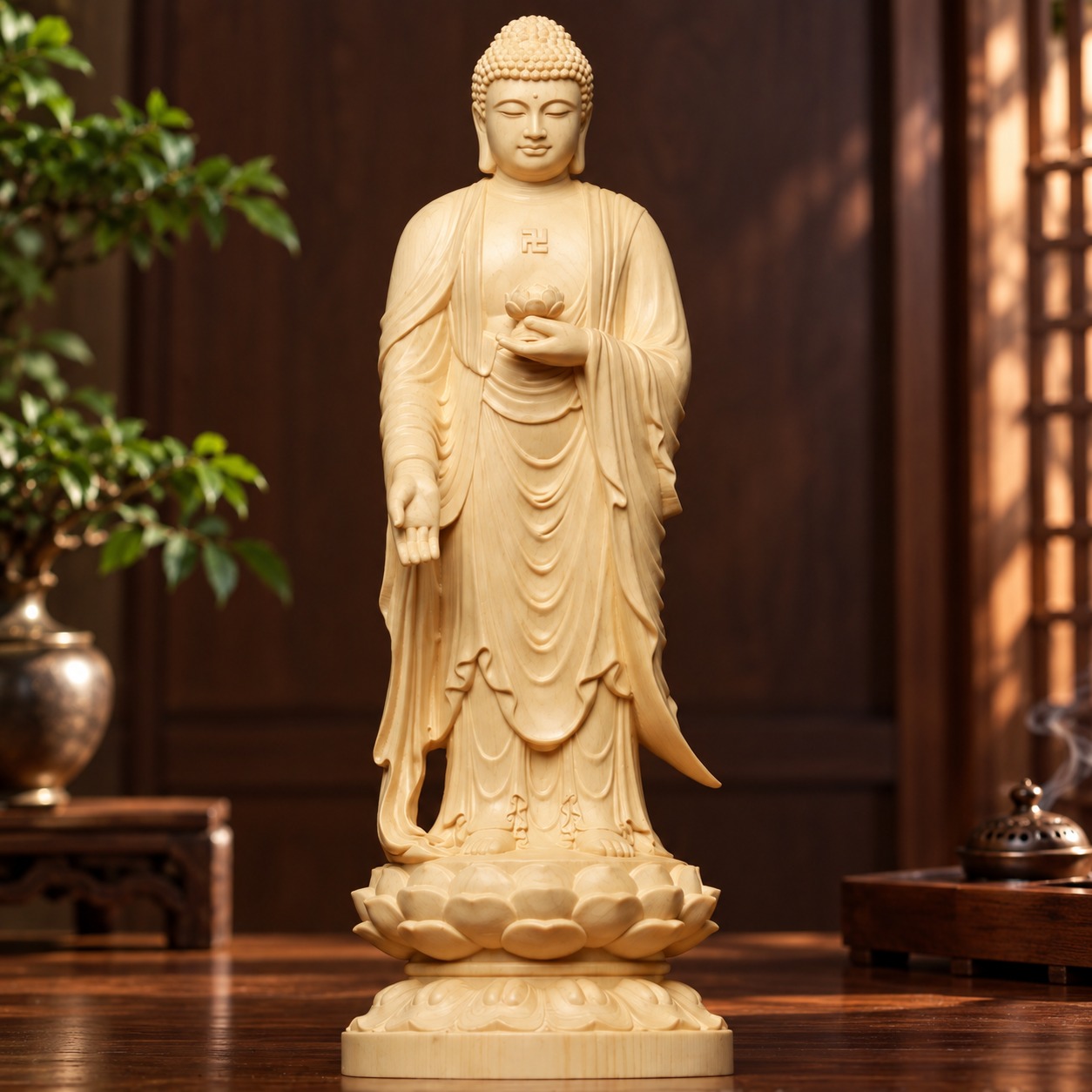
Statue en bois d'Amitabha Bouddha
The product record lists wood and dimensions of 3.9 × 3.9 × 11.8 in (10 × 10 × 30 cm).
Voir la galerie actuelle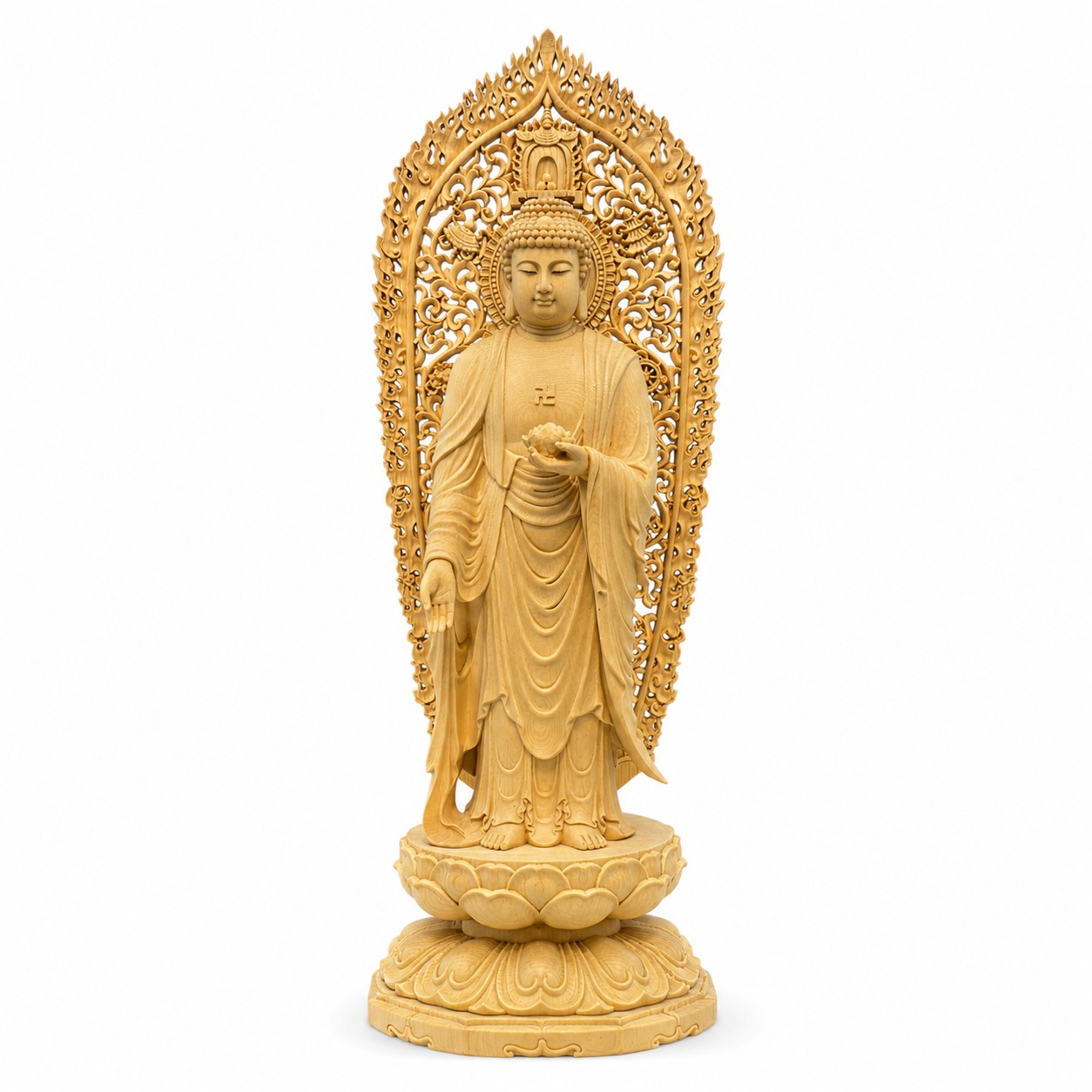
Figurine en bois du Bouddha Amitabha
The product record lists wood and a height of 18.1 in (46 cm).
Voir la galerie actuelle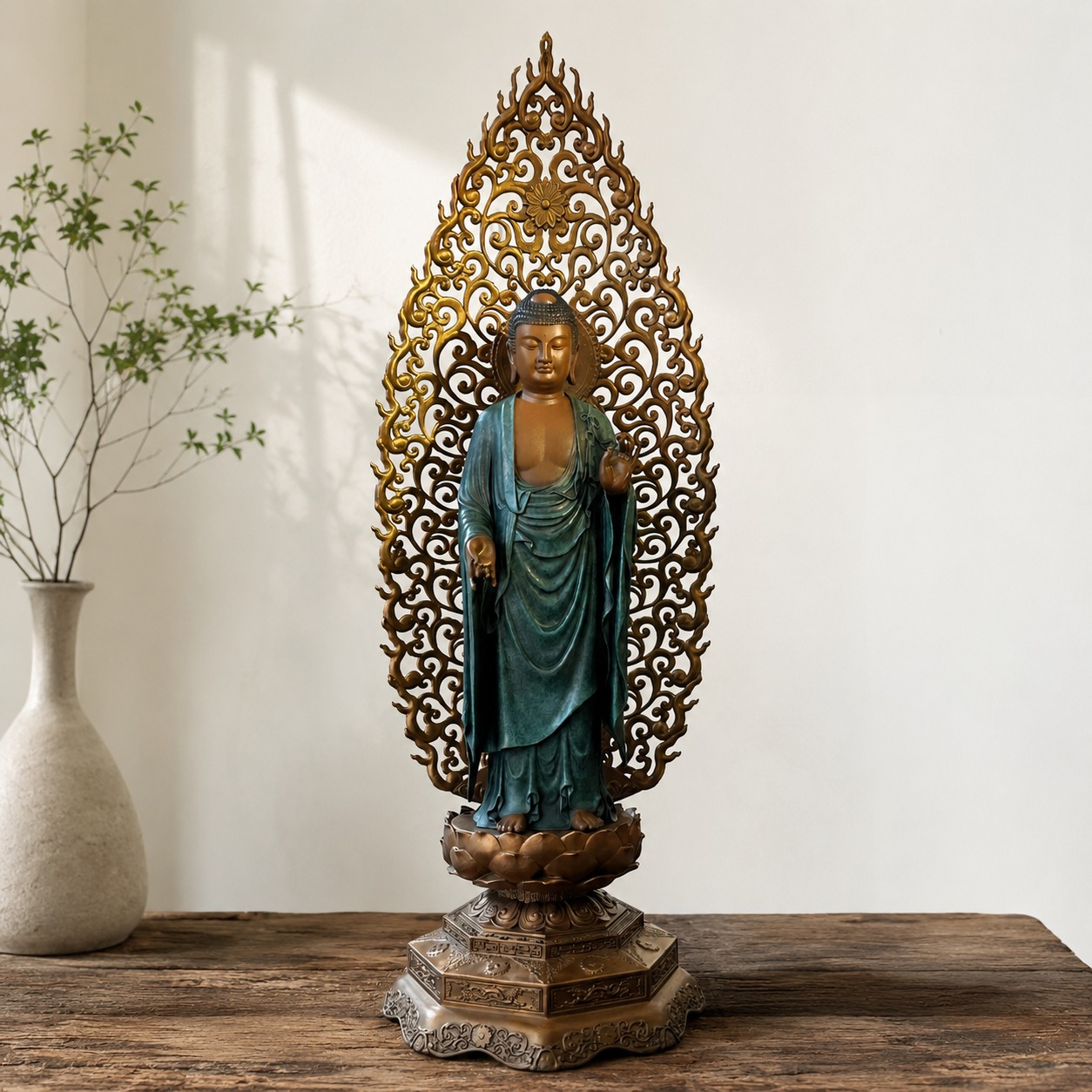
Statue d'Amitabha Buddha en alliage de cuivre
The product record lists copper alloy and dimensions of 7.2 × 8.1 × 22.0 in (18.3 × 20.5 × 56 cm).
Voir la galerie actuelleComparez la galerie réelle, les mesures indiquées, la finition visible et les politiques en vigueur. La signification culturelle n'est pas un résultat garanti.