Manjushri Meaning: Wisdom Sword, Lotus and Statue Forms
Manjushri is a major Mahayana bodhisattva associated with wisdom, but his images do not follow one universal template. This guide explains the sword, book, lotus and lion, then separates Indian, Tibetan, Chinese and Japanese forms so that a statue can be read in context.
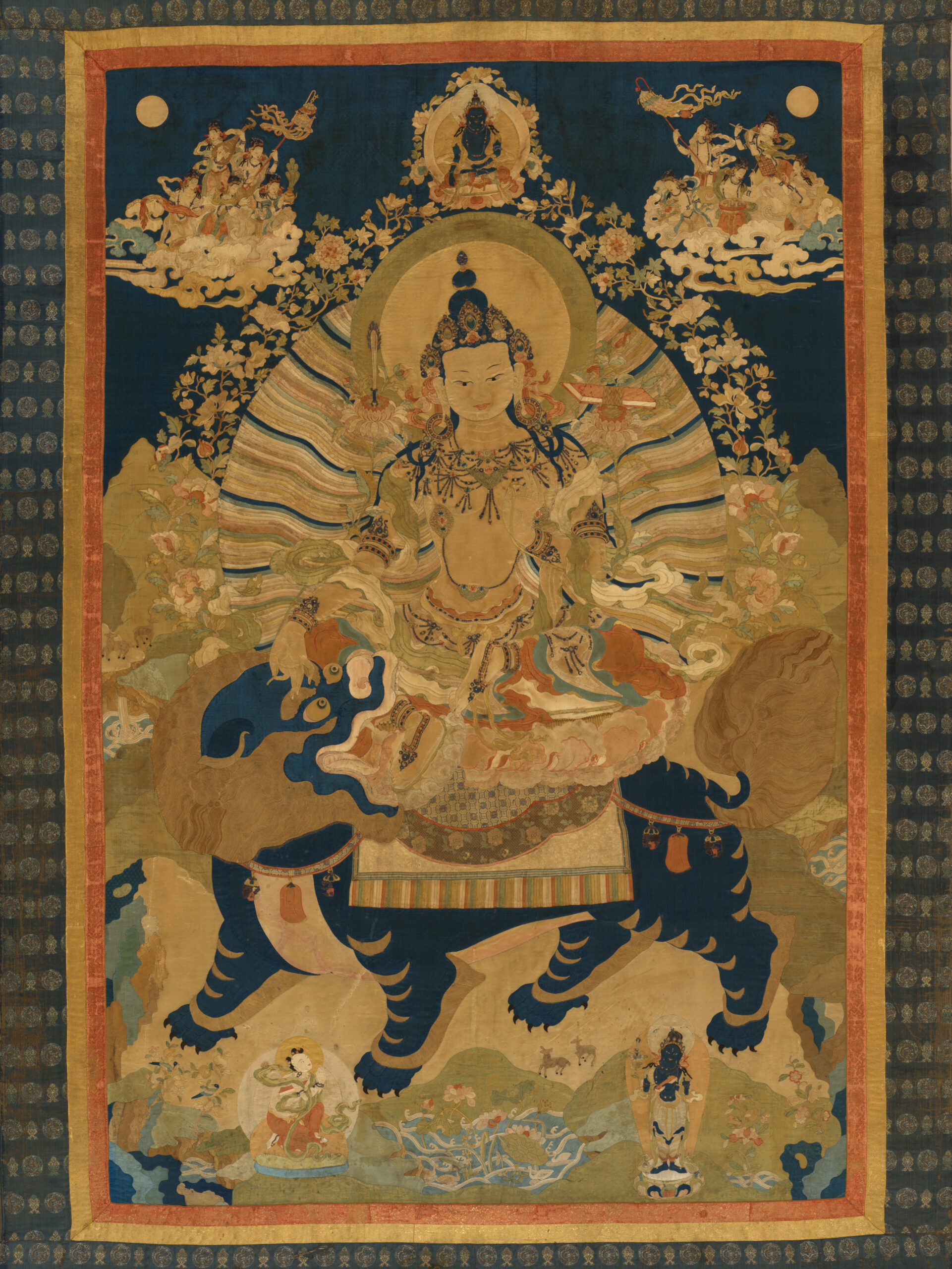
Manjushri is a bodhisattva of wisdom in Mahayana Buddhist traditions. In many sculptures and paintings he appears as a youthful, crowned figure holding or accompanied by a sword and a book. The book may rest on a lotus, and a lion may serve as his mount. Those are powerful clues, but none is a universal requirement.
The same figure moved through Indian, Himalayan, Chinese, Korean and Japanese religious worlds. Texts, rituals, court patronage and local image traditions shaped what artists emphasized. A Tibetan brass figure, a Chinese lion-mounted image and a Japanese Monju painting can all represent Manjushri without looking identical. Identification therefore depends on the complete object record: place, period, inscriptions, companions, pose and attributes.
Mañjuśrī, Wenshu, Monju and Munsu
The Sanskrit name is written Mañjuśrī, often simplified in English as Manjushri or Manjusri. In Chinese he is Wenshu (文殊), in Japanese Monju, and in Korean Munsu (문수). These names reflect different languages and transmission histories; they do not designate four separate bodhisattvas.
English product titles often mix those names. “Manjushri statue,” “Wenshu Bodhisattva” and “Monju on a lion” may point to related image traditions, yet the title alone cannot establish a statue’s date, origin or ritual use. Museum catalogues sometimes revise identifications as new evidence appears, so visible attributes should support—not replace—the documented record.
What Buddhist texts say about Manjushri
Manjushri appears in numerous Mahayana scriptures as a questioner, teacher or exceptionally perceptive bodhisattva. In The Teaching of Vimalakirti, the Buddha asks disciples and bodhisattvas to visit the lay teacher Vimalakirti. Manjushri is the one who accepts, and their dialogue becomes a central vehicle for discussions of sickness, compassion, nonduality and the bodhisattva path.
That literary role helps explain why later communities associated Manjushri so strongly with discernment and insight. It does not mean that every visual attribute comes directly from one passage of one sutra. The flaming sword, manuscript, lotus, lion, hairstyle and attendants belong to overlapping textual, ritual and artistic histories that developed differently by region.
This guide describes documented texts and image traditions. It does not claim that owning a statue produces wisdom, examination success, protection, spiritual attainment or another guaranteed result.
From Indian bodhisattva images to regional traditions
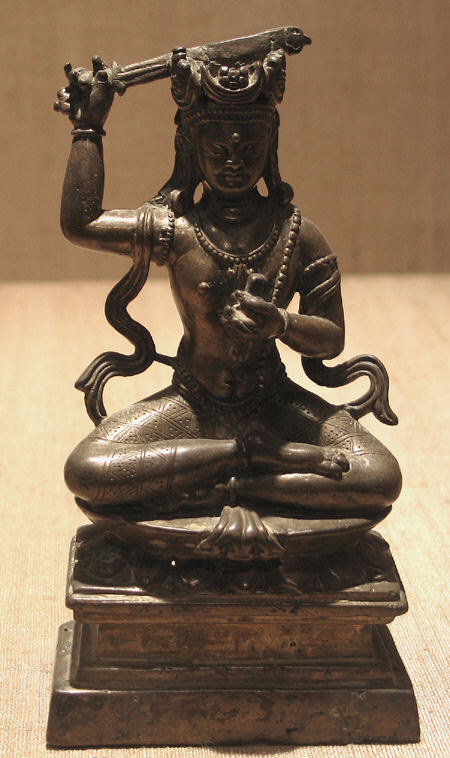
A tenth-century brass figure from Himachal Pradesh at The Metropolitan Museum of Art shows Manjushri in an Indian bodhisattva form. The museum identifies the sword in one hand and the manuscript in the other as signs of cutting away ignorance and transmitting wisdom. Crown, jewelry and princely dress distinguish the bodhisattva appearance from the simpler robes associated with a Buddha or monk.
This early example is useful because it does not depend on a lion. The figure can be identified through the paired attributes and the object’s art-historical context. As Manjushri devotion spread, artists retained some clues, changed others and created new combinations. A statue without a lion is not automatically misidentified, and a generic lion rider is not automatically Manjushri.
What the wisdom sword means
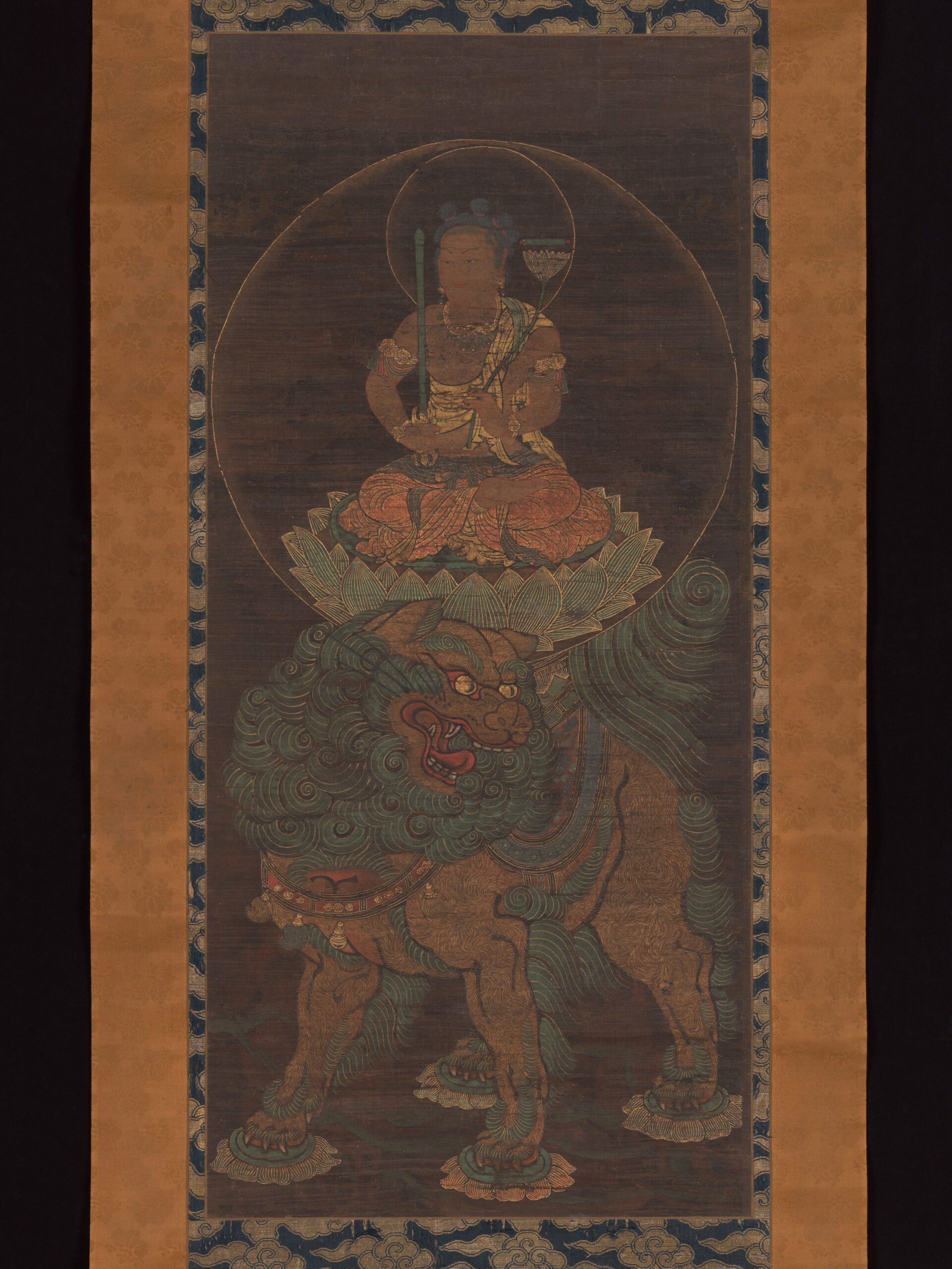
The sword is Manjushri’s most recognizable attribute in many later images. Museum interpretations commonly describe it as cutting through ignorance or the impediments to enlightenment. In some paintings it rises above the shoulder and is surrounded by flames. In other works it is held across the body, supported by a lotus or reduced to a surviving hilt after the blade has been lost.
A sword should therefore be read carefully. Damage can remove the blade, and restorations can change what survives. Other Buddhist figures may also carry weapons. A secure identification comes from the combination of sword, manuscript or lotus, bodhisattva dress, lion, inscription and known image type—not from the sword alone.
The book and lotus: wisdom made visible
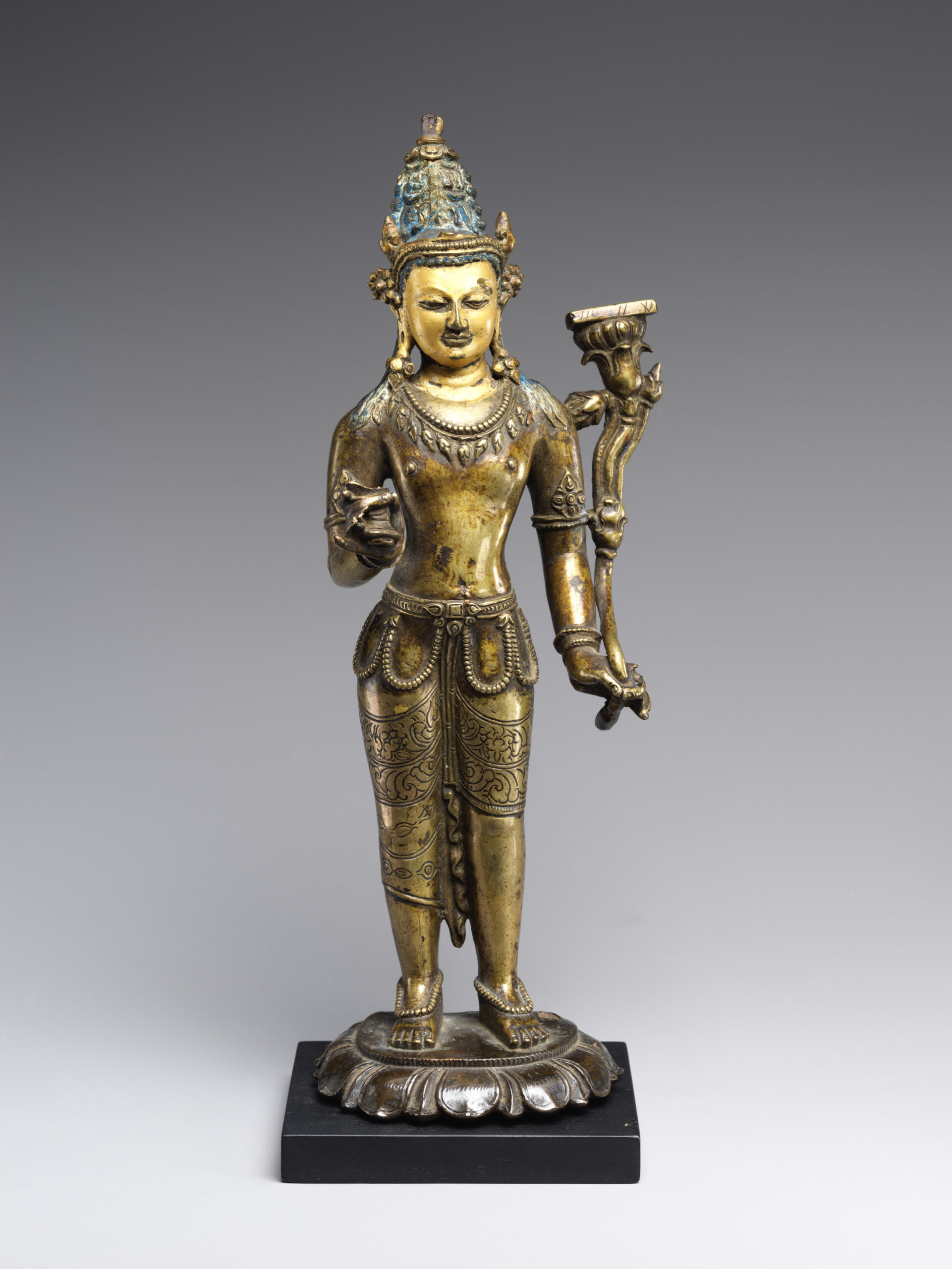
The manuscript is frequently identified as a Perfection of Wisdom text or, more cautiously, as a book embodying wisdom. It may be held in the hand, placed above a lotus near the shoulder or rendered as a scroll in East Asian painting. The lotus creates a visual support for an attribute that might otherwise appear to float beside the figure.
A twelfth-century Tibetan sculpture at The Met places a palm-leaf manuscript on a lotus. The sword blade is now missing, but its hilt remains. This is a practical lesson in object reading: absence in the present condition does not always mean the attribute was absent when the sculpture was made.
Why Manjushri rides a lion
The lion became one of the defining features of many Chinese and broader East Asian Manjushri images. Art-historical research places an important shift in Chinese representation in the late sixth century, when the lion emerged as his animal vehicle. Later images may add an attendant who guides the lion, the pilgrim Sudhana or figures connected with Mount Wutai narratives.
Museum descriptions often relate the lion to the strength or commanding voice of Buddhist teaching. That symbolism should not be turned into a product promise. Nor should the lion be treated as compulsory: the Indian and Tibetan sculptures shown in this guide demonstrate recognizable forms without a mount.
Mount Wutai and the Chinese history of Manjushri
Mount Wutai in Shanxi became the leading Chinese sacred landscape associated with Manjushri and an international pilgrimage center. Scholarship connects the mountain’s development with readings of the Avatamsaka Sutra, visionary accounts, monasteries, images and changing forms of court and clerical patronage. The association was produced historically; it should not be flattened into the claim that Manjushri simply “originated” at Wutai.
The mountain’s visual traditions were also diverse. Hong Wu’s study of the “True Visage” Manjushri type distinguishes medieval textual accounts, surviving images and later scholarly reconstruction. The lesson for a general reader is important: even a famous image type can contain debated details, and later replicas do not necessarily preserve every feature of an earlier model.
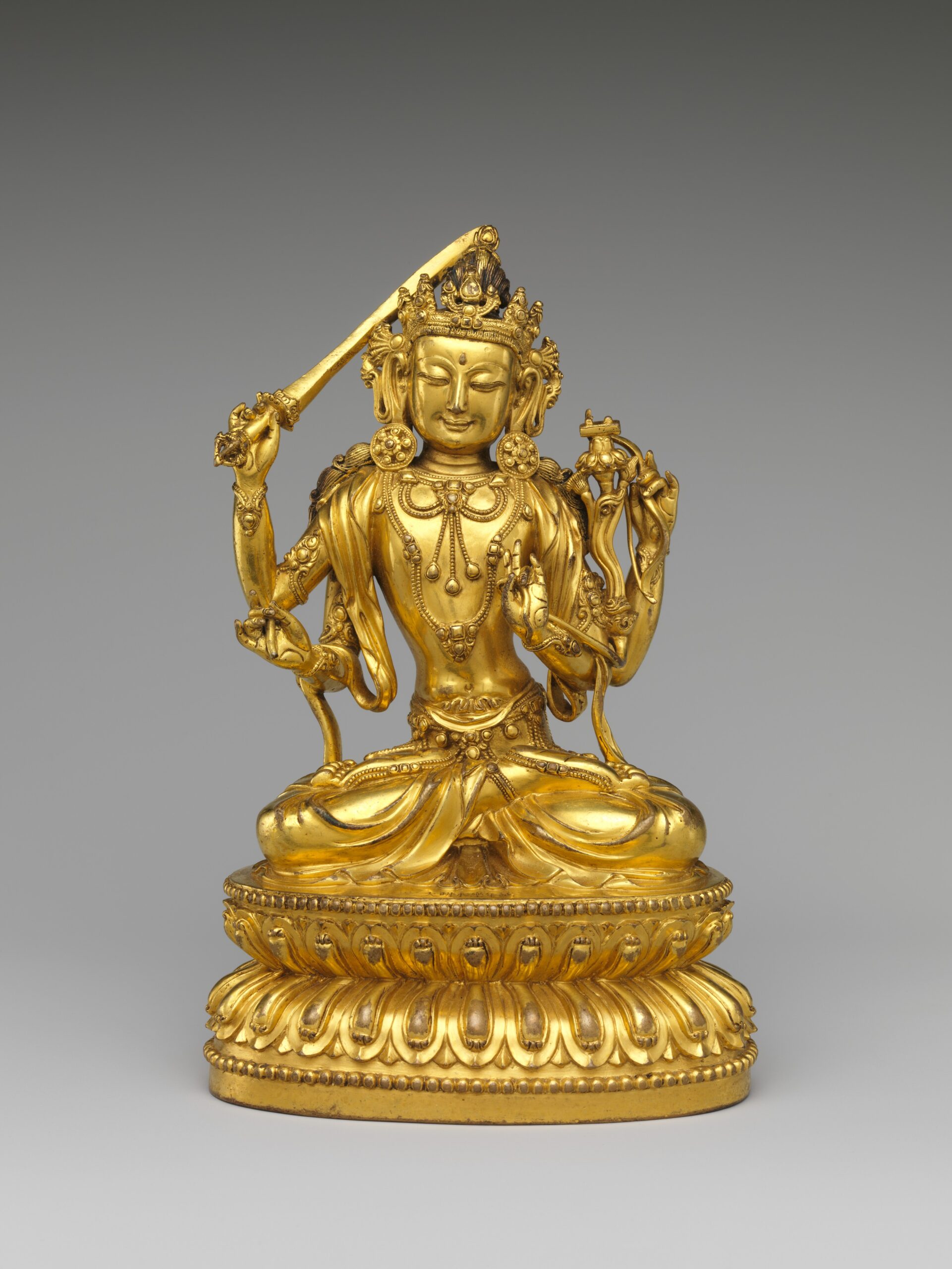
Under the Ming and Qing courts, Manjushri imagery also participated in relations among Chinese, Tibetan, Mongolian and Manchu Buddhist worlds. A four-armed gilt copper-alloy sculpture with a Yongle reign mark, for example, was made in an imperial context and intended as a gift to Tibetan Buddhist monasteries. It demonstrates that “Manjushri statue” can include multi-armed forms beyond the common sword-and-book image.
Why Manjushri statues have different forms
There is no single “standard Manjushri statue” that overrides every Buddhist tradition. Number of arms, pose, hairstyle, vehicle, attendants and handheld objects may vary with the text, mandala, lineage, region and intended setting. Objects can also lose detachable attributes or be repaired in ways that complicate identification.
A crowned and jeweled figure may hold the sword and manuscript directly, without a lion.
The sword and book may rise on lotuses beside the shoulders; peaceful and multi-armed forms both occur.
The lion mount, attendants and Mount Wutai associations can become prominent, while court images may follow Tibetan conventions.
Paintings and sculptures may show a youthful figure with five topknots, a sword, a sutra scroll and a lion.
A fourteenth-century Japanese painting at The Met shows Monju with five topknots seated on a lotus above a lion. The museum identifies the sword and the scroll above a lotus as familiar attributes and interprets the five topknots within a specific esoteric image tradition. This does not mean that every Japanese Monju must have five topknots.
Manjushri with Shakyamuni and Samantabhadra
In East Asian art, Manjushri and Samantabhadra may flank the historical Buddha Shakyamuni. Manjushri is commonly placed on the lion and Samantabhadra on an elephant. Museums describe this grouping as a triad, but orientation can vary by object and viewing convention, so a seller should not identify the figures from left and right positions alone.
Paired statues may also present Manjushri and Samantabhadra without the central Buddha. Their animal vehicles are strong clues, yet damage, simplified commercial forms or missing attributes can make a close view necessary. When a listing uses the phrase “Huayan Three Sages,” verify whether all three figures are actually included or whether the title refers more broadly to the iconographic group.
A practical identification checklist
A sword together with a manuscript or scroll is more informative than either object by itself.
The sword or book may rest above lotus stems beside the shoulders instead of being held directly.
A lion supports many Wenshu and Monju identifications; an elephant more often points to Samantabhadra.
Inscriptions, companions, place, period and museum or provenance records can resolve ambiguous attributes.
Do not use surface color to decide whether an object is ancient, bronze, brass, gilded or handmade. Patina can be natural, applied, repaired or digitally altered, and a photograph cannot establish composition or production method. Those facts require a reliable object or product record.
Display, devotion and modern practice
Manjushri remains a living religious figure, not only an art-historical subject. Recitations, rituals, study practices and temple arrangements differ among Buddhist communities. Anyone using an image devotionally should follow guidance from the relevant teacher or institution rather than treating a generalized retail article as ritual instruction.
For decorative display, choose a stable surface, allow clearance around swords, lotus stems and other projecting parts, and avoid standing moisture, strong heat and prolonged direct sunlight. Respectful handling is sensible object care, but there is no evidence-based room, direction or desk position that guarantees intelligence, grades or professional success.
What to check before buying a Manjushri statue
Start with the actual object rather than a promised effect. A careful product page should make it possible to compare the title, approved gallery and verified specifications.
Confirm whether the listing contains Manjushri alone, a Manjushri–Samantabhadra pair or a complete Shakyamuni triad.
Review front, side or three-quarter, detail, rear and base images where available; do not rely on one generated room scene.
Check height, width and depth against the intended shelf or cabinet instead of estimating scale from a photograph.
Use confirmed product facts and current policies. Do not infer alloy, wood species, age or technique from appearance.
Before checkout, review the current Shipping Policy and Returns & Refunds information. The product page remains the source for current images, dimensions, material wording, price, availability and policies.
Frequently asked questions
What does Manjushri represent?
Manjushri is associated with wisdom in Mahayana Buddhist texts and traditions. “Wisdom” here belongs to a Buddhist doctrinal and practice context; it is not a promise that a decorative object will improve memory or examination results.
Why does Manjushri carry a sword?
Museum and Buddhist interpretations commonly describe the sword as cutting through ignorance and obstacles to insight. Its form and placement vary, and the blade may be missing from an old sculpture.
What book is shown with Manjushri?
It is often identified as a Perfection of Wisdom scripture. Depending on the tradition and object record, it may appear as a palm-leaf manuscript, bound book or scroll, either held directly or supported by a lotus.
Is every lion-riding bodhisattva Manjushri?
No. The lion is a strong clue in many East Asian images, but a secure identification should also use attributes, companions, inscriptions and provenance. A lion by itself is not conclusive.
Are Wenshu and Monju different from Manjushri?
They are Chinese and Japanese names for Manjushri. Regional images can differ substantially because the name traveled through distinct languages, scriptures, rituals and art traditions.
Does a Manjushri statue guarantee wisdom or study success?
No. Individuals and Buddhist communities may give the image devotional meaning, but a statue does not guarantee academic, professional or spiritual outcomes.
Sources and further reading
- 84000: Translating the Words of the Buddha, The Teaching of Vimalakirti
- The Metropolitan Museum of Art: Manjushri, the Bodhisattva of Transcendent Wisdom, India, 10th century
- The Metropolitan Museum of Art: Manjushri, the Bodhisattva of Transcendent Wisdom, Tibet, 12th century
- The Metropolitan Museum of Art: Bodhisattva Manjushri, China, Yongle period
- The Metropolitan Museum of Art: Manjushri, the Bodhisattva of Transcendent Wisdom, China, 17th–18th century
- The Metropolitan Museum of Art: The Bodhisattva Monju (Manjushri) with Five Topknots, Japan, 14th century
- Kimbell Art Museum: Manjushri on a Lion
- Wen-shing Chou, Mount Wutai: Visions of a Sacred Buddhist Mountain, Princeton University Press
- Wei-Cheng Lin, Building a Sacred Mountain: The Buddhist Architecture of China’s Mount Wutai
- Hong Wu, “The Neglected Dress—Re-Evaluating the Iconography of the ‘True Visage’ Mañjuśrī,” Religions 15 (2024)
Image disclosure: This guide uses five Public Domain museum images and one approved Carvzen product image. It contains no AI-generated editorial illustrations.
Current object
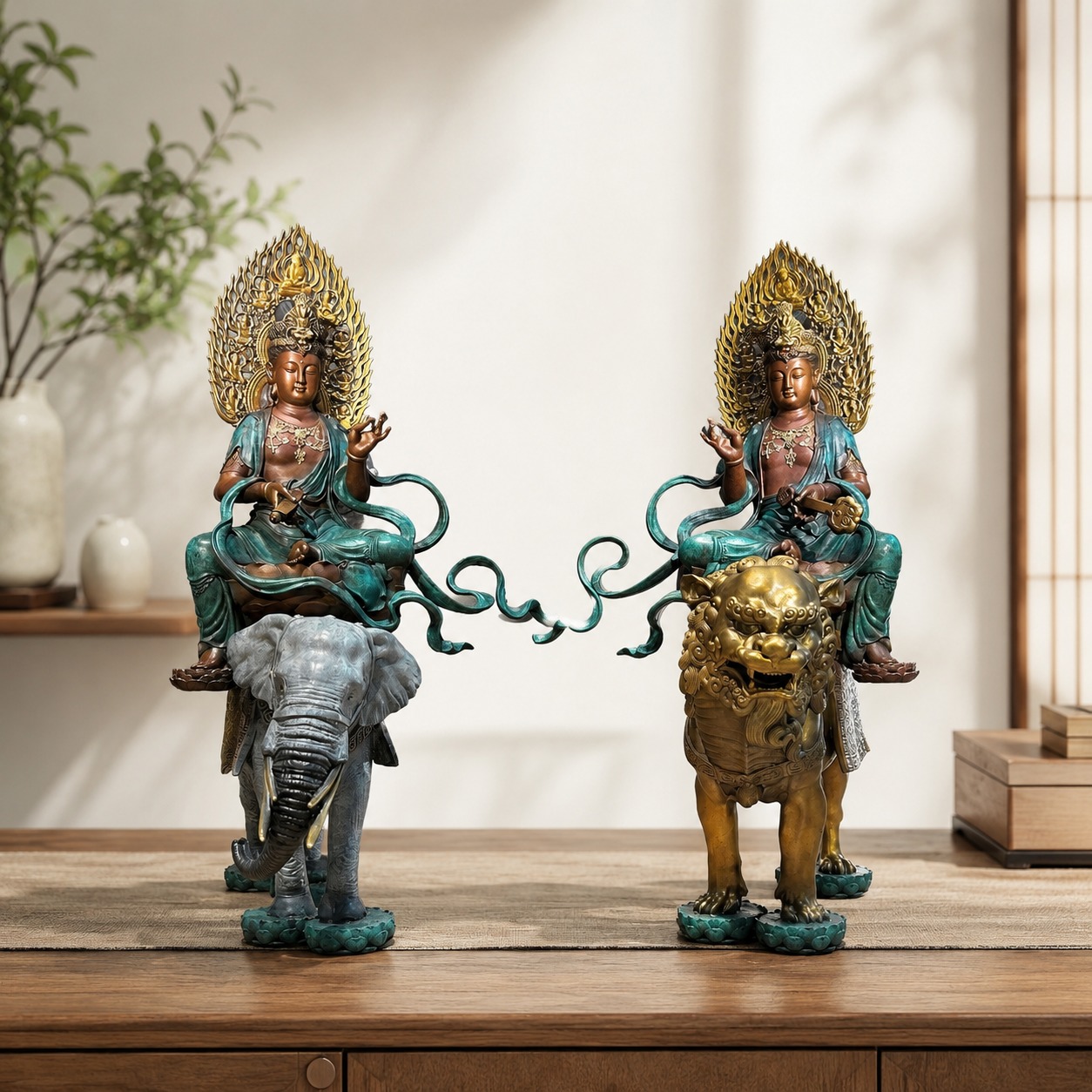
Manjushri and Samantabhadra Bronze Statue
A current bronze object presenting Manjushri with Samantabhadra, documented in the approved Carvzen product record.
Compare the real gallery, listed measurements, visible finish and current policies. Cultural meaning is not a promised result.
View current gallery