Guanyin Meaning: Avalokiteshvara, Symbols and Statue Forms
Guanyin is the Chinese name for Avalokiteshvara, the bodhisattva associated with compassion. This guide explains the names used across Buddhist traditions, why Guanyin appears in different forms, how to read familiar visual attributes, and what a modern statue can—and cannot—establish.
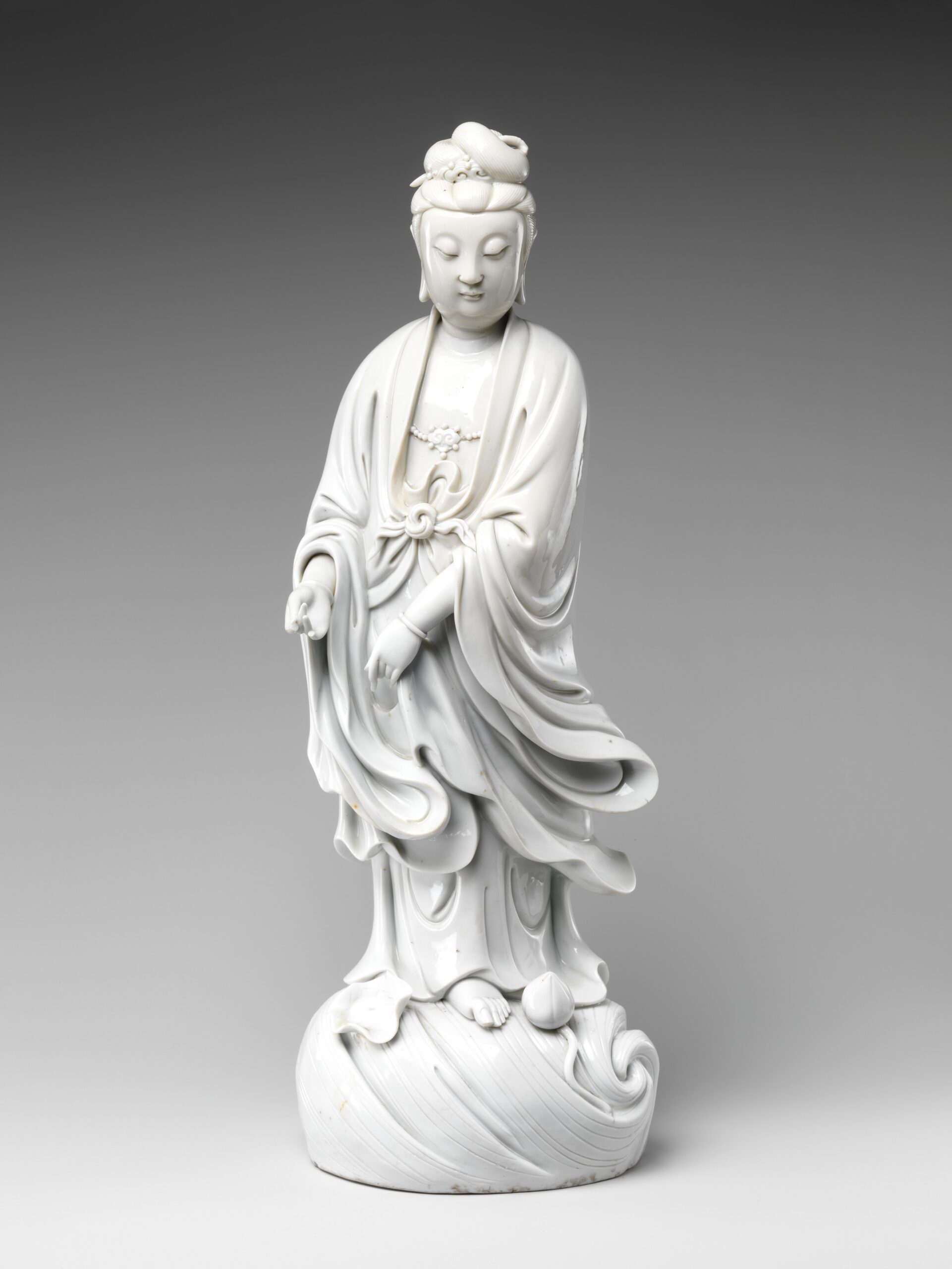
Guanyin is the Chinese name for Avalokiteshvara, a bodhisattva associated with compassion in Mahayana Buddhist traditions. The figure is also known as Guanshiyin in Chinese and Kannon or Kanzeon in Japanese. Historical paintings and sculptures show many forms rather than one fixed appearance.
A Guanyin image may be approached devotionally, culturally or decoratively. Those settings are not interchangeable, and the presence of a statue does not guarantee protection, healing, fertility, luck, prosperity or any other spiritual or material result.
Avalokiteshvara, Guanyin and Kannon
Avalokiteshvara is the Sanskrit name. Guanshiyin and the shortened Guanyin are Chinese names. Kannon and Kanzeon are Japanese names. The British Museum groups these names under one connected Buddhist figure while also documenting regional forms and titles.
The names help readers move between museum collections and cultural traditions. They do not mean that every depiction has the same pose, gender presentation, number of arms, attributes or ritual context. A name also does not prove the date, material, place of manufacture or devotional history of a modern object.
Is Guanyin a Buddha or a bodhisattva?
Museum records identify Guanyin as a bodhisattva, not as a historical Buddha. A bodhisattva is a figure associated with the Buddhist path and assistance to sentient beings. Guanyin is especially linked with compassion and appears in devotional art across a wide geographic and historical range.
English-language labels sometimes call Guanyin a “goddess of mercy.” That phrase reflects the strongly feminine forms familiar in later Chinese art, but it can blur the Buddhist classification and the figure’s longer history as Avalokiteshvara. For an evidence-led description, “the bodhisattva of compassion” is the clearer starting point.
Why does Guanyin appear male, female or androgynous?
Avalokiteshvara first appears in Indian Buddhist art and was historically represented in masculine or androgynous bodhisattva forms. The British Museum notes that Guanyin was often depicted as female in China from the Song dynasty onward, while the Metropolitan Museum records that female manifestations became common in Chinese art.
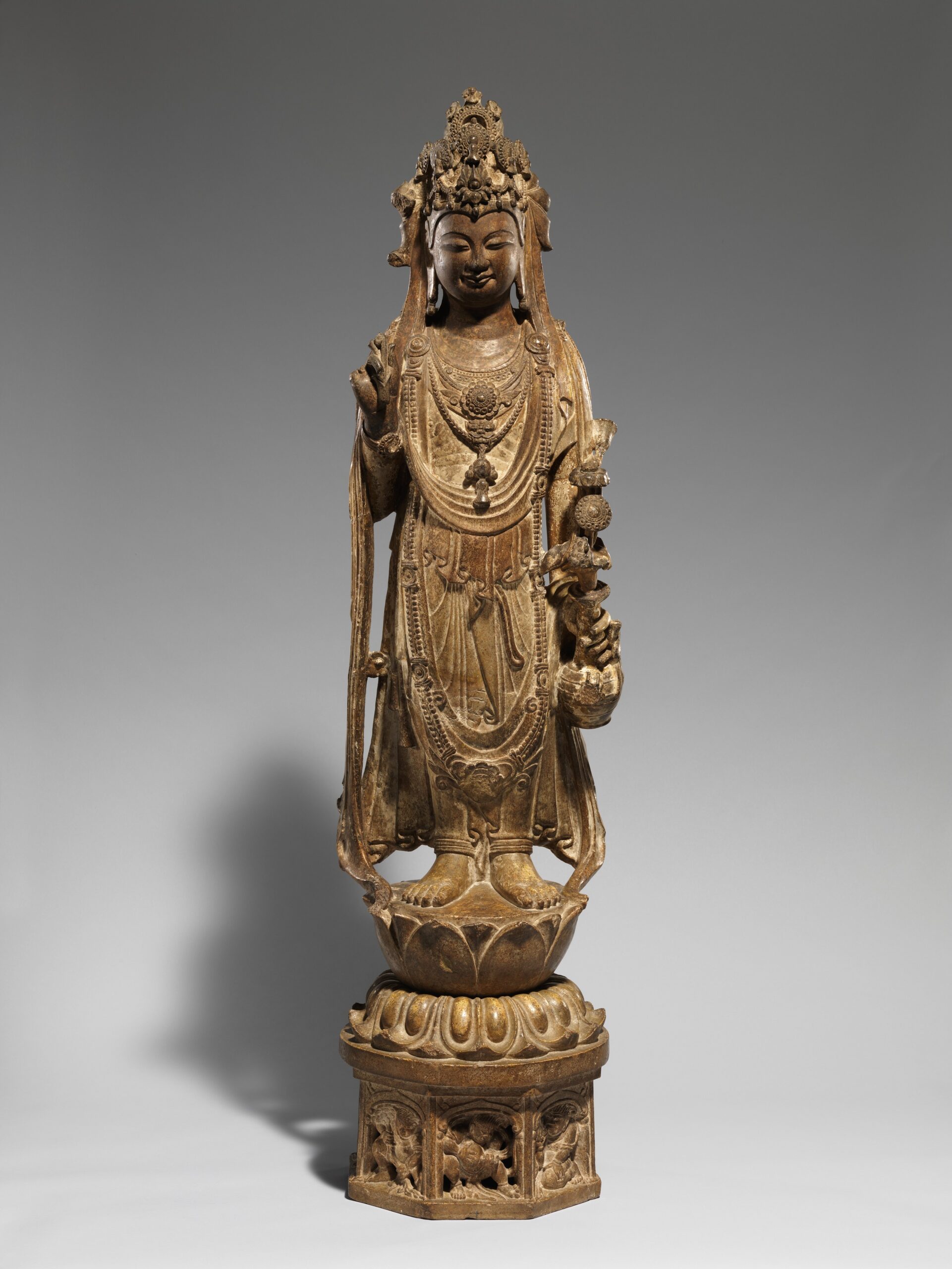
This was a long cultural and visual development, not a single moment when one identity was replaced by another. Earlier Chinese images can retain princely bodhisattva jewelry and a more masculine presentation; later paintings, porcelain figures and wood sculptures may use softer facial modeling, white robes or distinctly feminine forms.
Why are there so many forms of Guanyin?
Buddhist texts and visual traditions present Avalokiteshvara as appearing in different forms in response to different circumstances. Museum collections therefore include standing and seated figures, White-Robed Guanyin, Water-Moon Guanyin, Nanhai Guanyin, multi-armed forms and regionally specific manifestations.
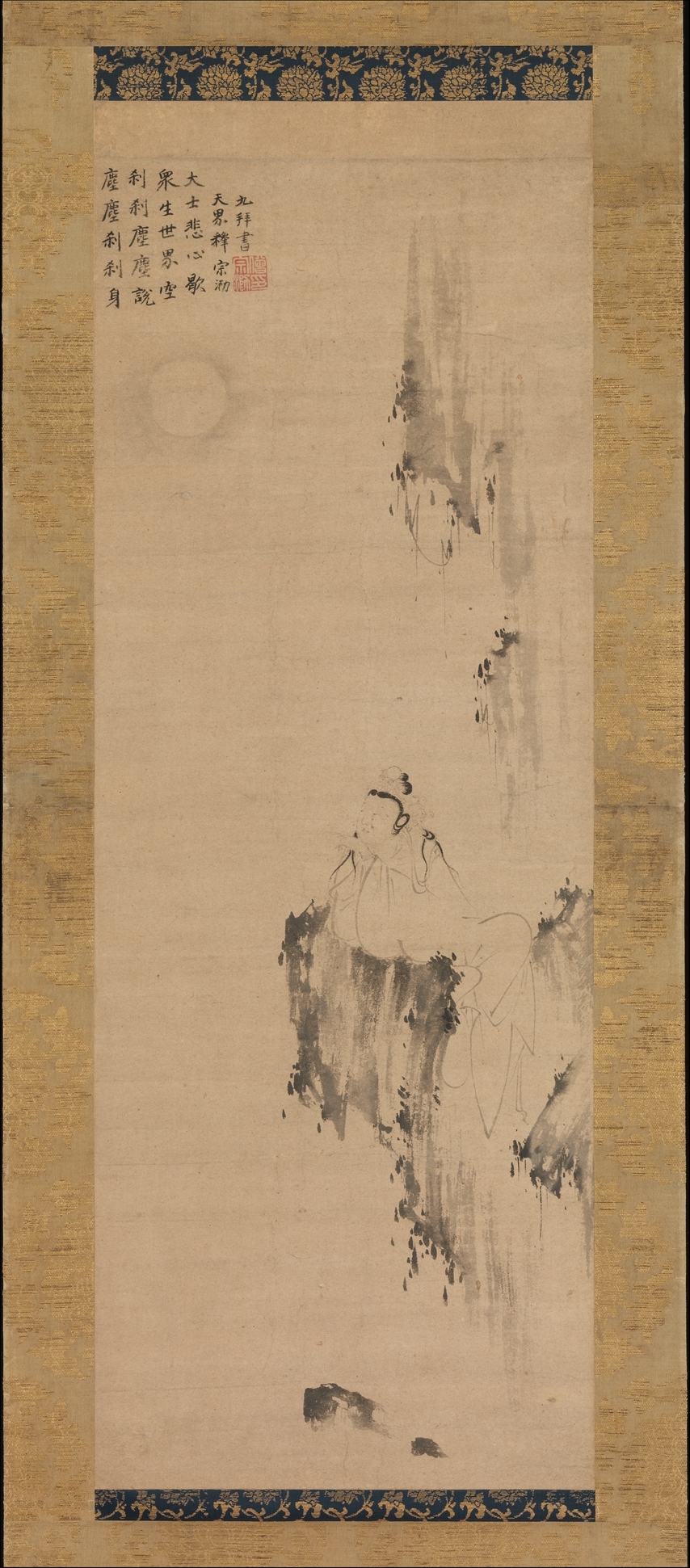
White-Robed Guanyin appears in Chinese painting as a contemplative figure dressed in pale robes. Water-Moon Guanyin is often shown seated in a relaxed posture near water or on a rocky ledge. Thousand-Armed Guanyin multiplies heads, arms or eyes to express an expansive capacity to perceive and respond. These are iconographic forms, not different retail “powers.”
How to recognize Guanyin in a statue
No single checklist identifies every Guanyin image. Recognition comes from a combination of the title, documented context and visible attributes. Depending on the form, useful clues can include:
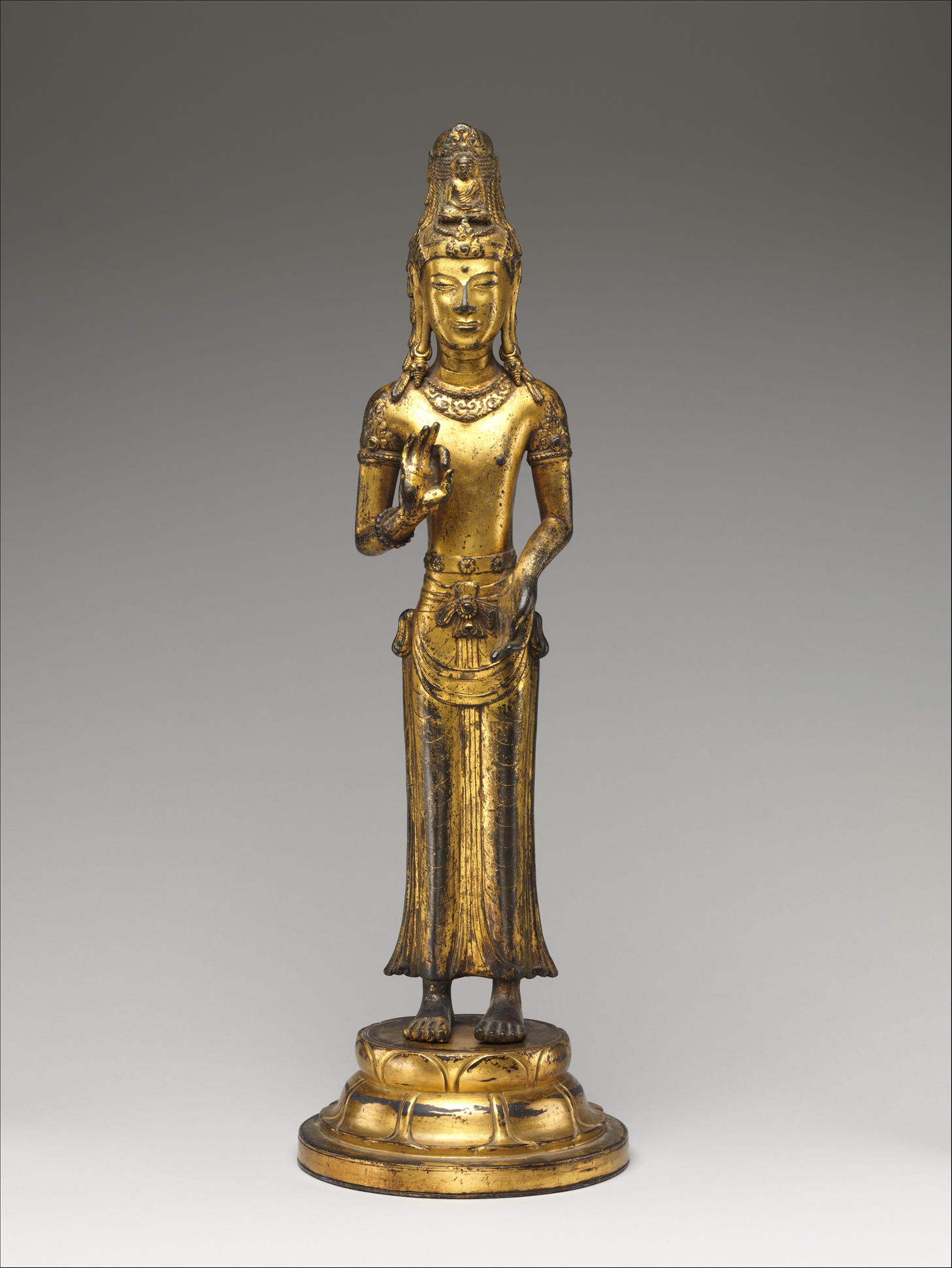
- A small Amitabha image in the crown or headdress. Avalokiteshvara is closely associated with Amitabha, and the small seated figure can be an important identifier.
- A lotus. A flower or lotus stem appears in many bodhisattva images, although it is not exclusive to Guanyin.
- A vase and willow branch. These are familiar in Water-Moon and later Chinese forms, but they do not appear in every depiction.
- A relaxed “royal ease” pose. One knee may be raised while the body rests informally on a rocky or lotus support.
- Multiple arms, heads or eyes. These belong to specific expanded forms and should not be treated as the standard appearance of every Guanyin.
Attributes should be described only when they are visible. A crown without a clearly readable Amitabha figure, for example, should not be promoted as proof of a precise form. Museum objects help explain iconography; they do not authenticate a modern commercial statue.
What does Nanhai Guanyin mean?
Nanhai Guanyin means Guanyin of the Southern Seas. The British Museum connects the form with Avalokiteshvara’s residence at Mount Potalaka, an idea transmitted through Buddhist scripture. In Chinese tradition, this sacred geography became closely associated with Mount Putuo off the coast of Zhejiang.
In art, Nanhai or Water-Moon imagery may include rock, waves, a relaxed seated pose, a vase, willow or the pilgrim Sudhana. Not every modern object uses all of these features. The phrase “Nanhai Guanyin” identifies a subject and iconographic tradition; it does not mean that a current statue was made at Mount Putuo, used in a temple or ritually consecrated.
What a modern Guanyin statue can—and cannot—tell you
Real photographs can establish visible facts: whether the figure stands or sits, what objects are present, how the robes and base are modeled, which parts project from the main form, and how the surface finish appears under the photographed light.
Images alone cannot prove wood species, metal alloy, age, geographic origin, ritual status, consecration, production method or the identity of a maker. A supplier title may identify the intended subject, but cultural research cannot fill gaps in the individual product record.
A Guanyin statue may carry devotional or personal meaning, but the object does not guarantee compassion, protection, healing, fertility, luck, prosperity or spiritual results.
Display and placement without a universal formula
Placement belongs to particular devotional communities, family practices and personal intentions. There is no single compass direction, room or shelf height that can be presented as mandatory for every Guanyin image.
For devotional use, follow the practice of the relevant tradition or community. For cultural or decorative display, begin with practical object care: use a stable surface, allow clearance around projecting details, avoid direct heat and standing moisture, limit prolonged direct sunlight, and place the object where it will not be knocked or handled accidentally.
What to check before buying a Guanyin statue
A careful listing should help you evaluate the actual object rather than rely on one symbolic claim or a single dramatic view.
Look for a precise title and visible features that support it.
Review the front, angle, detail, back and base where available.
Use listed measurements instead of judging scale from a cropped image.
Separate confirmed material facts from visual assumptions and marketing language.
Also read the current Shipping Policy and Returns & Refunds information before checkout. Product pages should remain the source for the item’s current gallery, dimensions, material wording, price, availability and policy links.
Frequently asked questions
Are Guanyin and Avalokiteshvara the same?
Guanyin is the Chinese name and cultural form of the bodhisattva known in Sanskrit as Avalokiteshvara. Related traditions use other names, including Kannon in Japan.
Is Guanyin male or female?
Historical depictions vary. Avalokiteshvara was represented in masculine or androgynous forms, while feminine manifestations became especially common in Chinese art. Do not force every image into one presentation.
Is Guanyin a Buddha?
Museum and Buddhist art records classify Guanyin as a bodhisattva associated with compassion. Popular English descriptions sometimes use “goddess of mercy,” but that is not the most precise Buddhist classification.
What does the small Buddha in Guanyin’s crown mean?
In many Avalokiteshvara images, a small Amitabha figure in the headdress helps identify the bodhisattva’s connection with Amitabha. It is a useful clue, not a feature present in every Guanyin statue.
Does a Guanyin statue need to face a particular direction?
No single direction applies to every tradition or owner. Devotional placement should follow the relevant community’s practice; decorative placement can prioritize stability, respectful handling and suitable environmental conditions.
Sources and further reading
- British Museum: Avalokiteśvara / Guanyin / Kannon
- British Museum: Nanhai Guanyin wood sculpture, 11th–12th century
- The Metropolitan Museum of Art: Bodhisattva Avalokiteshvara (Guanyin), late 6th–early 7th century
- The Metropolitan Museum of Art: Bodhisattva Guanyin, 18th-century Dehua porcelain
- The Metropolitan Museum of Art: White-Robed Guanyin, late 14th century
- The Metropolitan Museum of Art: Bodhisattva Avalokiteshvara (Guanyin), Dali kingdom
- The Metropolitan Museum of Art: Thousand-Armed, Thousand-Eyed Guanyin, 1629
- National Museum of Asian Art: Avalokiteshvara as Water-Moon Guanyin, 1095
Current object
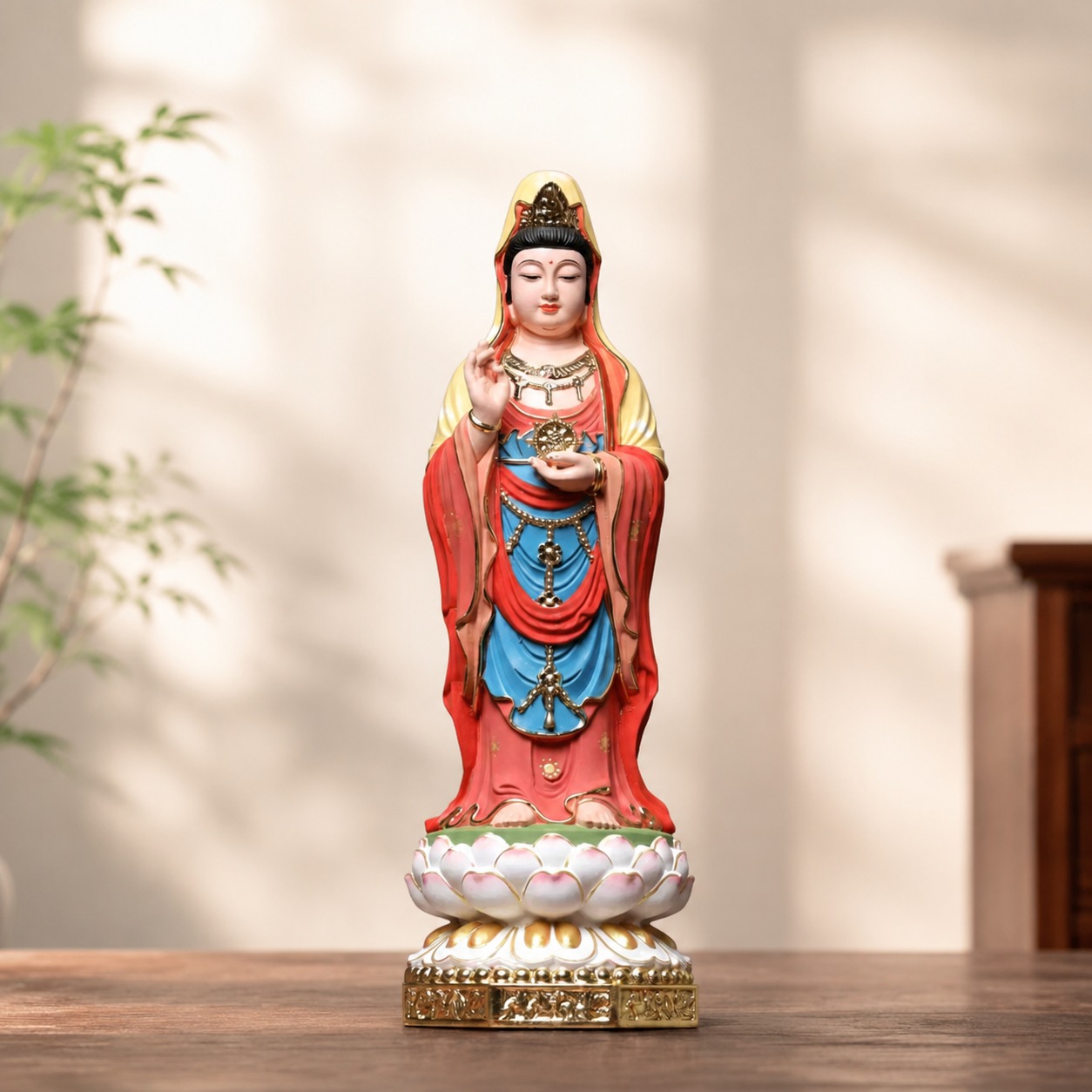
Nanhai Guanyin Wood Statue
A current decorative wood object with an approved eight-image gallery. The supplier-listed approximate height is 11.8 in (30 cm); the exact wood species is not confirmed.
Compare the real gallery, listed measurements, visible finish and current policies. Cultural meaning is not a promised result.
View current gallery