Medicine Buddha Statue Meaning: Bhaisajyaguru, Symbols and Statue Forms
A seated buddha with a small jar in his lap, a raised right hand and, in Himalayan art, a deep blue body. This guide explains who the Medicine Buddha is, what his jar, colour and companions mean, and how Chinese, Japanese, Korean and Tibetan statues tell him apart from other buddhas.
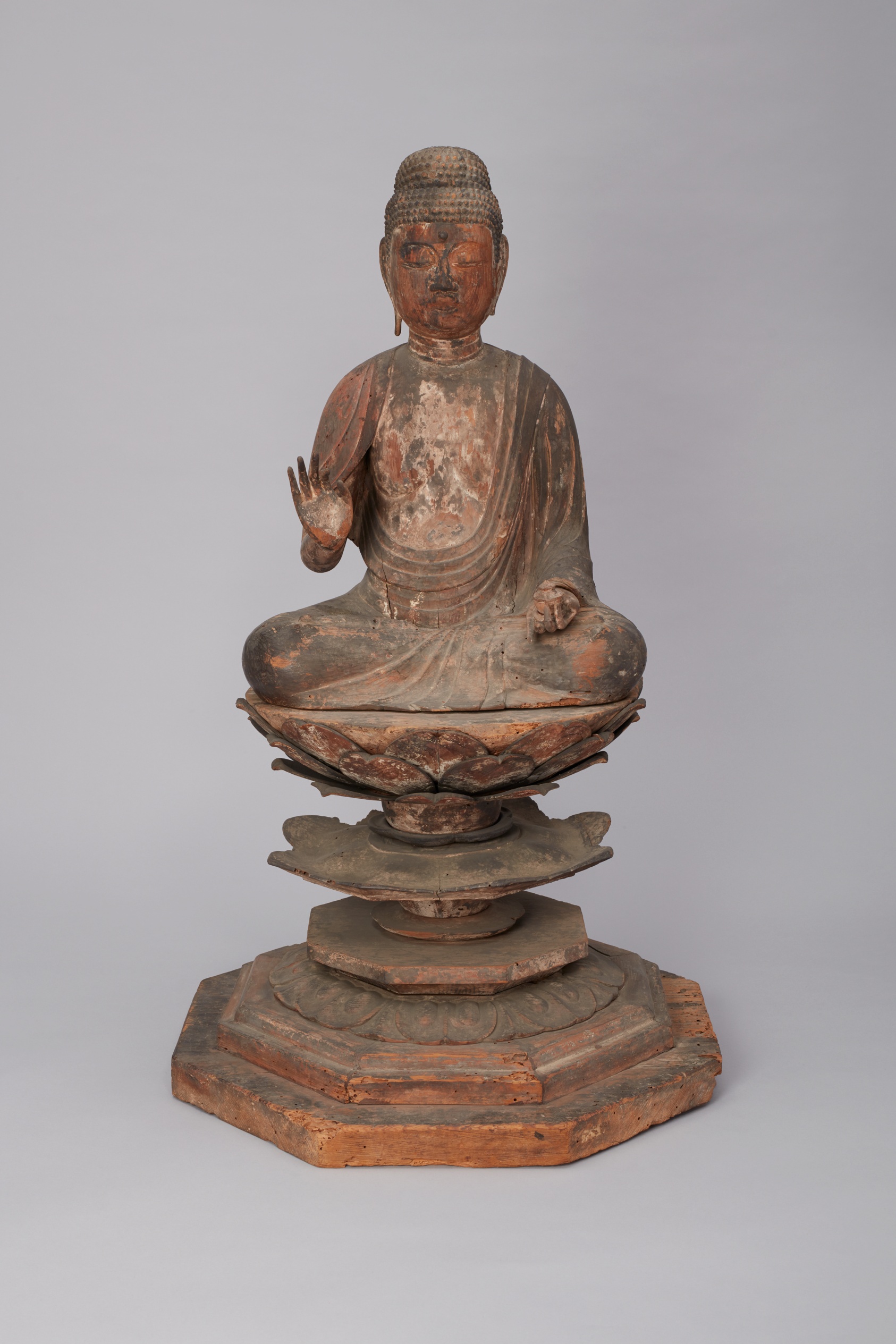
The buddha with a jar
Most buddhas in East Asian art look alike at first glance. They wear plain monastic robes, have tightly curled hair and a rounded bump on the crown of the head, and hold their hands in one of a small number of gestures. Telling them apart depends on small details.
For the Medicine Buddha, the detail is usually in his lap: a small lidded jar, bottle or bowl cupped in the left hand. Add a raised right hand, two crowned attendants and, sometimes, a ring of armoured guardians, and the identification becomes much more secure.
The image changes across Asia. A Chinese temple mural, a Japanese wooden statue, a Korean gilt plaque and a Tibetan scroll painting each show him differently. This guide follows the clues that stay steady and explains the ones that change.
Who is the Medicine Buddha?
The Medicine Buddha is Bhaiṣajyaguru, a Mahayana buddha whose Sanskrit name means “Master of Medicine.” His fuller title is often translated as “Medicine Master of Lapis Lazuli Light,” and texts place him in an Eastern Pure Land rather than in our own world.
In Chinese he is Yaoshi Fo (藥師佛) or Yaoshi Rulai. In Japanese he is Yakushi Nyorai (薬師如来), in Korean Yaksa Yeorae (약사여래), and in Tibetan he is known as Sangye Menla. These are names for the same buddha in different languages, shaped by different local traditions of image-making.
The Art Institute of Chicago describes him as a manifestation of a broader Buddhist metaphor: the Buddha as the master physician who seeks to end suffering by removing its root causes, which Buddhist teaching names as desire, aversion and ignorance. The medical imagery is real, but it sits inside that larger idea.
This guide explains texts, devotional history and image traditions. A Medicine Buddha statue can be meaningful for study, remembrance or personal practice; it does not treat illness, guarantee health or replace medical care, and no statue sold on this site should be read as a promise of any such result.
The sutra and the twelve vows
Most of what is known about the Medicine Buddha comes from a single scripture, usually called the Bhaiṣajyaguru Sutra or Sutra of the Medicine Buddha. It survives in several Chinese translations. The best known are associated with the pilgrim monk Xuanzang in the seventh century, and with the monk Yijing, who travelled to India and, as the Spencer Museum of Art notes, translated the sutra into Chinese; the museum adds that devotion to the Medicine Buddha expanded enormously in China after that time.
The sutra describes twelve great vows the Medicine Buddha made while still a bodhisattva. They promise, among other things, that beings will be freed from illness, poverty and want, will receive what they need to live, and will be turned toward the Buddhist path. The Metropolitan Museum of Art summarises the practical side of these vows as curing illness, ensuring the birth of healthy children and providing clothing and other necessities.
These are religious promises framed inside a scripture, not medical claims. Historically they made the Medicine Buddha a natural focus for prayers at times of illness, epidemic or disaster, by rulers as well as ordinary households.
Jar, hands and lapis blue
Three features do most of the identifying work.
The medicine jar or bowl is the clearest sign. It is usually held in the left hand, resting in the lap. In East Asian sculpture it is often a small lidded jar or round pot; in Himalayan painting it is more often an open bowl. The Cleveland Museum of Art notes that the Medicine Buddha is usually represented holding a bowl of medicine in the palm of one hand.
The hands often pair the jar with a raised right hand, palm outward, in the gesture of reassurance or “fear not.” Both the Chicago Yakushi Nyorai at the top of this page and the Cleveland Kamakura painting below use this combination. In Tibetan images the right hand instead rests on the knee, palm outward, holding a stem of a medicinal plant.
Lapis lazuli blue comes from his title. In Himalayan art his body is painted a deep blue for that reason, as in the thangka shown later in this guide. East Asian statues rarely make the body blue; there the title is carried by the name and the setting rather than the skin colour.
Attributes are fragile. The jar on an old wooden figure may be a later replacement or missing altogether, and a seated buddha with empty hands can be the Medicine Buddha in one temple and Shakyamuni in another. One clue is a starting point, not a verdict.
Sunlight, Moonlight and twelve generals
The Medicine Buddha rarely appears alone in large compositions. Two bodhisattvas usually stand at his sides: Suryaprabha, “Sunlight” (Riguang Pusa in Chinese, Nikkō in Japanese), and Candraprabha, “Moonlight” (Yueguang Pusa, Gakkō). In the Metropolitan Museum’s great mural below, they can be identified by the red sun and white moon beside them.
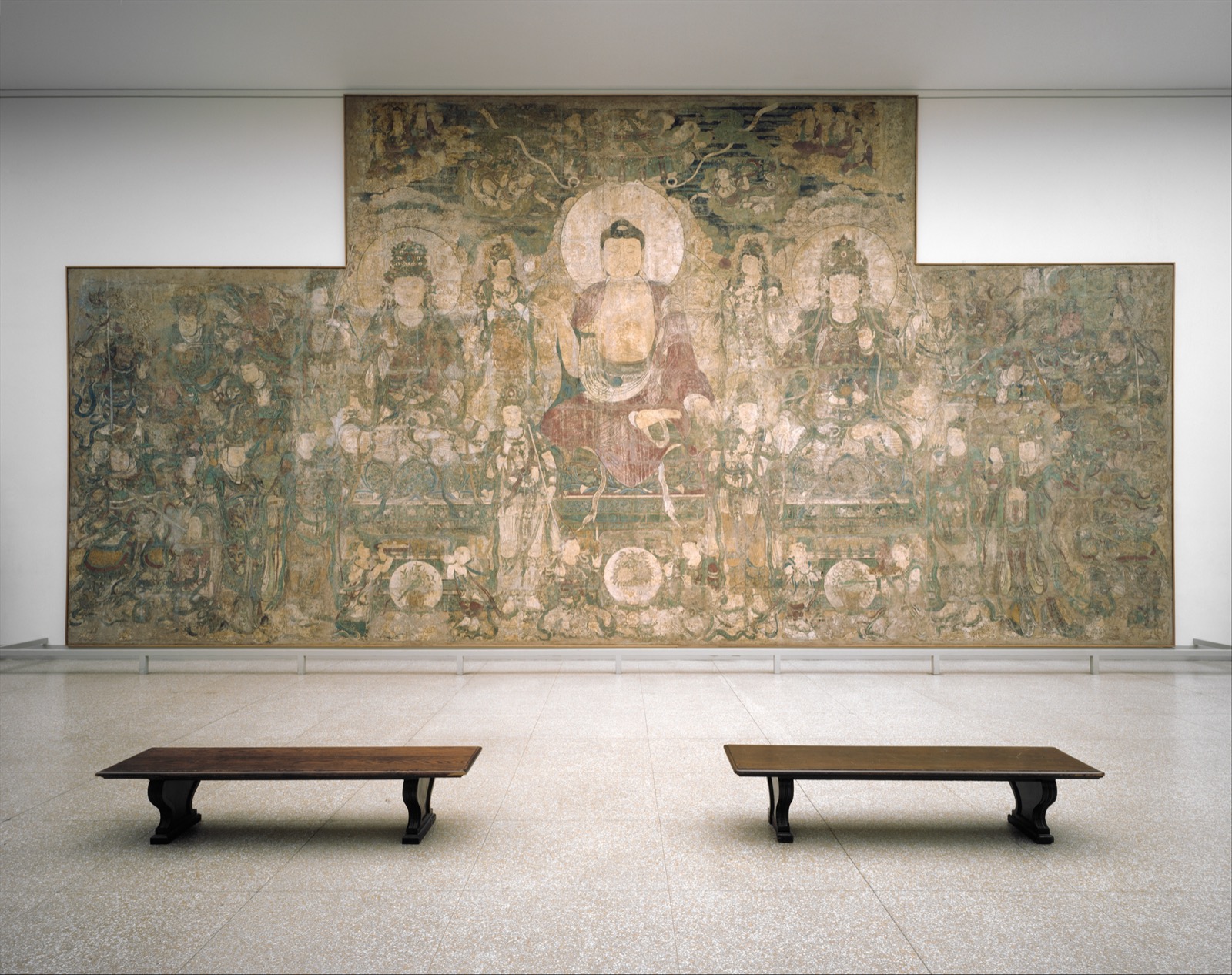
Around them stand the Twelve Divine Generals, armoured guardians who protect those who honour the sutra. The Met reads them as personifications of the Medicine Buddha’s vows. In Japanese images each general often carries one of the twelve zodiac animals in his hair or headdress, as the Cleveland Museum of Art points out in its Kamakura painting, which links the group to the hours, months and years of the calendar.

Yaoshi Fo in China
Chinese devotion to the Medicine Buddha spread with the sutra translations of the seventh century, and his Paradise became a major subject in the cave temples of Dunhuang, where Tang-dynasty murals depict the Eastern Pure Land and scenes from the sutra in great detail.
The Metropolitan Museum’s mural, painted around 1319 for a temple in Shanxi Province, shows how monumental these images could become. The museum notes that it was originally paired with an equally large painting of Tejaprabha, the Buddha of Blazing Light, an unusual pairing that may reflect concerns raised by the earthquake and fire that destroyed the Guangsheng monastery complex in 1303. Two smaller bodhisattvas near the bottom carry a monk’s staff and a medicine bowl, the Medicine Buddha’s traditional attributes.
In many later Chinese temples the Medicine Buddha sits in a row of three buddhas: Shakyamuni at the centre, Amitabha of the Western Pure Land on one side and the Medicine Buddha of the Eastern Pure Land on the other. This arrangement is why a single carved buddha with a jar is sometimes sold as part of a “three buddhas” set. Our Guanyin or Buddha guide explains how to tell crowned bodhisattvas from buddhas in the same halls.
Yakushi in Japan, Yaksa in Korea
The Medicine Buddha became one of the earliest focuses of state Buddhism in Japan. The Cleveland Museum of Art notes that from the 700s people in Japan prayed to Yakushi Nyorai for longevity, and the great temple of Yakushiji in Nara is named after him. Heian-period aristocrats commissioned calm, finely carved wooden figures such as the Chicago statue at the top of this page, which the museum says was traditionally invoked against both physical and spiritual afflictions.
In Korea, the Medicine Buddha appears in sculpture and painting from at least the Unified Silla period. The small gilt plaque below is only about 11 cm tall. It was made by hammering a copper sheet from the back, a technique called repoussé, and shows the buddha seated on a lotus between two standing attendants.
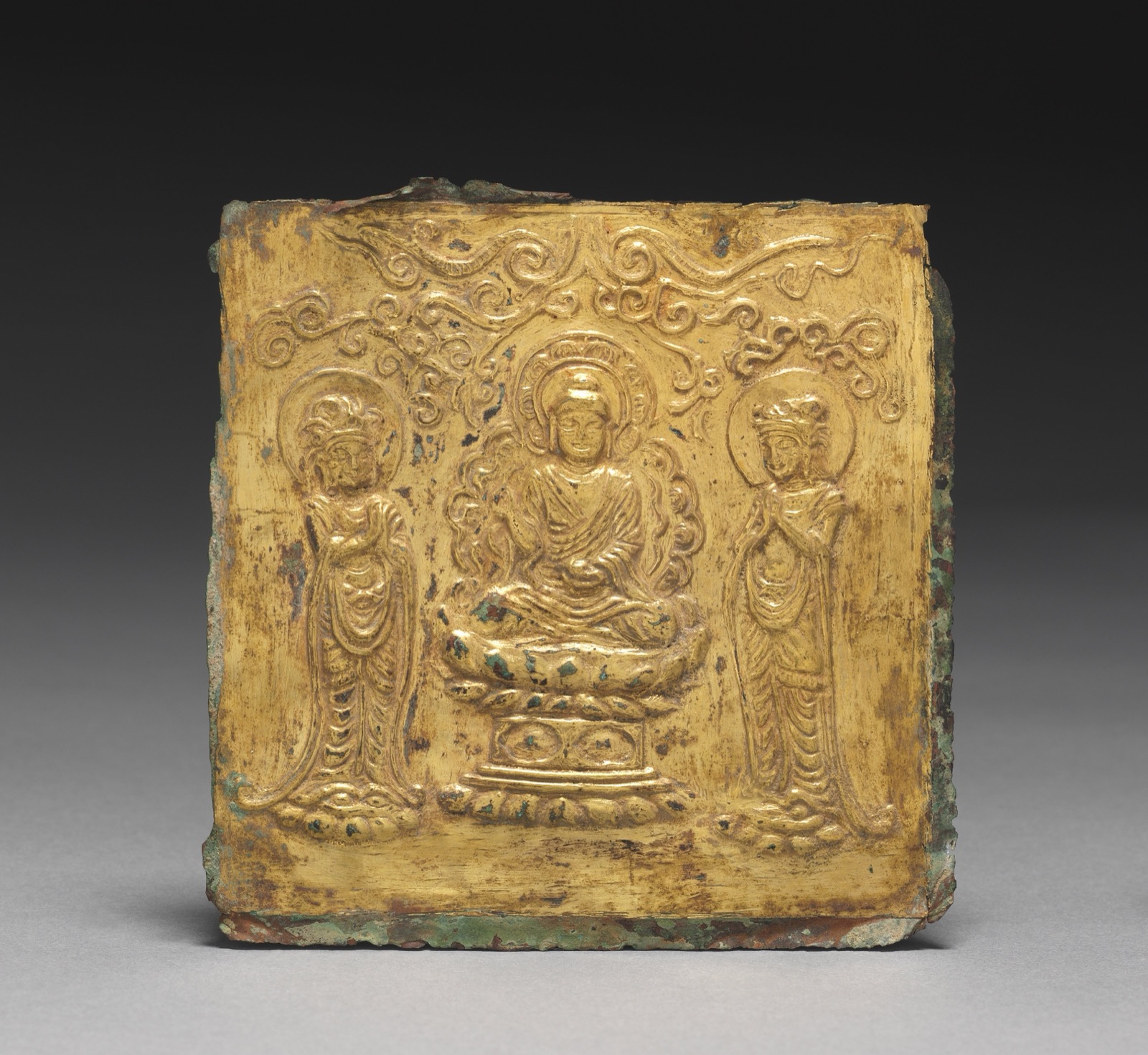
Notice that the triad formula, one buddha between two attendants, is shared with many other subjects. Without an inscription or a clear jar, the museum’s identification rests on context and comparison, which is how most identifications of old figures work.
The blue Medicine Buddha of Tibet
The Art Institute of Chicago notes that the Medicine Buddha as patron of healing gained particular popularity in Tibet. Tibetan paintings make the lapis title visible: the body is deep blue, the left hand holds an alms bowl in the lap and the right hand rests on the knee holding a plant stem.

Tibetan tradition also groups the Medicine Buddha with other healing buddhas. Questions about “the eight Medicine Buddhas” usually refer to this set: seven buddhas described in a longer version of the sutra, often joined by Shakyamuni. Christian Luczanits’s study of early Tibetan images shows that the iconography of the group took time to settle, so not every early painting arranges them the same way.
Medicine Buddha or another buddha?
Three figures are most often confused with the Medicine Buddha. Read the whole figure, not one detail.
Monastic robe and curled hair; a jar, pot or bowl in the left hand; often a raised right hand. Attendants may include Sunlight, Moonlight and twelve generals.
Usually hands in meditation, earth-touching or teaching gestures, without a medicine jar. Often the centre figure in a row of three.
Often in a meditation gesture or welcoming pose, sometimes holding a lotus; attendants are usually Guanyin and Mahasthamaprapta.
Long hair, crown and jewellery rather than a monk’s robe; the vase is a tall water vessel, often with a willow branch. See our Guanyin guide.
A smiling, round-bellied figure with a cloth sack is the Laughing Buddha, not the Medicine Buddha; our Maitreya and Laughing Buddha guide explains that separate tradition.
How to identify a Medicine Buddha statue
Look for a small jar, pot, bottle or bowl resting in the lap. It is the strongest single sign, but it can be lost or replaced on old figures.
A raised right hand in East Asian work, or a hand on the knee holding a plant stem and a blue body in Himalayan work.
Sunlight and Moonlight bodhisattvas, sun and moon discs, or twelve armoured generals point clearly to the Medicine Buddha.
Use listed material, measurements, finish and provenance. Do not infer age, material or ritual status from colour, patina or a room scene.
A seller’s title is a clue, not proof. “Medicine Buddha,” “Bhaisajyaguru,” “Yaoshi Fo,” “Healing Buddha” and “Yakushi” can all describe the same figure, and some listings use the name for any seated buddha.
Living practice, display and buying checks
The Medicine Buddha remains part of living Buddhist practice, and many temples hold Medicine Buddha services and recitations. Anyone looking for ritual guidance, including where a statue should face or which texts to recite, should ask a relevant temple or teacher rather than rely on a retail article.
For decorative display, choose a stable, clean surface at or above eye level, where the figure will not be knocked. Some people echo the temple arrangement by placing the Medicine Buddha on the eastern side of a group, matching his Eastern Pure Land; this is a convention, not a rule. Keep the piece away from standing moisture, strong heat and long direct sun. For wooden figures, our wooden statue care guide covers dry and humid rooms, and our antique wooden Buddha guide explains why “old-looking” finishes do not prove age.
Before buying, compare real front, side, detail and base views where available, check that the jar or bowl is actually present, and confirm the listed measurements rather than estimating scale from a room photo. Review the current Shipping Policy and Returns & Refunds information. These checks tell you what object is offered; they do not tell you what a statue will “do.”
Common questions
What does the Medicine Buddha hold?
Usually a medicine jar, pot or bowl in the left hand, resting in the lap. In East Asian images the right hand is often raised in reassurance; in Tibetan images it rests on the knee and holds a stem of a medicinal plant.
Why is the Medicine Buddha blue?
His title is “Medicine Master of Lapis Lazuli Light.” Himalayan painters express that title by giving him a deep blue body. Chinese, Japanese and Korean statues usually do not; they keep the ordinary colouring of a buddha image.
Is the Medicine Buddha the same as Yakushi Nyorai?
Yes. Yakushi Nyorai is the Japanese name for Bhaiṣajyaguru, just as Yaoshi Fo is the Chinese name and Yaksa Yeorae the Korean. Each tradition developed its own local forms.
Who are the eight Medicine Buddhas?
In Tibetan tradition, a group of seven healing buddhas described in a longer version of the sutra is often joined by Shakyamuni to make eight. The Medicine Buddha himself is the principal figure of the group.
Where should a Medicine Buddha statue be placed?
There is no single rule. Temples often place him on the eastern side of a group of three buddhas, matching his Eastern Pure Land. At home, most people simply choose a clean, stable and respectful place at or above eye level. For religious guidance, ask a temple or teacher.
Can a Medicine Buddha statue heal illness?
No statue can treat illness. The sutra’s promises are religious teachings, and devotion to the Medicine Buddha has always sat alongside, not instead of, medical care. Treat a statue as an object of study, remembrance or practice.
Sources and further reading
- The Art Institute of Chicago: Yakushi Nyorai, Heian period, 10th/11th century, 1921.388
- The Metropolitan Museum of Art: Buddha of Medicine Bhaishajyaguru (Yaoshi fo), Yuan dynasty, ca. 1319
- The Cleveland Museum of Art: Medicine Master Buddha and the Twelve Divine Generals, Kamakura period, 1938.422
- The Cleveland Museum of Art: Plaque with the Image of Medicine Buddha Triad, Unified Silla period, 1987.59
- The Art Institute of Chicago: The Medicine Buddha Bhaishajyaguru With His Mandala Retinue, Tibet, 14th century, 1996.29
- Spencer Museum of Art: 藥師佛 Yaoshi fo (Medicine Buddha)
- Rubin Museum of Art, Project Himalayan Art: Bhaishajyaguru, the Buddha of Healing
- Christian Luczanits, “Establishing an Iconography: The Case of Early Tibetan Representations of the Medicine Buddhas” (2020), SOAS Research Online
- Smithsonian National Museum of Asian Art: Bhaishajyaguru (“Master of Healing”), S2015.25
- Smarthistory: Buddha of Medicine Bhaishajyaguru (Yaoshi fo)
- Wikipedia: Bhaiṣajyaguru (sutra translations, twelve vows, temple arrangements)
Image disclosure: This guide uses five Public Domain or CC0 museum images and two approved Carvzen product images. It contains no AI-generated editorial illustrations.
Current objects
Medicine Buddha statues at Carvzen
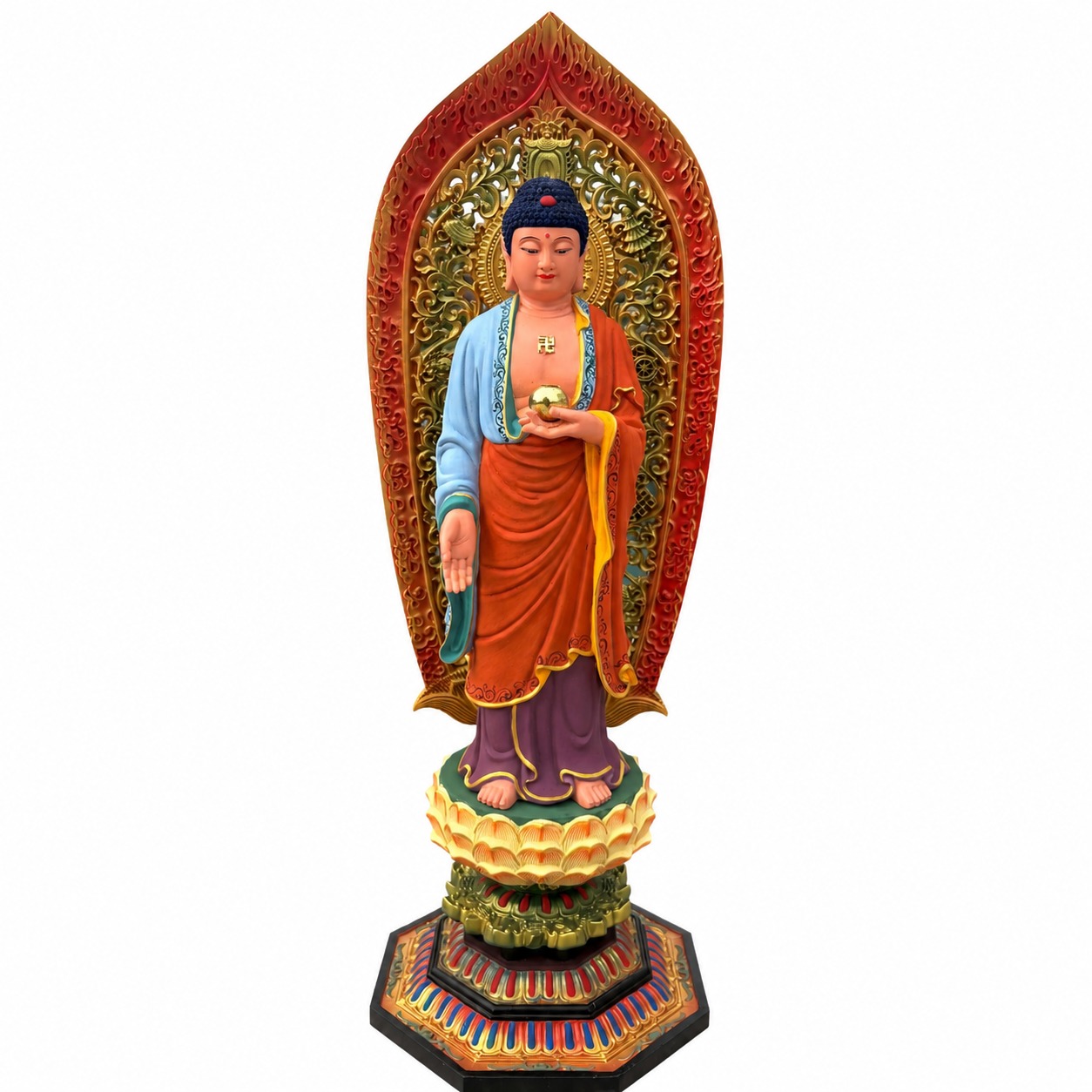
Painted Medicine Buddha Wood Statue
The product record lists painted wood and a height of 23.6 in (60 cm).
View current gallery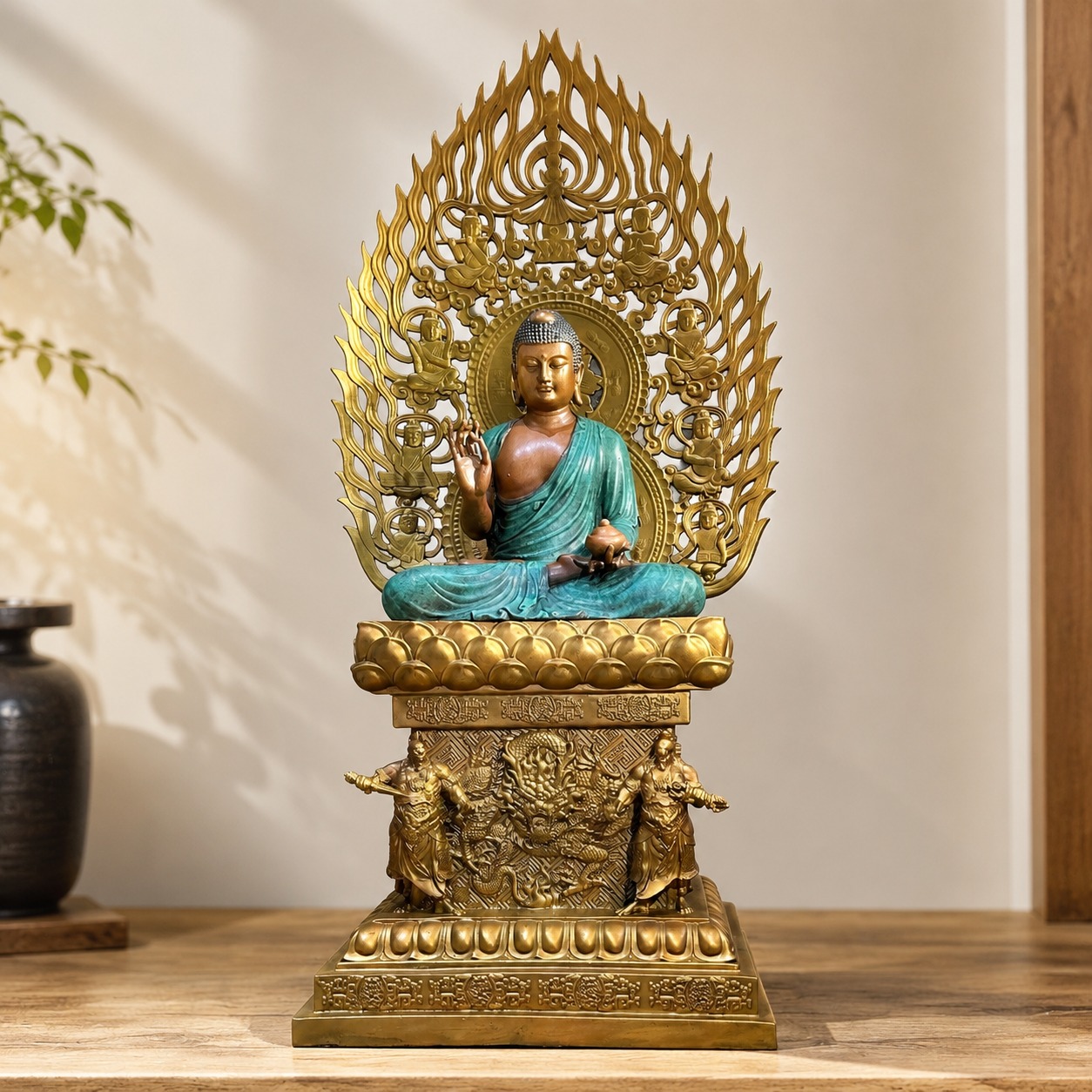
Medicine Buddha Copper Alloy Statue
The product record lists copper alloy and approximate dimensions of 6.0 × 7.7 × 18.7 in (15.2 × 19.6 × 47.5 cm).
View current galleryCompare the real gallery, listed measurements, visible finish and current policies. Cultural meaning is not a promised result.