Ksitigarbha (Jizo) Meaning: Staff, Jewel and Statue Forms
Most bodhisattvas wear crowns and jewels. Ksitigarbha usually appears as a shaven-headed monk with a ringed staff and a round jewel. This guide explains what the name means, where the vow to empty the hells comes from, and how Chinese Dizang, Korean Jijang and Japanese Jizo images differ.
A monk among bodhisattvas
Walk through a gallery of East Asian Buddhist sculpture and most bodhisattvas look princely. They wear tall crowns, necklaces, armlets and flowing scarves, the dress of ancient Indian royalty. Then one figure breaks the pattern: a shaved head, a plain monastic robe, a tall staff in one hand and a small round object in the other.
That figure is very often Ksitigarbha. The contrast is deliberate. Where other bodhisattvas display their spiritual rank through ornament, Ksitigarbha is usually shown as a traveling monk who goes where help is needed.
The image is not the same everywhere. A Tang-dynasty bronze, a Korean silk painting, a Japanese roadside stone and a modern Chinese temple figure can each look different. This guide follows the clues that stay steady and explains the ones that change.
What does Ksitigarbha mean?
Ksitigarbha is a Mahayana bodhisattva whose Sanskrit name is usually translated as “Earth Womb,” “Earth Store” or “Earth Treasury.” He is best known for a vow to help beings in all six realms of rebirth, and especially for the promise not to become a buddha until the hells are empty.
In Chinese he is Dizang (地藏), often called Dizang Pusa or Dizang Wang. In Japanese he is Jizō (地蔵), affectionately O-Jizō-san. In Korean he is Jijang (지장). These are not different figures; they are the same bodhisattva named in different languages and shaped by different local traditions. In East Asian Buddhism he is counted among the four great bodhisattvas, together with Guanyin (Avalokiteshvara), Manjushri and Samantabhadra.
This guide explains texts, legends and image traditions. A statue can be meaningful as an object of study, remembrance or personal practice; it does not guarantee protection, rescue of the dead, health or any other result.
The great vow and the hells
Much of Ksitigarbha’s popular identity comes from the Sutra of the Fundamental Vows of the Bodhisattva Ksitigarbha. Its Chinese version is traditionally attributed to the monk Śikṣānanda around the turn of the eighth century. No Sanskrit manuscript of it is known, and scholars still discuss whether it was translated or composed in China.
The sutra tells of earlier lives in which Ksitigarbha made his vow. In the best-known story he was a Brahmin girl whose mother had disparaged the Buddhist teaching; through devoted offerings and prayer the daughter secured her mother’s release from suffering. Stories like this tied Ksitigarbha closely to filial devotion and to care for the dead.
Ksitigarbha is also given a role in time: to teach and guide beings in the long period between the passing of the historical Buddha and the arrival of the future Buddha Maitreya. In Chinese tradition he became linked with the Ten Kings who judge the dead. Britannica notes that these judges are shown standing in his presence, as a sign of deference.
Historians caution against a simple story in which an obscure Indian bodhisattva slowly “became” a Chinese god of the underworld. Zhiru’s study of medieval Dizang shows a much more varied figure between the sixth and tenth centuries, connected with art, ritual, scripture and narrative at once. The underworld role grew stronger later; it was never the only thing Ksitigarbha meant.
The staff and the jewel
Two attributes do most of the identifying work.
The ringed staff is a monk’s staff, called khakkhara in Sanskrit, xizhang (錫杖) in Chinese and shakujō in Japanese. Metal rings hang from its top. The Metropolitan Museum of Art describes the rings on its Jizō figure as jingling to announce the bodhisattva’s arrival. In Buddhist explanation the sound also warns small creatures so they are not stepped on, and in Ksitigarbha’s case the staff is often read as the tool that opens the gates of hell.
The wish-fulfilling jewel, or cintamani, is usually a round or tear-shaped gem held in the left hand. It is read as the light that dispels darkness and as a sign of the vow to relieve suffering.

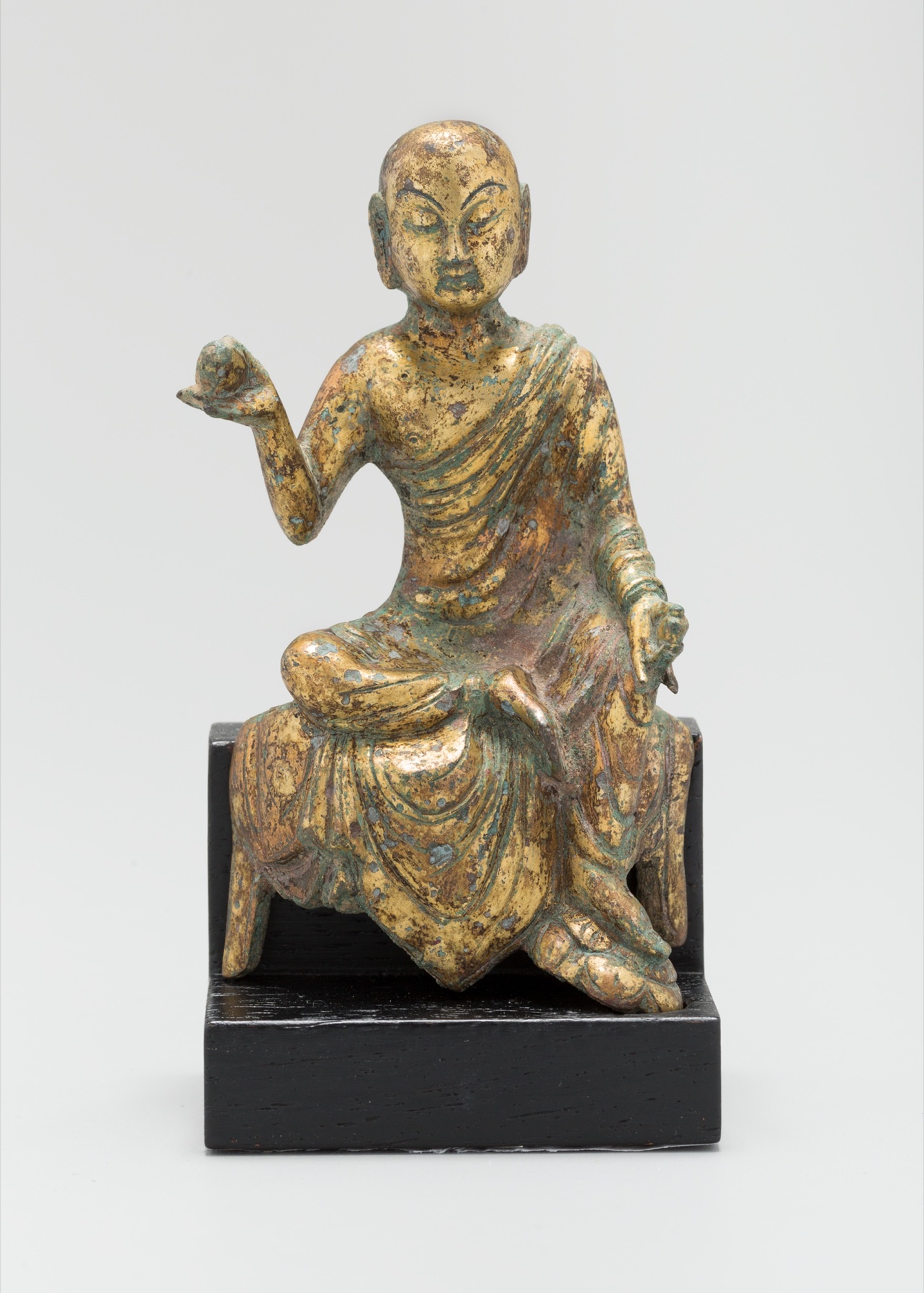
Hands and attributes can vary. Some figures raise the jewel high, as in the Tang bronze at the top of this page. Others hold it at the waist. The staff may be missing on old sculptures because it was carved or cast separately and lost. One attribute alone is a clue, not a verdict.
Dizang in China
The earliest Chinese images do not all look like the familiar monk. Some early cave sculptures present Dizang in the princely dress shared by other bodhisattvas. From the Tang dynasty onward, the monk form became increasingly common, as in the small gilt figure from the Art Institute of Chicago shown above: a shaved head, a robe draped over one shoulder and a jewel raised in the hand.
Dizang was not always shown alone. Chün-fang Yü and Yao Chongxin have studied Sichuan cliff sculptures in which Dizang and Guanyin share a niche or appear as a pair, a grouping that grew from practice and art as much as from scripture.
In later and modern Chinese Buddhism Dizang is often crowned. A common form is the monk wearing a five-panel crown with images of the Five Buddhas, sometimes called the Five Buddha crown. Zhiru describes this crowned monk as the popular image of Dizang as sovereign of the underworld. Some Chinese images add a seated animal, identified in popular tradition as Diting, a creature said to hear and discern the truth.
Because a crowned monk with a staff can resemble the pilgrim monk Tang Sanzang from Journey to the West, the two are sometimes confused. Tang Sanzang is a literary character drawn from a historical traveler; Dizang is a bodhisattva with a jewel and a vow.
Jijang in Korea
Korean painters of the Goryeo dynasty (918–1392) produced some of the most refined images of Ksitigarbha. The Cleveland Museum of Art describes its fourteenth-century hanging scroll as showing him in the guise of a youthful monk, holding a staff to announce his presence and a wish-fulfilling jewel that symbolizes his vow to relieve suffering.

Notice how the Korean painting keeps the monk’s staff and jewel but surrounds the figure with patterned robes and gold detail. The monk form does not have to look austere. In later Joseon temple painting he often sits at the center of large assembly scenes, surrounded by crowded ranks of attendant figures.
Jizo in Japan
In Japan, Jizō became one of the most familiar Buddhist figures in everyday life. The Web Japan feature Japan Up Close describes Jizō as the patron of children and travelers, found in temples, graveyards and along country roads. Many stone figures wear red bibs and caps.
Jizō images also took part in Pure Land devotion. The Met’s painting below shows a raigō, or welcoming descent, in which Jizō comes down on a cloud. The museum notes that Jizō raigō images began in the Kamakura period and are often associated with Kasuga Shrine in Nara.
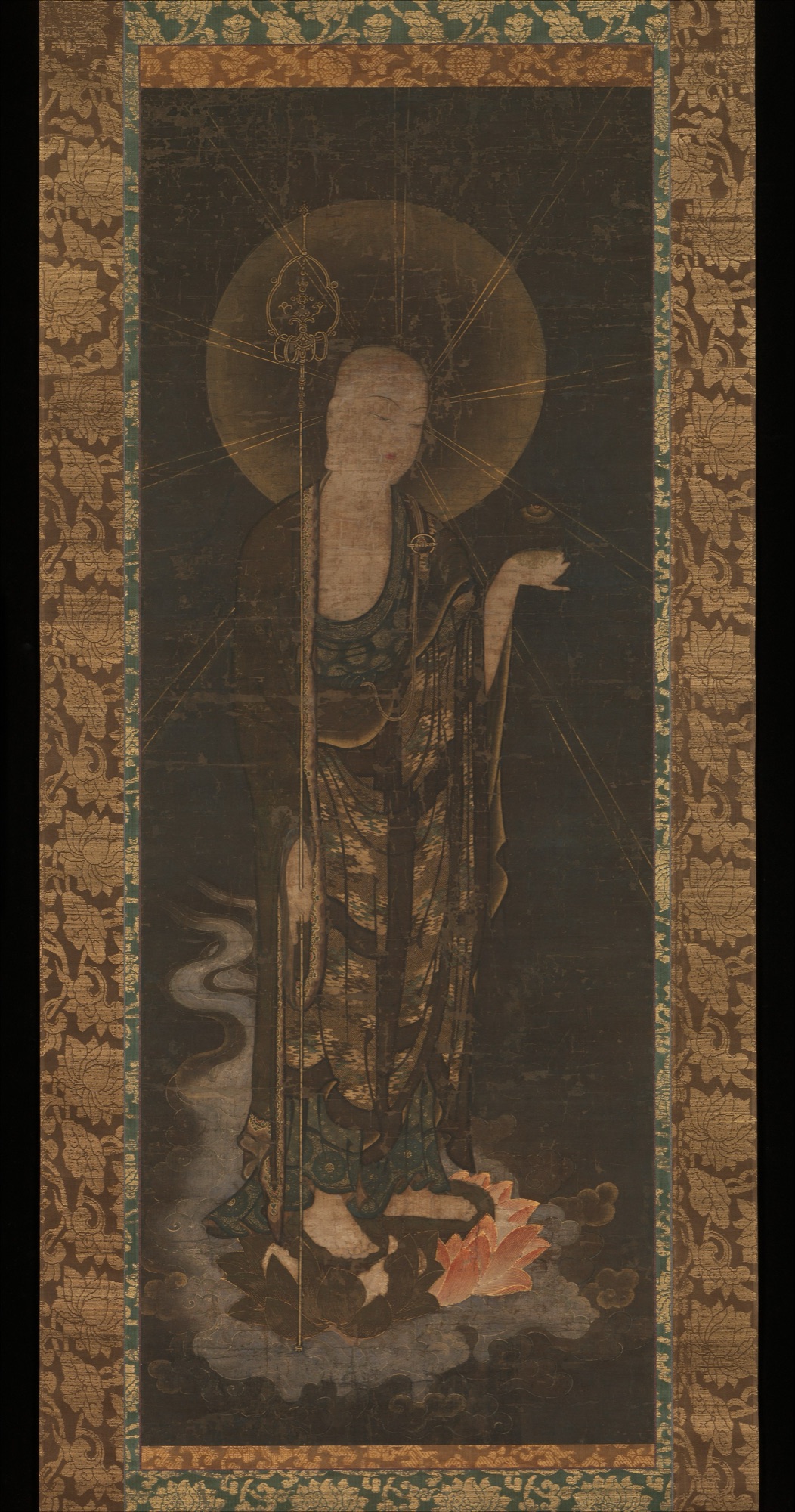
Jizō’s care for children includes children who have died, and Japanese memorial customs connected with miscarriage and infant loss developed around him. These are personal and sensitive practices. They belong to families and temples, not to product descriptions.

Search results for “Jizo statue” often mix this living tradition with video-game collectibles and garden ornaments. A Japanese stone Jizō, a Chinese crowned Dizang and a decorative figurine answer different questions, even when they share a name.
Ksitigarbha, Guanyin or a monk?
Three figures are most often confused with Ksitigarbha. Use the whole figure, not one detail.
Shaved head or monk’s crown, plain robe, ringed staff, round or tear-shaped jewel. Often standing or seated on a lotus or rock.
Usually long hair and a crown, often with a small seated Buddha in front; may hold a vase, willow branch or lotus. See our Guanyin or Buddha guide.
Curled hair and a cranial protuberance rather than a shaved head; hands in a gesture, not holding a staff and jewel.
Monk figures may hold a staff or bowl, but a staff plus jewel, a halo or a Five Buddha crown points toward Ksitigarbha.
In Himalayan art, Ksitigarbha more often appears in the crowned, jewelled dress shared by the Eight Great Bodhisattvas. The monk form described here is mainly an East Asian convention.
How to identify a Ksitigarbha statue
Look for a shaved head, a monk’s hood or a five-panel crown. A tall bodhisattva crown with long hair suggests another figure.
A ringed staff and a round jewel together are the strongest sign. Either may be missing on old or simplified figures.
Judges in official robes, attendant figures or a seated animal can point to the Chinese underworld setting.
Use listed material, measurements, finish and provenance. Do not infer age, material or ritual status from color, patina or a room scene.
A seller’s title is a starting clue. “Dizang,” “Jizo,” “Earth Store Bodhisattva” and “Ksitigarbha King” can all describe the same figure, while “Jizo statue” may also name a modern garden piece.
Living practice, display and buying checks
Ksitigarbha remains part of living Buddhist practice, especially in memorial halls, funerals and remembrance of the dead. Anyone seeking ritual guidance should follow a relevant temple or teacher rather than a retail article.
For decorative display, use a stable surface and leave clearance around the staff, which is often a separate, slender part. Keep the piece away from standing moisture, strong heat and long direct sun. For wooden figures, our wooden statue care guide covers dry and humid rooms.
Before buying, compare real front, side, detail and base views where available, and confirm the listed measurements rather than estimating scale from a room photo. Review the current Shipping Policy and Returns & Refunds information. These checks tell you what object is offered; they do not tell you what a statue will “do.”
Common questions
Is Jizo the same as Ksitigarbha?
Yes. Jizō is the Japanese name for Ksitigarbha, just as Dizang is the Chinese name and Jijang the Korean. Japanese Jizō traditions, such as roadside figures and red bibs, developed their own local forms.
Why is Ksitigarbha a monk when other bodhisattvas wear crowns?
The monk form presents him as a traveling teacher who goes among suffering beings. It became the common East Asian convention from around the Tang dynasty, though early and Himalayan images can show the princely bodhisattva dress.
What does Ksitigarbha hold?
Usually a ringed staff in the right hand and a wish-fulfilling jewel in the left. Some figures reverse or change the positions, or have lost the separately made staff.
Is Ksitigarbha a god of the underworld?
Not in the strict sense. He is a bodhisattva who vows to help beings in the hells. In Chinese popular religion he became closely linked with the Ten Kings who judge the dead, which is why later images can make him look like a sovereign.
Is it appropriate to keep a Ksitigarbha statue at home?
Many households keep Buddhist images for remembrance, study or practice. Customs differ by tradition, so people who want religious guidance should ask a temple or teacher. As a decorative object, treat it with care and place it where it will not be knocked or damaged.
Sources and further reading
- The Art Institute of Chicago: Dizang (Kshitigarbha) Seated and Holding a Wish-Bearing Jewel (Chintamani), Tang dynasty, 1926.270
- The Metropolitan Museum of Art: Jizō, the Bodhisattva of the Earth Store, Kamakura period, 18.93
- The Metropolitan Museum of Art: Welcoming Descent of the Bodhisattva Jizō, early 14th century, 25.215.102
- The Metropolitan Museum of Art: Utagawa Kuniyoshi, Wayfarers Looking at the Statue of Jizo Bosatsu in a Pine Grove at Hashiba, JP750
- The Cleveland Museum of Art: Standing Ksitigarbha, Goryeo dynasty, 2025.141
- The Art Institute of Chicago: Ksitigarbha Bodhisattva with Assembly, Joseon dynasty, 18th century, 1921.1
- Zhiru, The Making of a Savior Bodhisattva: Dizang in Medieval China, University of Hawai‘i Press
- Chün-fang Yü and Yao Chongxin, “Guanyin and Dizang: The Creation of a Chinese Buddhist Pantheon,” Asiatische Studien 70, no. 3 (2016)
- Encyclopaedia Britannica: Dizang
- Rubin Museum of Art, Project Himalayan Art: Bodhisattva Kshitigarbha
- Japan Up Close: The Meaning Behind Jizo Statues
- Wikipedia: Kṣitigarbha (sutra transmission, Five Buddha crown and Diting traditions)
Image disclosure: This guide uses five Public Domain or CC0 museum images and one approved Carvzen product image. It contains no AI-generated editorial illustrations.
Current object
Ksitigarbha Wood Statue
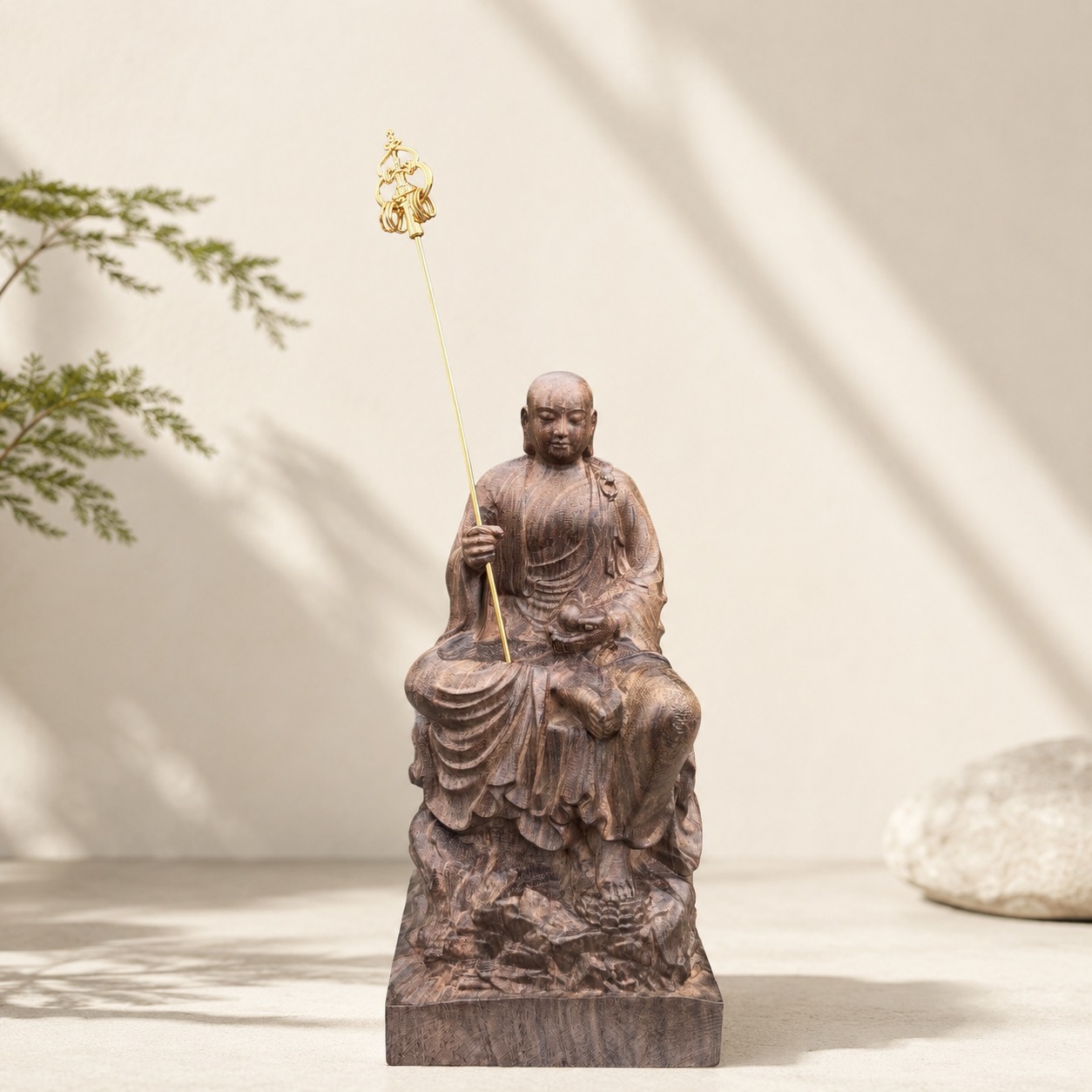
A current Carvzen object. The approved gallery shows a seated monk-form figure holding a staff and a round jewel; the product record lists the material as wood and a height of 7.5 in (19 cm).
Compare the real gallery, listed measurements, visible finish and current policies. Cultural meaning is not a promised result.
View current gallery