Значение Будды Амитабхи: Чистая земля, мудры и формы статуй
Будда, сидящий в медитации или стоящий с опущенной рукой, словно протягивающий её навстречу. В этом руководстве объясняется, кто такой Амитабха, что означают Чистая Земля и фраза “Намо Амитофо”, а также как китайские, японские, корейские и тибетские изображения показывают его и его спутников.
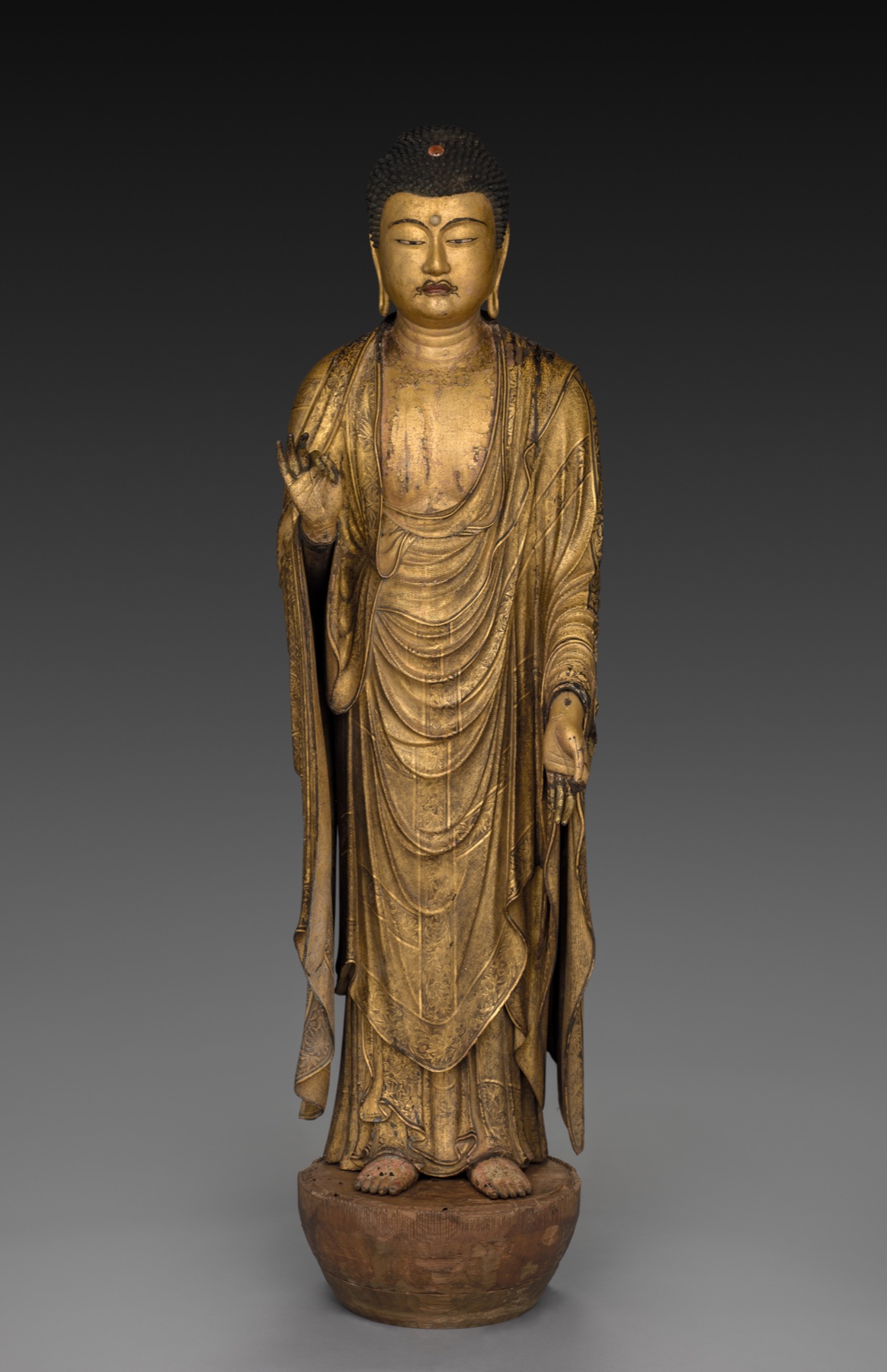
Будда, который выходит навстречу
Большинство будд в восточноазиатском искусстве на первый взгляд похожи: простые монашеские одежды, мелко завитые волосы, округлый выступ на макушке и небольшой набор жестов рук. Различить их помогают мелкие детали и окружение.
Амитабха — будда, которого чаще всего изображают движущимся навстречу созерцающего. На картинах он спускается по облакам; в стоящих статуях он опускает одну руку, словно протягивая её. В сидячей позе он обычно держит обе руки на коленях в медитации. Эти образы выросли из одной из самых распространённых форм буддийской набожности в Восточной Азии: надежды на перерождение в его Чистой земле.
Этот путеводитель прослеживает эту традицию через музейные предметы из Китая, Японии, Кореи и Тибета и объясняет, какие признаки позволяют опознать Амитабху, а какие могут ввести в заблуждение.
Кто такой Амитабха?
Амитабха — будда Махаяны, чьё санскритское имя означает “Бесконечный свет”. Священные тексты Чистой земли описывают его правящим в Сукхавати, “Земле блаженства”, или Западной Чистой земле, где условия считаются идеальными для достижения пробуждения.
По-китайски он Амито Фо (阿彌陀佛). По-японски он Амида Нёрай или Амида Буцу, по-корейски Амита Буль, а по-тибетски Опме. Он тесно связан со вторым именем — Амитаюс, “Бесконечная жизнь”; в Китае и Японии эти два имени часто объединяют, как показывает название статуи выше в Музее искусств Кливленда, Будда бесконечной жизни и света, показывает. Тибетское искусство обычно разделяет их (см. ниже).
Музей Метрополитен отмечает, что поклонение Амитабхе было важной частью китайской буддийской практики с VI века, с целью перерождения в Чистой земле, где условия благоприятствуют духовному пониманию. Он не исторический будда Шакьямуни, а один из многих будд, которых тексты Махаяны помещают в другие миры.
Этот путеводитель объясняет священные тексты, историю набожности и традиции образов. Статуя Амитабхи может быть значимой для изучения, памяти или личной практики; она не гарантирует перерождения, защиты, удачи или любого другого результата, и ни одна статуя, продаваемая на этом сайте, не должна восприниматься как такое обещание.
Дхармакара и сорок восемь обетов
История Амитабхи рассказана главным образом в трёх текстах, часто объединяемых как Три сутры Чистой земли: более длинная Сутра Сукхавати-вьюха (Сутра неизмеримой жизни), более короткая Сутра Амитабхи, и Сутра созерцания, которая учит визуализации Чистой земли.
Более длинная сутра рассказывает о монахе по имени Дхармакара, который давным-давно дал ряд обетов, описывающих землю будды, которую он создаст, и существ, которым он поможет. Когда он стал буддой Амитабхой, обеты были исполнены и Сукхавати возникла. Самая известная версия перечисляет сорок восемь обетов. Филологические исследования самых ранних китайских переводов показывают, что более старые версии содержали двадцать четыре обета, поэтому привычное число само по себе развивалось со временем.
Два обета наиболее важны для образов. Поздние учителя Чистой земли придавали особое значение восемнадцатому, который связывает перерождение с искренней верой и призыванием имени Амитабхи. И, как объясняет Музей Азии, картины его сошествия иллюстрируют девятнадцатый обет, в котором он обещает явиться в момент смерти тем, кто желает переродиться в его земле.
Это религиозные учения, изложенные в священных текстах. Разные школы толкуют их по-разному, и этот путеводитель не занимает по ним позиции.
Что означает “Намо Амитофо”
“Намо Амитофо” (南無阿彌陀佛) — китайская форма короткой фразы, означающей “Поклон Амитабхе Будде” или “Я принимаю прибежище в Амитабхе Будде”. По-японски это “Наму Амида Буцу”. Её чтение называется няньфо китайском как нэмбуцу по-японски. Это наиболее распространённая практика, связанная с Амитабхой.
Картина южнносунской эпохи ниже делает эту практику видимой. Кливлендский музей искусства отмечает, что фраза написана десять раз в каллиграфии над фигурами, причём каждая строка поднимается из лотоса, чтобы подчеркнуть непрерывное повторение.

В буддийских общинах китайскоязычных стран эта фраза также используется как повседневное приветствие, благодарность или прощание среди практикующих. Это повседневное употребление — живая традиция; ей не нужна статуя, и статуе она не нужна.
Руки медитации и приветствия
У Амитабхи нет постоянного предмета, подобного сосуду Медицинского Будды, поэтому его руки выполняют основную работу по опознаванию.
Медитация. Сидящие фигуры Амитабхи часто обе руки кладут на колени, ладонями вверх, иногда большие и указательные пальцы образуют два кольца. Метрinterprets позу рук статуи Тан эпохи ниже, руки которой теперь утрачены, как свидетельство того, что она когда-то держала этот медитативный жест, поэтому она описана как “вероятно, Амитабха”.”
Приветствие. Стоящие фигуры часто опускают левую руку и поднимают правую, ладонью наружу. Метр описывает правую руку своей картины южнносунской эпохи как жест приветствия, а Кливлендский музей искусства описывает свою камакурскую статую вверху этой страницы как стоящую в позе приветствия умирающим. Многие более поздние китайские стоящие фигуры, часто называемые цзеинь (接引, “принимающие и направляющие”) изображениями, держат в одной руке маленький лотос или лотосовое основание у груди, а другая свисает вниз, раскрытая к зрителю.
Варианты учения. В искусстве Чистой Земли Восточной Азии также развились жесты рук, связанные с “девятью степенями” перерождения, описанными в Сутра созерцания. В эссе Кливлендского музея искусства Гихуль Чон объясняет, что показанный далее в этом руководстве корейский триад исполняет один из таких жестов: правая рука поднята к груди, левая опущена, а каждый большой палец касается среднего.
Жесты перекликаются между буддами, а руки на старых статуях часто повреждены или заменены. Медитативный жест сам по себе мог бы принадлежать и Шакьямуни. Читайте руки вместе с окружающими фигурами и обстановкой.
Гуаньинь, Махастхамапрапта и другие
Amitabha usually appears between two bodhisattvas: Avalokiteshvara, known in China as Guanyin, and Mahasthamaprapta (Dashizhi in Chinese, Seishi in Japanese). Together they form the Western Paradise triad. Guanyin often wears a small seated buddha in the crown, representing Amitabha; our Гуаньинь гид explains that detail and Guanyin’s many other forms.
This is the clearest difference from the Medicine Buddha, whose attendants are the Sunlight and Moonlight bodhisattvas. In many later Chinese temples Amitabha also sits beside Shakyamuni and the Medicine Buddha in a row of three buddhas; our Medicine Buddha guide compares those three figures side by side, so the comparison is not repeated here.
Not every triad follows the standard pair. Korean artists sometimes replaced Mahasthamaprapta with Ksitigarbha, as the Korean section below shows.
Амито Фо в Китае
The Tang-dynasty figure below, made in the early seventh century, is one of the most impressive early Chinese images thought to show Amitabha. It was made with the dry-lacquer technique: according to the Met, a core was covered with clay and wrapped in layers of lacquer-soaked cloth, with further layers of lacquer added on top. The museum notes that this technique spread from China to Japan in the eighth century.

From the twelfth century onward, paintings of Amitabha descending to welcome the dying became common. The Met notes that images of Amitabha, alone or with bodhisattvas, were among the most widely produced in China from the twelfth to the fourteenth century. In its painting below, he stands on two lotuses with the right hand raised in welcome.

Амида в Японии
Pure Land devotion grew strongly in Japan from the late tenth century. The Met notes that the monk Genshin (942–1017) wrote The Essentials of Rebirth in the Pure Land (Ōjōyōshū), which described the hells and explained practices, including нэмбуцу, aimed at rebirth in paradise. The Tokyo National Museum describes Hōnen (1133–1212) as the founder of Jōdo Shū, Japan’s first Pure Land school, who taught repeated recitation of “Namu Amida Butsu.”
Paintings of Amida’s welcoming descent, called райго, became one of the great subjects of Japanese Buddhist art. The Cleveland Museum of Art notes that such images could be placed before a dying person to help them remain faithful.
The standing Amida at the top of this page belongs to the same world. The museum records that documents placed inside its hollow body include a copy of the Amida Sutra, a list of donors who joined in dedicating the statue, and a record that it was completed in 33 days in 1269 at Shitennōji temple in Osaka. The lead sculptor was Kōshun.
Амита в Корее
Amitabha was also central in Korea from the Unified Silla period onward. The small Joseon-dynasty bronze below shows how a triad could vary. Ghichul Jung’s Cleveland Museum of Art essay notes that Amitabha sits slightly larger at the centre. The crowned figure is Avalokiteshvara, and the figure with a shaven head, like a monk, holding a jewel, is Ksitigarbha, who here replaces Mahasthamaprapta. The essay says this pairing was in vogue in Korea in the 1300s and 1400s.

Readers who know Ksitigarbha from our Ksitigarbha (Jizo) guide will recognise the shaven head and jewel. Seeing him beside Amitabha is a useful reminder that companions identify a scene only when read together.
Амитабха и Амитаюс в Тибете
Tibetan painting shows Sukhavati as a crowded, jewelled landscape. In the Met’s painting below, made in Central Tibet around 1700, the buddha sits in meditation at the heart of his Pure Land, surrounded by palaces, trees, pools and assemblies of figures.

Himalayan art usually separates Amitabha from Amitayus, the “Buddha of Infinite Life.” Himalayan Art Resources describes Amitayus as normally red, wearing a crown and jewels, with a long-life vase held above his hands in meditation. Museums such as the Met and LACMA describe the vase as holding the elixir of immortality and link Amitayus with prayers for long life. Amitabha, by contrast, is usually shown in a buddha’s plain monastic robes without a crown.
Himalayan Art Resources also notes a great deal of overlap between the two in Tibetan tradition, while in early sutra literature they were not the same figure. A crowned buddha holding a vase in the lap is therefore usually Amitayus, not the Medicine Buddha and not a plain Amitabha.
How to identify an Amitabha statue
Both hands resting in the lap in meditation, or a standing figure with one hand raised, sometimes holding a small lotus, and one lowered in welcome. No medicine jar in the lap.
Guanyin, often with a small buddha in the crown, and Mahasthamaprapta at the sides point clearly to Amitabha. Korean triads may show Ksitigarbha instead.
A plain robe and no crown suggest Amitabha; a crown, jewellery and a vase in the lap usually indicate Amitayus in Himalayan art.
Use listed material, measurements, finish and provenance. Do not infer age, material or ritual status from colour, patina or a room scene.
A seller’s title is a clue, not proof. “Amitabha,” “Amituofo,” “Amida,” “Buddha of Infinite Light” and sometimes “Amitayus” can describe the same or closely related figures, and some listings use the name for any seated buddha. A smiling, round-bellied figure with a sack is the Laughing Buddha; our Майтрея и Смеющийся Будда гид explains that separate tradition, and our гид по Гуаньинь или Будде explains how to tell crowned bodhisattvas from buddhas.
Живая практика, экспонирование и проверки при покупке
Amitabha is at the centre of living Pure Land practice in China, Japan, Korea, Vietnam and elsewhere, and many temples hold recitation services in his name. Anyone looking for ritual guidance, such as which direction an image should face or which texts to recite, should ask a relevant temple or teacher rather than rely on a retail article.
For decorative display, choose a stable, clean surface at or above eye level where the figure will not be knocked. Some people echo the temple arrangement by placing Amitabha on the western side of a group, matching his Western Pure Land; this is a convention, not a rule. Keep the piece away from standing moisture, strong heat and long direct sun. For wooden figures, our гид по уходу за деревянными статуями covers dry and humid rooms, and our antique wooden Buddha guide explains why “old-looking” finishes do not prove age.
Before buying, compare real front, side, detail and base views where available, check what the hands are actually doing, and confirm the listed measurements rather than estimating scale from a room photo. Review the current Политика доставки и Возврат и возмещение информация. Эти проверки сообщают, какой предмет предлагается; они не говорят, что статуя будет “делать”.”
Частые вопросы
What does Amitabha Buddha represent?
In Pure Land Buddhism, Amitabha is the buddha of the Western Pure Land, whose vows describe a realm where beings can be reborn and continue toward awakening. His name means “Infinite Light,” and he is closely associated with compassion through his attendant Guanyin.
Why do people say “Amitabha” or “Namo Amituofo”?
The phrase means “Homage to Amitabha Buddha.” Pure Land practitioners recite it as their main practice, and in Chinese-speaking Buddhist communities it is also used as a greeting or expression of thanks.
How is Amitabha different from Shakyamuni?
Shakyamuni is the historical Buddha who taught in India. Amitabha is a buddha described in Mahayana scriptures as presiding over another realm. In art the two can look almost identical; Amitabha is more often shown in welcome or with Guanyin and Mahasthamaprapta, while Shakyamuni is more often shown touching the earth or teaching, or at the centre of a row of three buddhas.
What is the Amitabha hand gesture?
Seated figures usually hold the meditation gesture, hands resting in the lap. Standing figures often raise the right hand and lower the left in welcome. East Asian art also developed variations linked to the nine grades of rebirth.
Are Amitabha and Amitayus the same buddha?
In Chinese and Japanese tradition the names are often merged. In Tibetan art they are usually shown differently: Amitabha in plain robes, Amitayus crowned and holding a long-life vase. Early scriptures treat them as distinct.
Where should an Amitabha statue be placed?
There is no single rule. Temples often associate him with the west, matching his Western Pure Land. At home, most people simply choose a clean, stable and respectful place at or above eye level. For religious guidance, ask a temple or teacher.
Источники и дополнительное чтение
- Кливлендский музей искусств: Будда безграничной жизни и света (Амида Нёрай), Kamakura period, 1269, 1960.197
- Метрополитен-музей: Buddha, probably Amitabha, Tang dynasty, early 7th century, 19.186
- Кливлендский музей искусств: Будда Амитабха с двумя сопутствующими бодхисаттвами, Southern Song dynasty, 1974.35
- Метрополитен-музей: Buddha Amitabha Descending from His Pure Land, Southern Song dynasty, 1987.148
- Кливлендский музей искусств: Amitabha Triad, Joseon dynasty, 1918.501, and Ghichul Jung, “Korea in Focus: The Amitâbha Triad” (2021)
- Метрополитен-музей: Amitabha, the Buddha of the Western Pure Land (Sukhavati), Central Tibet, ca. 1700, 2004.139
- Кливлендский музей искусств: Welcoming Descent of Amida (Amida Raigō), Kamakura period, 1953.123
- Asia Society Museum: Buddha Amitabha (Amida Nyorai), 1979.204
- Метрополитен-музей: The Essentials of Rebirth in the Pure Land (Ōjōyōshū)
- Tokyo National Museum: Hōnen and the history of Japanese Pure Land Buddhism (special exhibition, 2024)
- Метрополитен-музей: Amitayus, the Buddha of Eternal Life, Tibet
- Himalayan Art Resources: Amitayus and its conflation with Amitabha
- BDK English Tripiṭaka: The Three Pure Land Sutras (translation, 2003)
- “On the Vows in the Earliest Version of the Larger Sukhāvatīvyūha Sūtra,” Journal of Indian and Buddhist Studies
- Wikipedia: Amitābha (names, scriptures and regional traditions)
Раскрытие информации об изображениях: This guide uses six Public Domain or CC0 museum images and three approved Carvzen product images. It contains no AI-generated editorial illustrations.
Текущие объекты
Amitabha statues at Carvzen
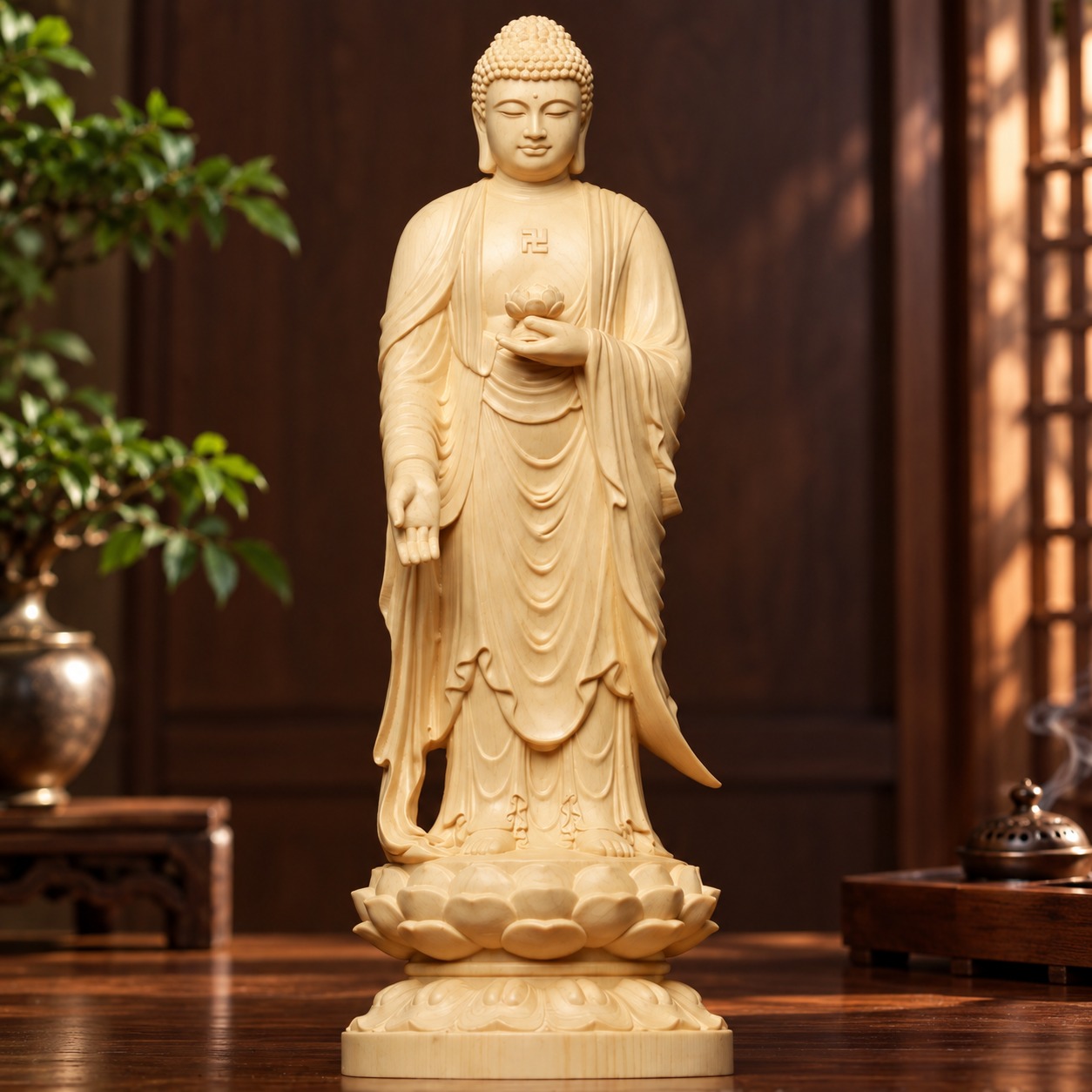
Статуя Будды Амитабхи из дерева
The product record lists wood and dimensions of 3.9 × 3.9 × 11.8 in (10 × 10 × 30 cm).
Посмотреть текущую галерею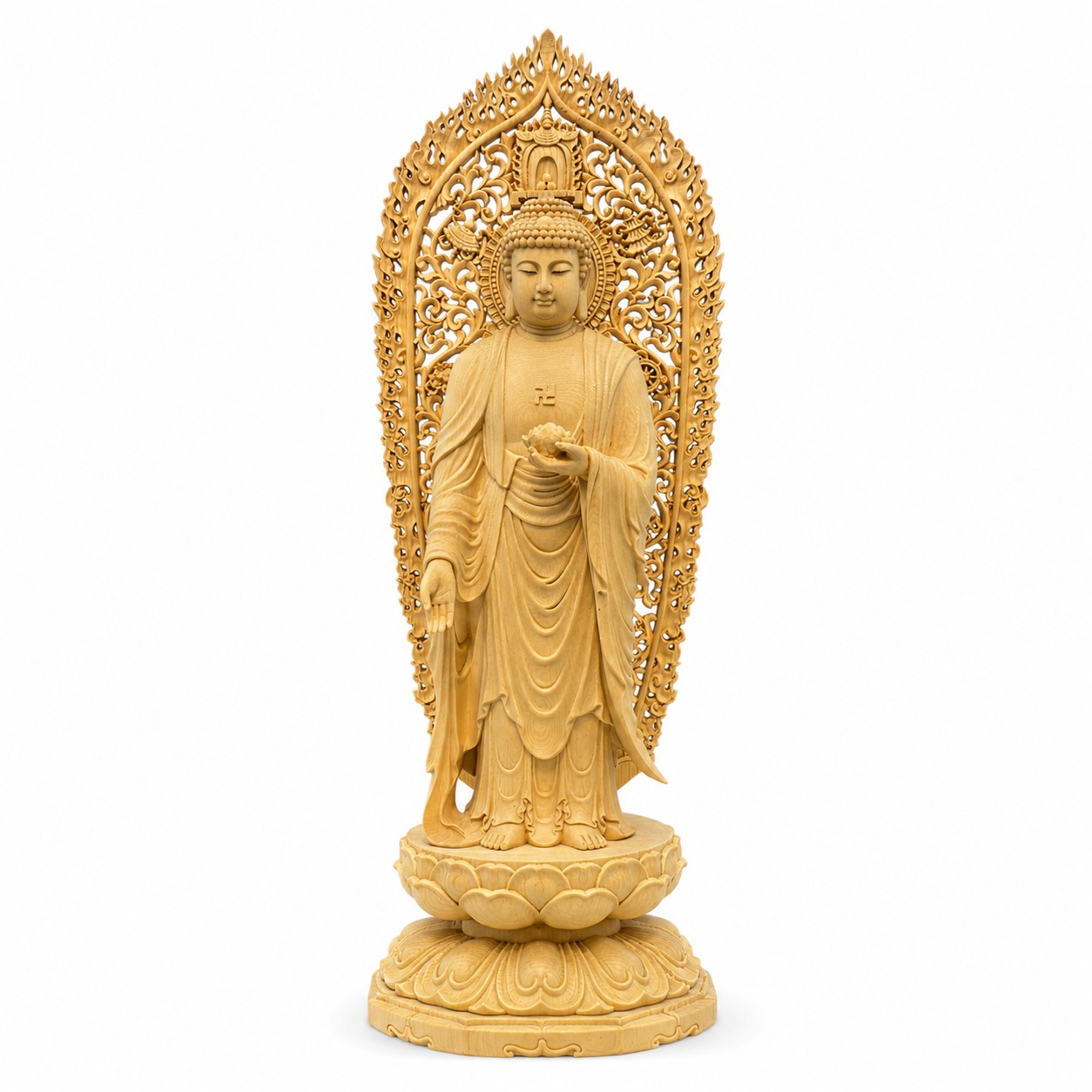
Деревянная фигурка Будды Амитабхи
The product record lists wood and a height of 18.1 in (46 cm).
Посмотреть текущую галерею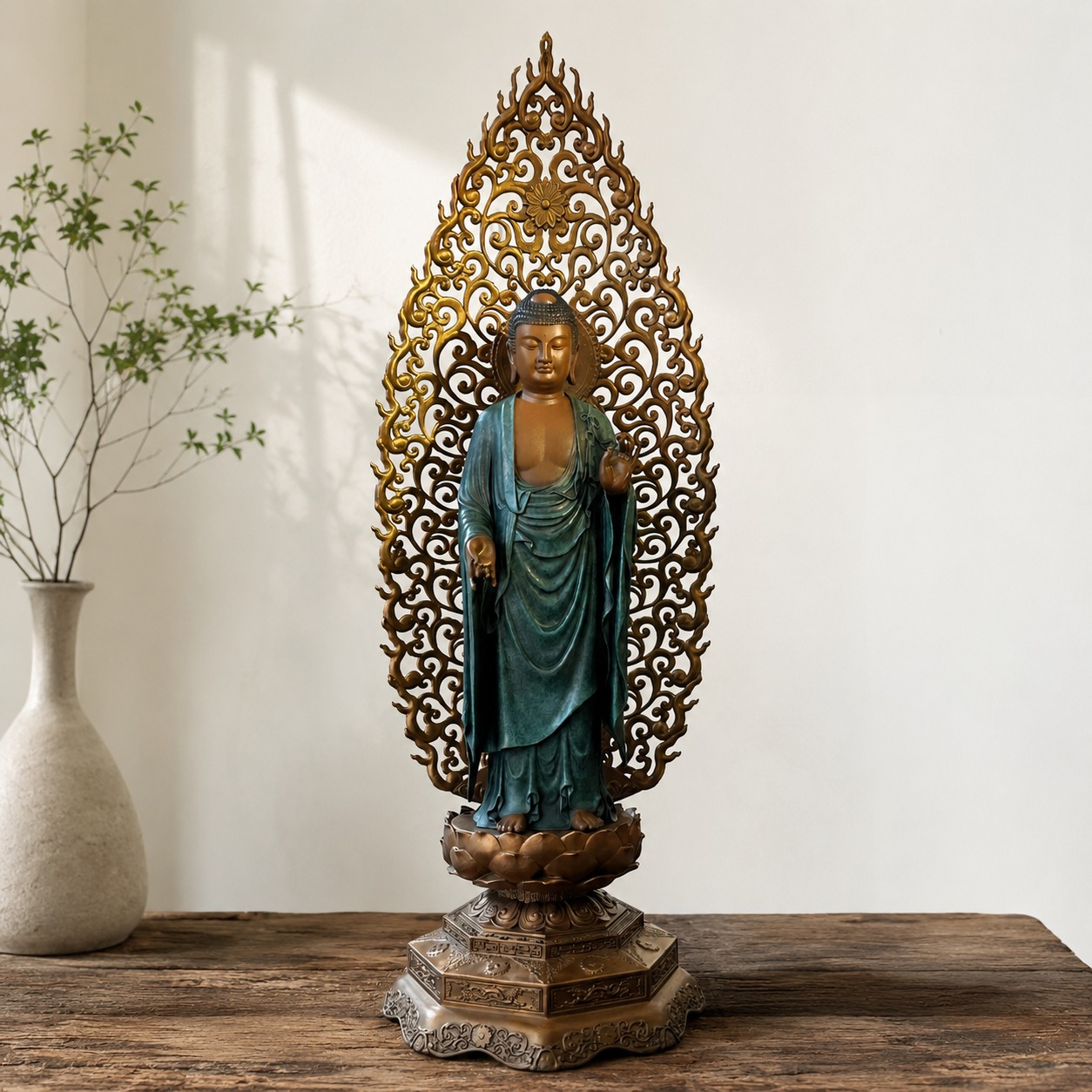
Статуя Будды Амитабхи из медного сплава
The product record lists copper alloy and dimensions of 7.2 × 8.1 × 22.0 in (18.3 × 20.5 × 56 cm).
Посмотреть текущую галереюСравните реальную галерею, указанные размеры, видимую отделку и действующие правила. Культурное значение не является гарантированным результатом.