Amitabha Buddha Meaning: Pure Land, Mudras and Statue Forms
A buddha who sits in meditation, or stands with one hand lowered as if reaching down to greet someone. This guide explains who Amitabha is, what the Pure Land and the phrase “Namo Amituofo” mean, and how Chinese, Japanese, Korean and Tibetan images show him and his companions.
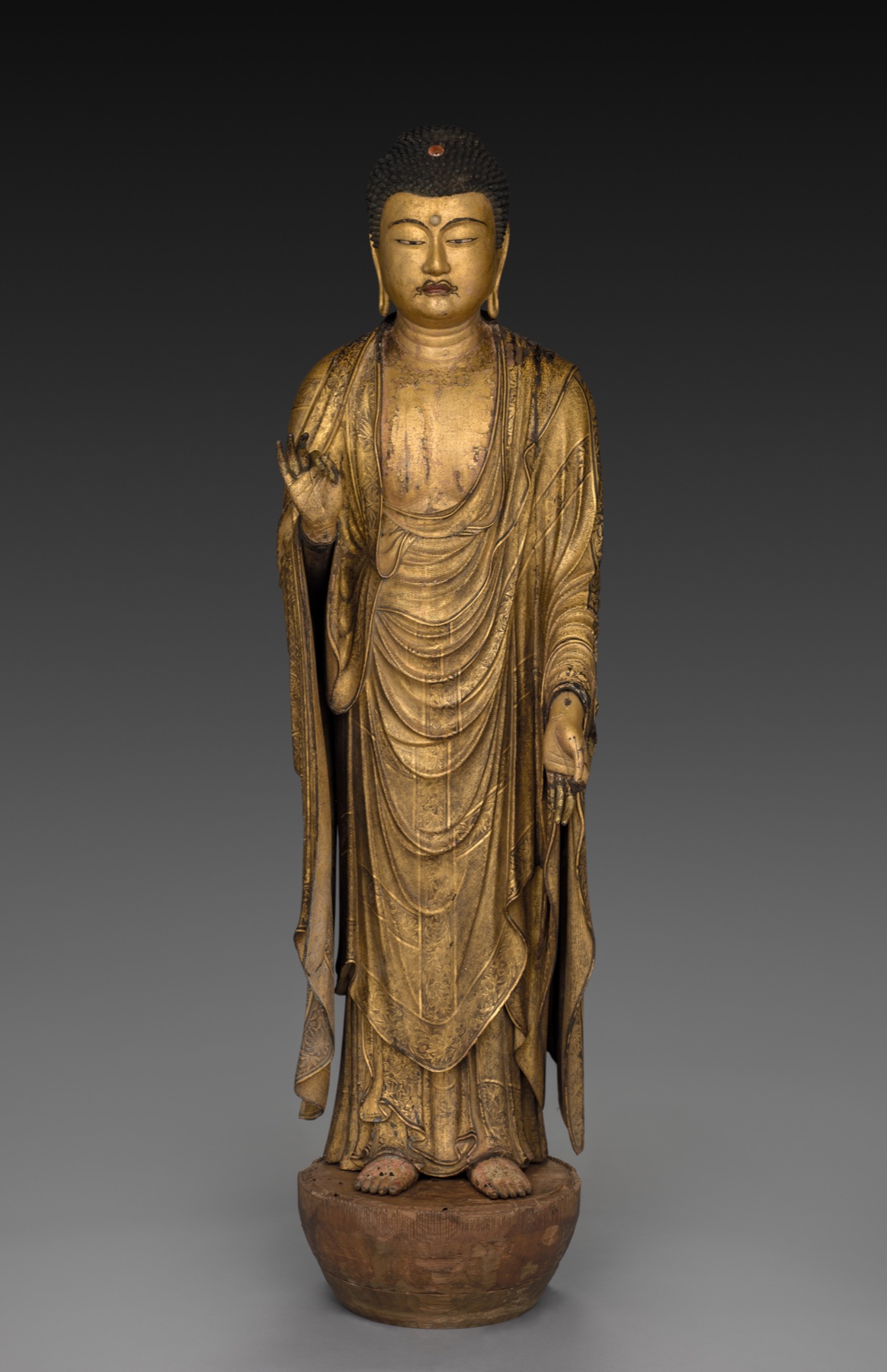
The buddha who comes to meet you
Most buddhas in East Asian art look alike at first glance: plain monastic robes, tightly curled hair, a rounded bump on the crown of the head and a small set of hand gestures. Telling them apart depends on small details and on the company they keep.
Amitabha is the buddha most often shown moving toward the viewer. In paintings he steps down on clouds; in standing statues he lowers one hand as if reaching out. When seated, he usually rests both hands in his lap in meditation. These images grew out of one of the most widespread forms of Buddhist devotion in East Asia: the hope of rebirth in his Pure Land.
This guide follows that tradition through museum objects from China, Japan, Korea and Tibet, and explains which clues identify Amitabha and which ones can mislead.
Who is Amitabha?
Amitabha is a Mahayana buddha whose Sanskrit name means “Infinite Light.” Pure Land scriptures describe him presiding over Sukhavati, the “Land of Bliss” or Western Pure Land, where conditions are said to be ideal for reaching awakening.
In Chinese he is Amituo Fo (阿彌陀佛). In Japanese he is Amida Nyorai or Amida Butsu, in Korean Amita Bul, and in Tibetan Öpame. He is closely linked with a second name, Amitayus, “Infinite Life”; in Chinese and Japanese the two are often merged, as the Cleveland Museum of Art’s title for the statue above, Buddha of Infinite Life and Light, shows. Tibetan art usually keeps them apart (see below).
The Metropolitan Museum of Art notes that devotion to Amitabha has been a major part of Chinese Buddhist practice since the sixth century, with the goal of rebirth in a Pure Land where conditions favour spiritual understanding. He is not the historical Buddha, Shakyamuni, but one of many buddhas whom Mahayana texts place in other realms.
This guide explains scriptures, devotional history and image traditions. An Amitabha statue can be meaningful for study, remembrance or personal practice; it does not guarantee rebirth, protection, good fortune or any other result, and no statue sold on this site should be read as such a promise.
Dharmakara and the forty-eight vows
Amitabha’s story is told mainly in three texts, often grouped as the Three Pure Land Sutras: the longer Sukhāvatīvyūha Sutra (the Sutra of Immeasurable Life), the shorter Amitabha Sutra, and the Contemplation Sutra, which teaches visualisation of the Pure Land.
The longer sutra tells of a monk named Dharmakara who, long ago, made a series of vows describing the buddha-land he would create and the beings he would help. When he became the buddha Amitabha, the vows were fulfilled and Sukhavati came into being. The best-known version lists forty-eight vows. Philological research on the earliest Chinese translations shows that older versions contained twenty-four vows, so the familiar number itself developed over time.
Two vows matter most for images. Later Pure Land teachers gave special importance to the eighteenth, which links rebirth to sincere faith and calling Amitabha’s name. And, as the Asia Society Museum explains, paintings of his descent illustrate the nineteenth vow, in which he promises to appear at the moment of death to those who wish to be reborn in his land.
These are religious teachings framed inside scriptures. Different schools interpret them differently, and this guide does not take a position on them.
What “Namo Amituofo” means
“Namo Amituofo” (南無阿彌陀佛) is the Chinese form of a short phrase meaning “Homage to Amitabha Buddha” or “I take refuge in Amitabha Buddha.” In Japanese it is “Namu Amida Butsu.” Reciting it is called nianfo in Chinese and nenbutsu in Japanese. It is the most common practice connected with Amitabha.
The Southern Song painting below makes the practice visible. The Cleveland Museum of Art notes that the phrase is written ten times in the calligraphy above the figures, each line rising from a lotus blossom, to stress continual recitation.

In Chinese-speaking Buddhist communities the phrase is also used as an everyday greeting, thanks or farewell among practitioners. That everyday use is a living custom; it does not need a statue, and a statue does not need it.
Meditation and welcoming hands
Amitabha has no fixed object like the Medicine Buddha’s jar, so his hands do most of the identifying work.
Meditation. Seated Amitabha figures often rest both hands in the lap, palms up, sometimes with the thumbs and index fingers forming two rings. The Met reads the arm position of the Tang statue below, whose hands are now lost, as evidence that it once held this meditation gesture, which is why it is catalogued as “probably Amitabha.”
Welcome. Standing figures often lower the left hand and raise the right, palm outward. The Met describes the right hand of its Southern Song painting as held in a gesture of welcome, and the Cleveland Museum of Art describes its Kamakura statue at the top of this page as standing in a posture of welcome for the dying. Many later Chinese standing figures, often called jieyin (接引, “receiving and guiding”) images, hold a small lotus or lotus seat at the chest in one hand while the other hangs down, open toward the viewer.
Teaching variations. East Asian Pure Land art also developed hand gestures tied to the “nine grades” of rebirth described in the Contemplation Sutra. In a Cleveland Museum of Art essay, Ghichul Jung explains that the Korean triad shown later in this guide makes one of these, with the right hand raised to the chest, the left lowered and each thumb touching the middle finger.
Gestures overlap between buddhas, and hands on old statues are often damaged or replaced. A meditation gesture alone could equally belong to Shakyamuni. Read the hands with the companions and setting.
Guanyin, Mahasthamaprapta and others
Amitabha usually appears between two bodhisattvas: Avalokiteshvara, known in China as Guanyin, and Mahasthamaprapta (Dashizhi in Chinese, Seishi in Japanese). Together they form the Western Paradise triad. Guanyin often wears a small seated buddha in the crown, representing Amitabha; our Guanyin guide explains that detail and Guanyin’s many other forms.
This is the clearest difference from the Medicine Buddha, whose attendants are the Sunlight and Moonlight bodhisattvas. In many later Chinese temples Amitabha also sits beside Shakyamuni and the Medicine Buddha in a row of three buddhas; our Medicine Buddha guide compares those three figures side by side, so the comparison is not repeated here.
Not every triad follows the standard pair. Korean artists sometimes replaced Mahasthamaprapta with Ksitigarbha, as the Korean section below shows.
Amituo Fo in China
The Tang-dynasty figure below, made in the early seventh century, is one of the most impressive early Chinese images thought to show Amitabha. It was made with the dry-lacquer technique: according to the Met, a core was covered with clay and wrapped in layers of lacquer-soaked cloth, with further layers of lacquer added on top. The museum notes that this technique spread from China to Japan in the eighth century.

From the twelfth century onward, paintings of Amitabha descending to welcome the dying became common. The Met notes that images of Amitabha, alone or with bodhisattvas, were among the most widely produced in China from the twelfth to the fourteenth century. In its painting below, he stands on two lotuses with the right hand raised in welcome.

Amida in Japan
Pure Land devotion grew strongly in Japan from the late tenth century. The Met notes that the monk Genshin (942–1017) wrote The Essentials of Rebirth in the Pure Land (Ōjōyōshū), which described the hells and explained practices, including nenbutsu, aimed at rebirth in paradise. The Tokyo National Museum describes Hōnen (1133–1212) as the founder of Jōdo Shū, Japan’s first Pure Land school, who taught repeated recitation of “Namu Amida Butsu.”
Paintings of Amida’s welcoming descent, called raigō, became one of the great subjects of Japanese Buddhist art. The Cleveland Museum of Art notes that such images could be placed before a dying person to help them remain faithful.
The standing Amida at the top of this page belongs to the same world. The museum records that documents placed inside its hollow body include a copy of the Amida Sutra, a list of donors who joined in dedicating the statue, and a record that it was completed in 33 days in 1269 at Shitennōji temple in Osaka. The lead sculptor was Kōshun.
Amita in Korea
Amitabha was also central in Korea from the Unified Silla period onward. The small Joseon-dynasty bronze below shows how a triad could vary. Ghichul Jung’s Cleveland Museum of Art essay notes that Amitabha sits slightly larger at the centre. The crowned figure is Avalokiteshvara, and the figure with a shaven head, like a monk, holding a jewel, is Ksitigarbha, who here replaces Mahasthamaprapta. The essay says this pairing was in vogue in Korea in the 1300s and 1400s.

Readers who know Ksitigarbha from our Ksitigarbha (Jizo) guide will recognise the shaven head and jewel. Seeing him beside Amitabha is a useful reminder that companions identify a scene only when read together.
Amitabha and Amitayus in Tibet
Tibetan painting shows Sukhavati as a crowded, jewelled landscape. In the Met’s painting below, made in Central Tibet around 1700, the buddha sits in meditation at the heart of his Pure Land, surrounded by palaces, trees, pools and assemblies of figures.

Himalayan art usually separates Amitabha from Amitayus, the “Buddha of Infinite Life.” Himalayan Art Resources describes Amitayus as normally red, wearing a crown and jewels, with a long-life vase held above his hands in meditation. Museums such as the Met and LACMA describe the vase as holding the elixir of immortality and link Amitayus with prayers for long life. Amitabha, by contrast, is usually shown in a buddha’s plain monastic robes without a crown.
Himalayan Art Resources also notes a great deal of overlap between the two in Tibetan tradition, while in early sutra literature they were not the same figure. A crowned buddha holding a vase in the lap is therefore usually Amitayus, not the Medicine Buddha and not a plain Amitabha.
How to identify an Amitabha statue
Both hands resting in the lap in meditation, or a standing figure with one hand raised, sometimes holding a small lotus, and one lowered in welcome. No medicine jar in the lap.
Guanyin, often with a small buddha in the crown, and Mahasthamaprapta at the sides point clearly to Amitabha. Korean triads may show Ksitigarbha instead.
A plain robe and no crown suggest Amitabha; a crown, jewellery and a vase in the lap usually indicate Amitayus in Himalayan art.
Use listed material, measurements, finish and provenance. Do not infer age, material or ritual status from colour, patina or a room scene.
A seller’s title is a clue, not proof. “Amitabha,” “Amituofo,” “Amida,” “Buddha of Infinite Light” and sometimes “Amitayus” can describe the same or closely related figures, and some listings use the name for any seated buddha. A smiling, round-bellied figure with a sack is the Laughing Buddha; our Maitreya and Laughing Buddha guide explains that separate tradition, and our Guanyin or Buddha guide explains how to tell crowned bodhisattvas from buddhas.
Living practice, display and buying checks
Amitabha is at the centre of living Pure Land practice in China, Japan, Korea, Vietnam and elsewhere, and many temples hold recitation services in his name. Anyone looking for ritual guidance, such as which direction an image should face or which texts to recite, should ask a relevant temple or teacher rather than rely on a retail article.
For decorative display, choose a stable, clean surface at or above eye level where the figure will not be knocked. Some people echo the temple arrangement by placing Amitabha on the western side of a group, matching his Western Pure Land; this is a convention, not a rule. Keep the piece away from standing moisture, strong heat and long direct sun. For wooden figures, our wooden statue care guide covers dry and humid rooms, and our antique wooden Buddha guide explains why “old-looking” finishes do not prove age.
Before buying, compare real front, side, detail and base views where available, check what the hands are actually doing, and confirm the listed measurements rather than estimating scale from a room photo. Review the current Shipping Policy and Returns & Refunds information. These checks tell you what object is offered; they do not tell you what a statue will “do.”
Common questions
What does Amitabha Buddha represent?
In Pure Land Buddhism, Amitabha is the buddha of the Western Pure Land, whose vows describe a realm where beings can be reborn and continue toward awakening. His name means “Infinite Light,” and he is closely associated with compassion through his attendant Guanyin.
Why do people say “Amitabha” or “Namo Amituofo”?
The phrase means “Homage to Amitabha Buddha.” Pure Land practitioners recite it as their main practice, and in Chinese-speaking Buddhist communities it is also used as a greeting or expression of thanks.
How is Amitabha different from Shakyamuni?
Shakyamuni is the historical Buddha who taught in India. Amitabha is a buddha described in Mahayana scriptures as presiding over another realm. In art the two can look almost identical; Amitabha is more often shown in welcome or with Guanyin and Mahasthamaprapta, while Shakyamuni is more often shown touching the earth or teaching, or at the centre of a row of three buddhas.
What is the Amitabha hand gesture?
Seated figures usually hold the meditation gesture, hands resting in the lap. Standing figures often raise the right hand and lower the left in welcome. East Asian art also developed variations linked to the nine grades of rebirth.
Are Amitabha and Amitayus the same buddha?
In Chinese and Japanese tradition the names are often merged. In Tibetan art they are usually shown differently: Amitabha in plain robes, Amitayus crowned and holding a long-life vase. Early scriptures treat them as distinct.
Where should an Amitabha statue be placed?
There is no single rule. Temples often associate him with the west, matching his Western Pure Land. At home, most people simply choose a clean, stable and respectful place at or above eye level. For religious guidance, ask a temple or teacher.
Sources and further reading
- The Cleveland Museum of Art: Buddha of Infinite Life and Light (Amida Nyorai), Kamakura period, 1269, 1960.197
- The Metropolitan Museum of Art: Buddha, probably Amitabha, Tang dynasty, early 7th century, 19.186
- The Cleveland Museum of Art: Buddha Amitābha with Two Attending Bodhisattvas, Southern Song dynasty, 1974.35
- The Metropolitan Museum of Art: Buddha Amitabha Descending from His Pure Land, Southern Song dynasty, 1987.148
- The Cleveland Museum of Art: Amitabha Triad, Joseon dynasty, 1918.501, and Ghichul Jung, “Korea in Focus: The Amitâbha Triad” (2021)
- The Metropolitan Museum of Art: Amitabha, the Buddha of the Western Pure Land (Sukhavati), Central Tibet, ca. 1700, 2004.139
- The Cleveland Museum of Art: Welcoming Descent of Amida (Amida Raigō), Kamakura period, 1953.123
- Asia Society Museum: Buddha Amitabha (Amida Nyorai), 1979.204
- The Metropolitan Museum of Art: The Essentials of Rebirth in the Pure Land (Ōjōyōshū)
- Tokyo National Museum: Hōnen and the history of Japanese Pure Land Buddhism (special exhibition, 2024)
- The Metropolitan Museum of Art: Amitayus, the Buddha of Eternal Life, Tibet
- Himalayan Art Resources: Amitayus and its conflation with Amitabha
- BDK English Tripiṭaka: The Three Pure Land Sutras (translation, 2003)
- “On the Vows in the Earliest Version of the Larger Sukhāvatīvyūha Sūtra,” Journal of Indian and Buddhist Studies
- Wikipedia: Amitābha (names, scriptures and regional traditions)
Image disclosure: This guide uses six Public Domain or CC0 museum images and three approved Carvzen product images. It contains no AI-generated editorial illustrations.
Current objects
Amitabha statues at Carvzen
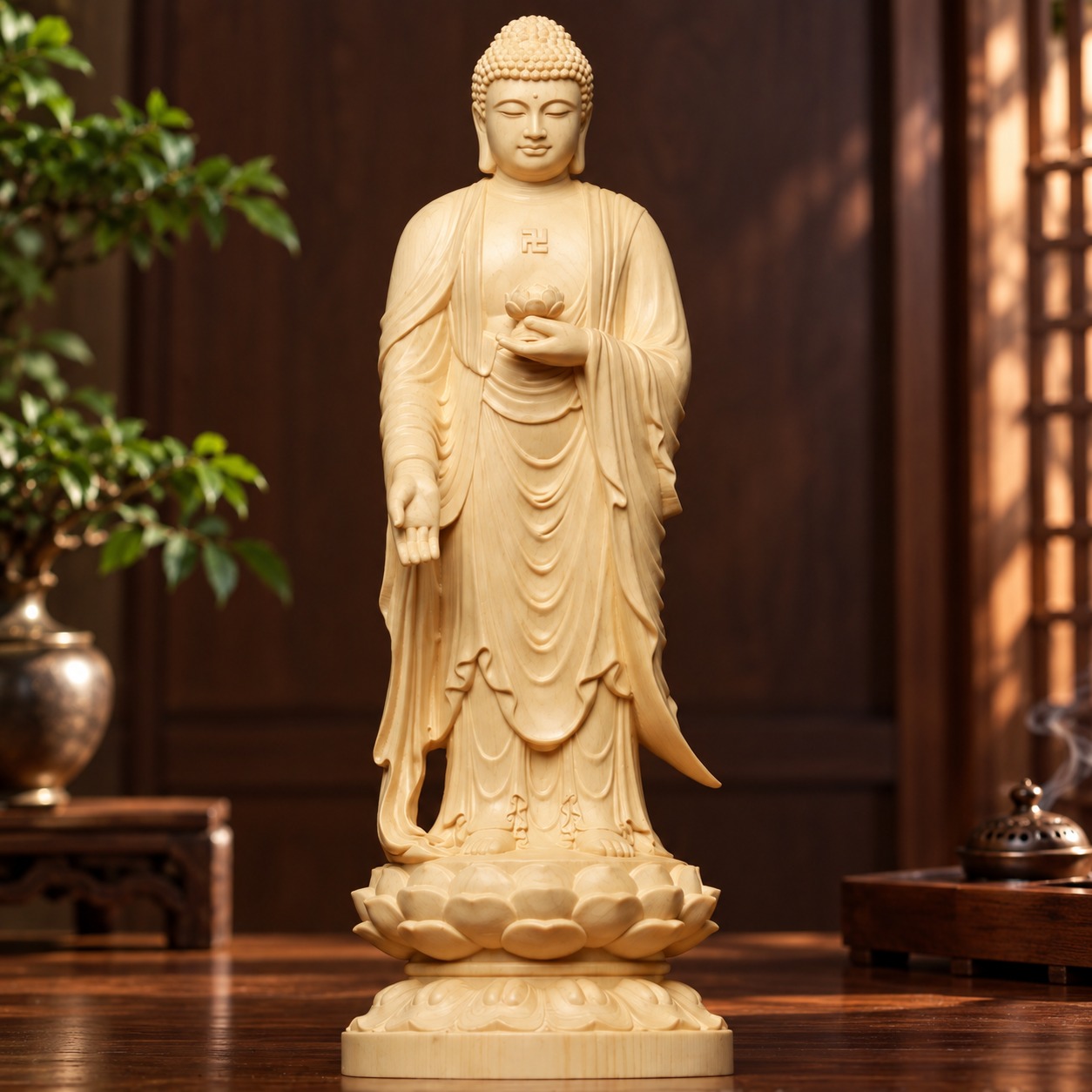
Amitabha Buddha Wood Statue
The product record lists wood and dimensions of 3.9 × 3.9 × 11.8 in (10 × 10 × 30 cm).
View current gallery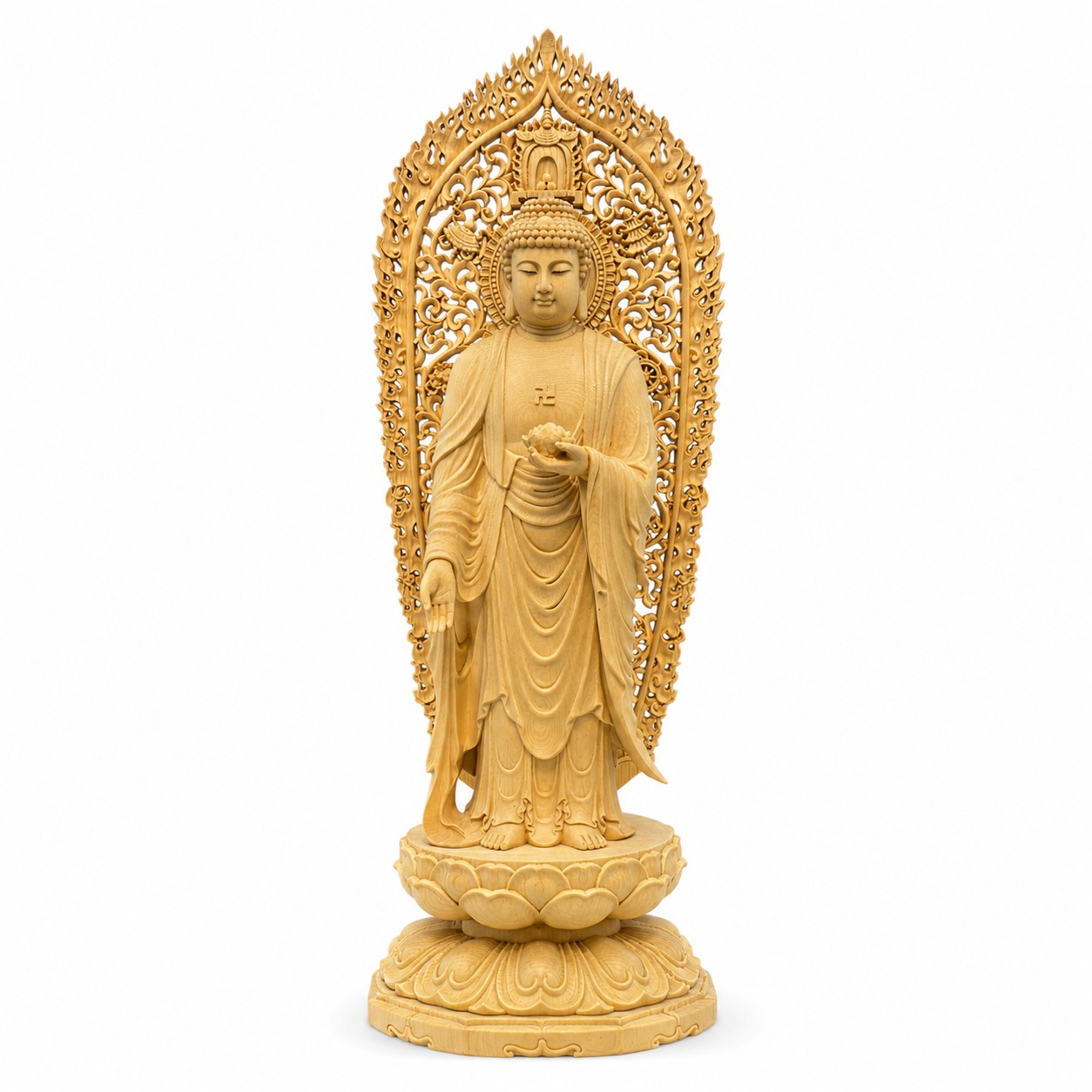
Amitabha Buddha Statue Wood Figurine
The product record lists wood and a height of 18.1 in (46 cm).
View current gallery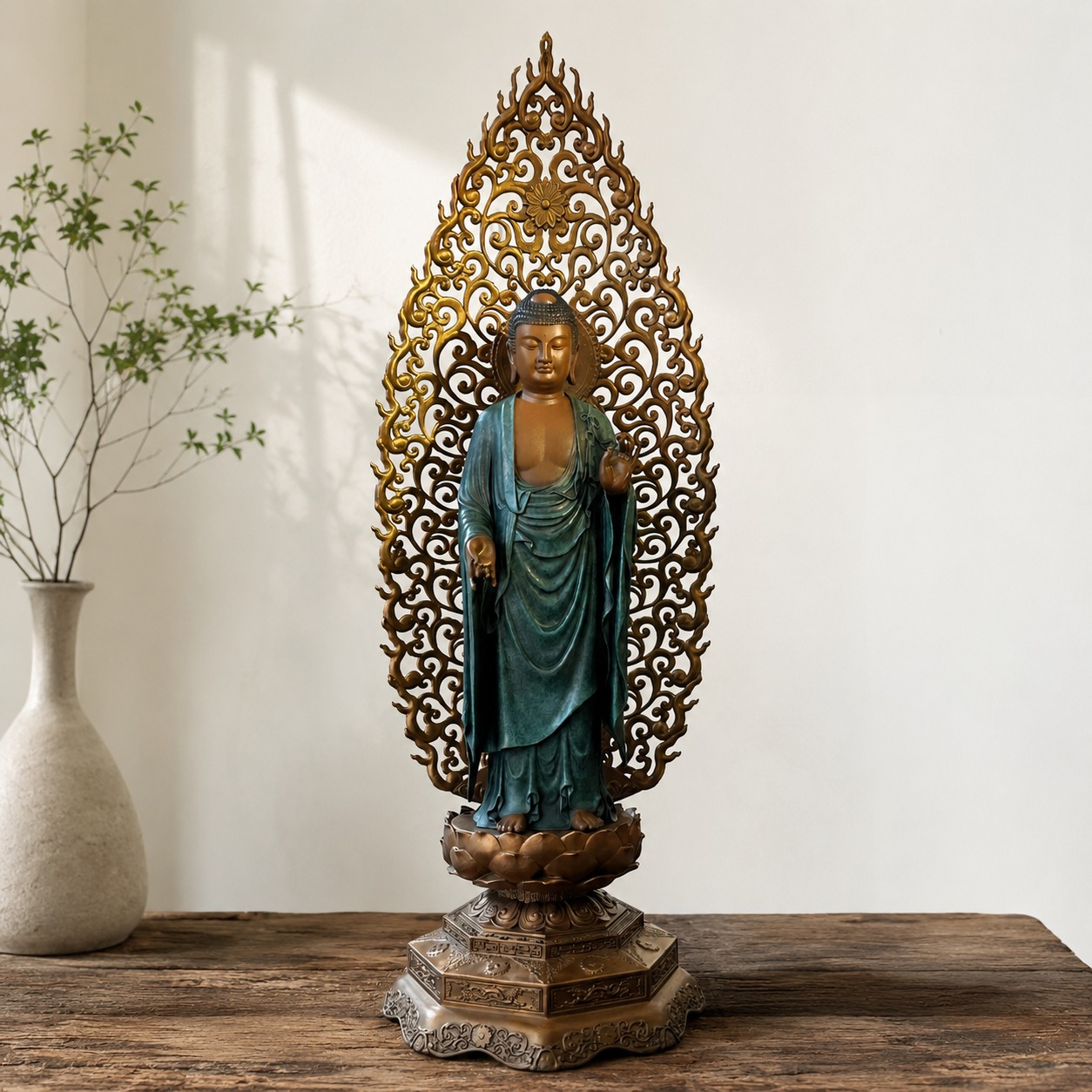
Amitabha Buddha Copper Alloy Statue
The product record lists copper alloy and dimensions of 7.2 × 8.1 × 22.0 in (18.3 × 20.5 × 56 cm).
View current galleryCompare the real gallery, listed measurements, visible finish and current policies. Cultural meaning is not a promised result.